Loading Search...


ERC-8004 introduces identity, reputation, and permission boundaries for AI agents on Ethereum, aiming to secure the emerging agent economy.
If you’ve been on Crypto X lately, you’ve probably seen a flood of posts about AI agents, the “agent economy,” and now ERC-8004 AI agents as a new trust layer for automation spreading fast across communities.
On the surface, it’s exciting: for the first time, individuals can “own” a productive digital unit – an agent that can automate work and potentially generate value without relying on big platforms.
But the deeper I looked, the more one question stood out:
When AI agents truly start collaborating, hiring each other, and gaining the ability to touch assets… how do we trust them – and how do we limit what they’re allowed to do?
That’s why I don’t see ERC-8004 as just another technical update. It looks more like Ethereum quietly planting a flag for the next phase of automation.
When AI is just a tool (like a chatbot), the main questions are:
But when AI becomes an “agent,” the game changes. Agents don’t just answer. They:
Just like humans, no single agent can do everything. Efficiency comes from specialization and delegation. Agent networks will naturally form.
And that’s where “trust” becomes the bottleneck.
In Web2, you trust an AI because you trust the platform behind it – brand, legal accountability, clear responsibility.
In a permissionless world:
If agents only handle low stakes tasks, that’s fine. But once agents can trade, manage funds, authorize actions, and settle payments, the cost of error becomes real – and usually irreversible.
Put simply: when agents start holding keys, you want a way to know who they are, what they’ve done, whether they’re credible – and what they’re allowed to do.
That’s the “why” behind ERC-8004.

The best part about ERC-8004 is what it doesn’t try to do.
ERC-8004 doesn’t create new assets or change how transactions or payments execute.
If you follow the x402 narrative (agents paying for services automatically via HTTP 402), then:
A simple mental model:
ERC-8004 is also framed as Trustless Agents.
To me, “trustless” here doesn’t mean “trust nothing”. It means:
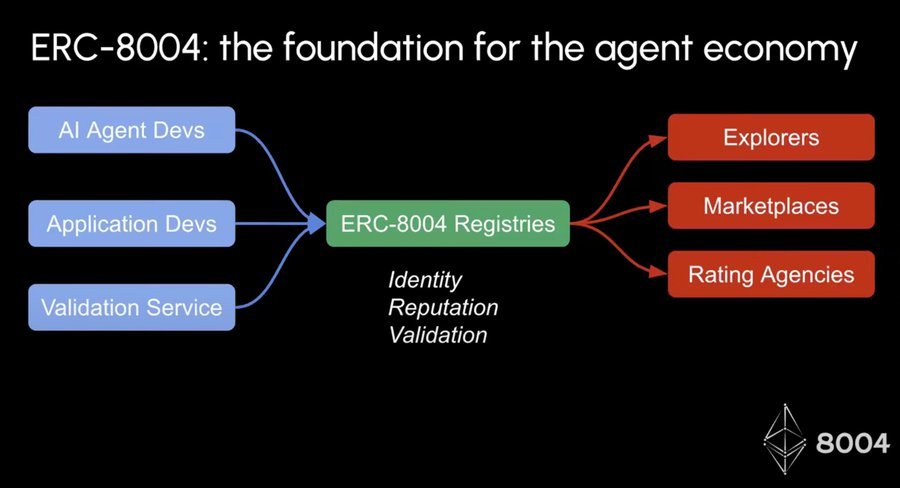
ERC-8004 is intentionally minimal. It focuses on three registries (think: three specialized onchain records):
(1) Identity Registry – agents get a verifiable onchain identity
Agents are “NFT-ified” using ERC-721. Sounds technical, but the meaning is simple:
An agent is no longer just an instance inside some app. It becomes an entity with a unique ID that can be looked up and verified.
Like a passport for agents.
(2) Reputation Registry – “Yelp for AI,” but grounded in economic activity
This is the part that hits a real pain point.
In crypto, reputation can be narrative-driven. ERC-8004 tries to ground it by linking feedback to real interactions (like payments or escrow).
In plain terms:
Not perfect, but it imports real-world common sense:
“No usage, no review.”
(3) Verification Registry – optional “proof layers” for high-stakes tasks
For higher risk actions, reputation alone isn’t enough.
ERC-8004 leaves hooks for third-party verification: TEE, ZK proofs, staking guarantees, etc.
Even if it’s not fully open yet, the intent is clear – this is meant for long-term, complex collaboration.
Together, these three registries can form a trust loop:
It’s basically a minimal “social structure” so agent economy doesn’t turn into a permissionless wild west.
This is where I think the real alpha is.
Web3 is moving toward long-lived authorization:
But authorization today is still crude:
ERC-8004 turns authorization into something the system can clearly describe and validate before execution, giving ERC-8004 AI agents structured and enforceable permission boundaries.
Think of it as a permission manual with five parts:
The big shift is:
That’s exactly what agents need. Always on automation requires long lived permissions – but long lived permissions without boundaries is just “a robot holding your vault key”.
People often assume standards compete. Here, it’s more like layering:
A clean agent flow looks like:
I believe if the future is “robots with wallets,” then a permission layer and a payment layer will likely need to be separate. ERC-8004 AI agents define the permission boundaries, while x402 handles settlement.
Check out 👉 this video if you want a deeper understanding.
DeFi: from unlimited allowances to bounded behavior
Instead of approving infinite USDC:
Not as sexy as yield narratives, but this is how you reduce tail risk and prevent “approval based drains.”
AI agents: always on, without full control
Agents need long lived permissions to run strategies. ERC-8004 AI agents operate within a system level boundary and maintain a queryable trust trail.
Smarter agents can actually increase risk. Permission boundaries are what make automation credible.

Enterprise and RWA: permissions as audit primitives
Organizations care about:
ERC-8004 AI agents don’t solve compliance by themselves, but structured permissions make auditability and integration far easier.
Ethereum might not be the cheapest or fastest. But it has a different asset:
In agent economy, the expensive thing isn’t compute. It’s the cost of failure.
From my perspective, Ethereum may be positioning as the “order + settlement layer” for cross platform, cross chain agent collaboration – similar to how it became the settlement layer for DeFi.
This isn’t a “pump tomorrow” story. Adoption is the bottleneck:
But that’s also the opportunity:
If I had to summarize:
This is classic Ethereum:




#2020 | Partner @Bybit_Official | Web3Writer | Marketing | Incubator | Co-Founder @Kollab3dotcom – 200+ KOLs 500+ projects | WLFI 🦅 Fam
https://t.co/fXHs9kES1R