Loading Search...


Aether Games shut down after the collapse of its Web3 gaming model, highlighting structural flaws in blockchain-based game development

Author: Tanishq Bodh
December 16, 2025 – Aether Games, the Web3 studio behind Cards of Eternity, has officially shut down operations. The move brings a definitive close to one of the most ambitious blockchain gaming experiments of the past cycle. The announcement came on December 15, 2025. It was accompanied by an unusually candid post-mortem detailing the financial, strategic, and structural failures behind the collapse.
Despite millions in funding and a globally recognized Wheel of Time license, Aether Games failed to build a sustainable player base. The studio also had more than 221,000 social media followers. Even so, those advantages were not enough. The shutdown has since become a cautionary case study for Web3 gaming builders working at the intersection of crypto incentives and traditional game development.
The most visible sign of Aether’s decline was the collapse of its native token, $AEG. Following its token generation event in early 2024, $AEG briefly surged to an all-time high near $0.35 before entering a prolonged downturn. By mid-2025, the token had lost over 99.9% of its value, liquidity evaporated, and major exchanges including Bybit, delisted the asset.
Loading chart...
As token performance deteriorated, the studio’s ability to fund development, , and security eroded rapidly. volume dried up, liquidity incentives failed, and market makers exited. Community confidence followed the same trajectory, with engagement declining sharply throughout 2025.
Aether’s post-mortem acknowledged a series of compounding failures. Marketing spend was heavily directed toward influencers and agencies that failed to deliver player retention. Advisors exited early. Multiple security incidents forced the shutdown of Discord and Telegram channels amid scam waves and wallet exploits.
Strategic pivots only added confusion. In mid-2025, Aether attempted to remove blockchain elements entirely to appeal to Web2 players, before later reintroducing crypto mechanics and revenue-sharing features. Instead of reducing costs, these shifts increased complexity and burn rate.
Operational expenses – including audits, compliance, and exchange listings, consumed hundreds of thousands of dollars without generating meaningful revenue. Even the strength of The Wheel of Time IP proved insufficient to overcome weak adoption.
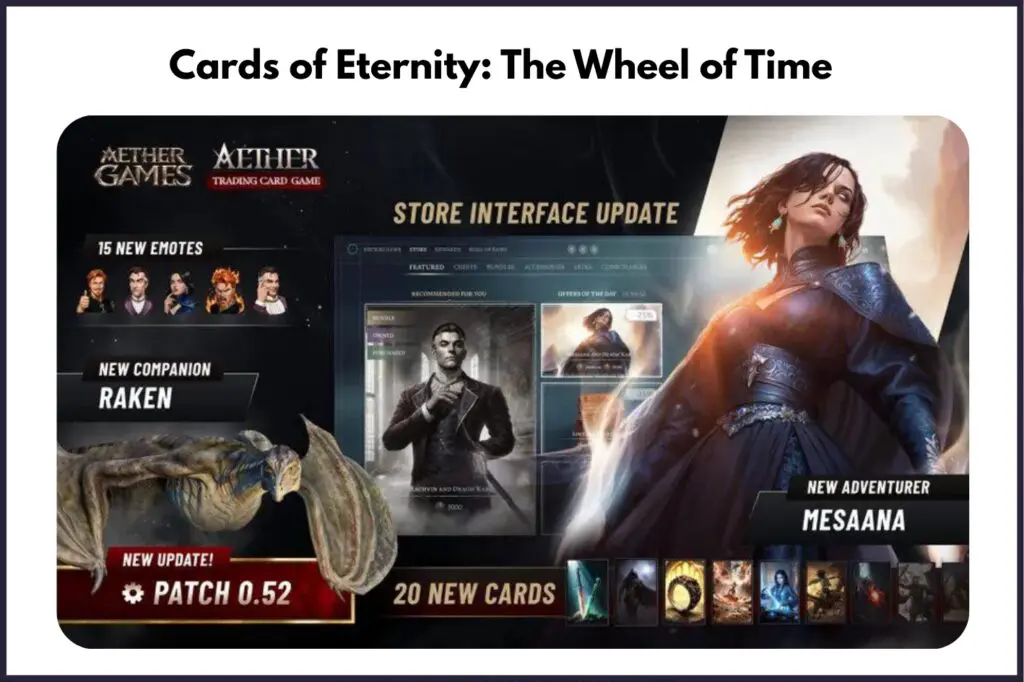
At its core, Cards of Eternity was a blockchain-based trading card game inspired by Magic: The Gathering, featuring NFT cards, on-chain ownership, and the $AEG token for staking and governance. However, the studio ultimately concluded that crypto mechanics added significant overhead without delivering proportional value at small scale.
The final admission was blunt: Web3 gaming only works when projects reach massive player numbers. Without scale, blockchain systems become liabilities rather than advantages.
All services have now been permanently shut down. No migrations, refunds, or token burns were announced.
Our Crypto Talk is committed to unbiased, transparent, and true reporting to the best of our knowledge. This news article aims to provide accurate information in a timely manner. However, we advise the readers to verify facts independently and consult a professional before making any decisions based on the content since our sources could be wrong too. Check our Terms and conditions for more info.



OpenSea Delays $SEA Token Launch, Offers Fee Refunds
PancakeSwap launches PancakeTown, First Ever Interactive AI agent World
MEXC Prediction Markets Go Live With Zero Fees
Solana Foundation Launches Tokens.xyz Platform
OpenSea Delays $SEA Token Launch, Offers Fee Refunds
PancakeSwap launches PancakeTown, First Ever Interactive AI agent World
MEXC Prediction Markets Go Live With Zero Fees
Solana Foundation Launches Tokens.xyz Platform