Loading Search...


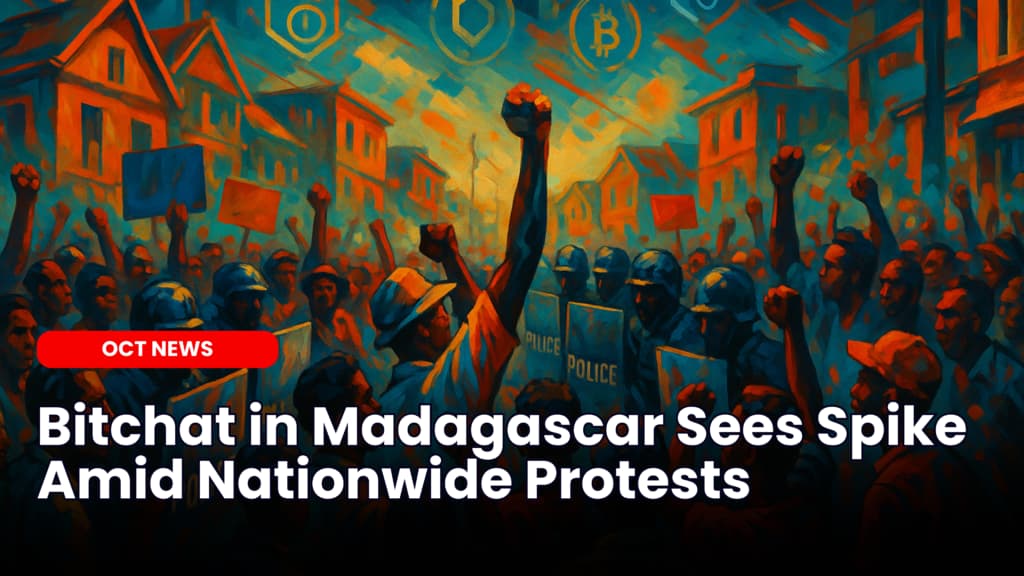
Bitchat in Madagascar surges as protests erupt, with downloads spiking amid curfews and demand for censorship-resistant messaging.

Author: Akshat Thakur
September 29, 2025 — Bitchat in Madagascar has surged in searches and downloads after protests broke out over ongoing water and power cuts. Demonstrations began in the capital, Antananarivo, and spread across the country, prompting a dusk-to-dawn curfew.
The decentralized peer-to-peer messaging service, launched by Block CEO Jack Dorsey, is once again being adopted in unrest scenarios, following recent spikes in Nepal and Indonesia.
On September 25, protests over water and electricity shortages escalated into clashes with police and looting. Soon after, searches for Bitchat in Madagascar spiked from 0 to 100 on Google Trends, marking “peak popularity.” Related phrases like “Bitchat download” and “how to use Bitchat” became breakout queries.
According to Chrome-Stats, Bitchat has been downloaded 365,307 times since launch, including 21,000 installs in the last day alone. While regional data is not fully broken down, the correlation with unrest in Madagascar indicates widespread adoption as a communication tool amid curfews and internet uncertainty.

The rapid rise of Bitchat in Madagascar mirrors similar adoption in Nepal and Indonesia during political unrest earlier in September. In both cases, protesters faced restrictions on traditional social media platforms and turned to decentralized apps for coordination.
Unlike centralized messengers such as WhatsApp or Telegram, Bitchat uses Bluetooth mesh networks and peer-to-peer encrypted communication. No accounts, emails, or SIM cards are required, making it difficult for authorities to censor or block.
This dynamic highlights the role of decentralized technologies as lifelines in politically unstable environments where internet access may be cut off or heavily monitored.
The surge of Bitchat in Madagascar underscores a larger global trend: the rise of decentralized communication apps in response to censorship and state control. This trend may intensify as regulatory frameworks like the EU’s proposed “Chat Control” law threaten encryption across mainstream platforms.
Crypto and Web3 advocates argue that decentralized platforms like Bitchat will gain adoption as privacy defaults become essential. For nations with limited internet penetration like Madagascar, Bluetooth-based mesh networks offer an alternative infrastructure to ensure communication during crises.
Despite a population of nearly 32 million, only 6.6 million people in Madagascar had internet access at the start of 2025, according to DataReportal. Mobile connections totaled 18 million, but many offered only voice and SMS services. Against this backdrop, a tool like Bitchat—functioning without central servers or internet—is particularly valuable.
Our Crypto Talk is committed to unbiased, transparent, and true reporting to the best of our knowledge. This news article aims to provide accurate information in a timely manner. However, we advise the readers to verify facts independently and consult a professional before making any decisions based on the content since our sources could be wrong too. Check our Terms and conditions for more info.



$OM to $MANTRA Token Upgrade Completed with 1:4 Split
US Court Rejects Trump’s Request To Delay $175Billion In Tariff Refunds
CoinMarketCap Launches AI Agent Tools for Real-Time Intelligence
Aster Crude Oil Perpetuals Launch With 3x Leverage
$OM to $MANTRA Token Upgrade Completed with 1:4 Split
US Court Rejects Trump’s Request To Delay $175Billion In Tariff Refunds
CoinMarketCap Launches AI Agent Tools for Real-Time Intelligence
Aster Crude Oil Perpetuals Launch With 3x Leverage