Loading Search...


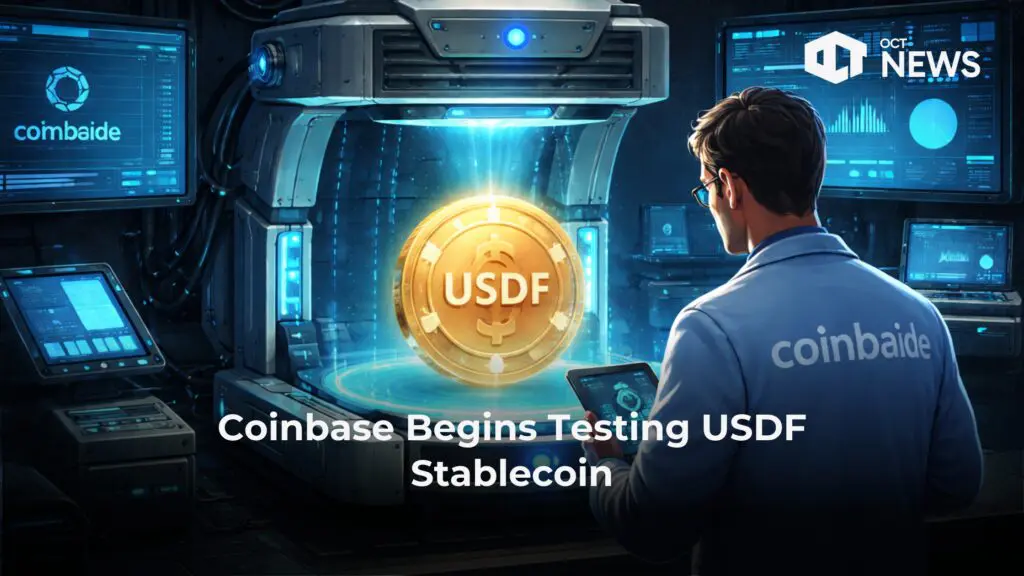
Coinbase tests Flipcash’s USDF stablecoin under its Custom Stablecoins feature, enabling branded USDC-backed tokens for payments and rewards.

Author: Kritika Gupta
30th January 2026-Coinbase has started internal testing of Flipcash’s upcoming USDF stablecoin, signaling an important step forward in the exchange’s push toward enterprise-focused digital dollars. This testing is happening under Coinbase’s new “Custom Stablecoins” feature, first announced in December 2025. The feature allows businesses to issue branded, dollar-pegged tokens that remain fully backed by USDC reserves. As a result, companies can potentially deploy stablecoins for payroll, cross-border payments, customer rewards, and other financial workflows without building their own issuance stack from scratch.
High Signal Summary For A Quick Glance

Coinaute En
@Coinaute_en

🧪💵 Coinbase is piloting Flipcash’s USDF stablecoin under its new “Custom Stablecoins” initiative, which lets businesses launch their own dollar-backed tokens using USDC as collateral. https://t.co/y5qGkMWREZ
02:00 PM·Jan 29, 2026

CoinMarketCap
@CoinMarketCap
LATEST: ⚡ Coinbase is testing Flipcash's upcoming USDF stablecoin as part of its new "Custom Stablecoins" feature that will allow businesses to create their own branded, dollar-backed tokens collateralized by USDC. https://t.co/F0AMA1fUOQ

01:25 AM·Jan 29, 2026

icn.live
@icnweb3news
Behind the Scenes The USDF stablecoin is reportedly in internal testing on @coinbase systems, a potential move to compete with USDC, RLUSD, and other regulated digital dollars. https://t.co/DJXg3et1Dd

07:03 PM·Jan 27, 2026
Coinbase’s Custom Stablecoins initiative is being shaped by two accelerating forces: regulatory clarity and institutional demand. In 2025, the GENIUS Act introduced clearer guidelines around stablecoin issuance, oversight, and compliance expectations.
At the same time, Coinbase has strong economic motivation to expand stablecoin offerings. Stablecoins continue to generate major revenue opportunities through payments, settlement infrastructure, custody flows, and ecosystem integrations. Coinbase reported $247 million in stablecoin-related revenue in Q4 alone, reinforcing the incentive to build beyond its traditional USDC partnership with Circle.
Furthermore, in June 2025 Coinbase launched a stablecoin payments stack with Shopify, allowing merchants to accept USDC without deep blockchain knowledge, which highlighted Coinbase’s long-term intent to lead stablecoin commerce infrastructure. These efforts help explain why Coinbase USDF stablecoin testing fits into a broader multi-year strategy.
Market response to stablecoin-driven expansion has often been favorable. When Coinbase rolled out the Shopify-linked stablecoin payments platform, Coinbase shares reportedly rallied while Circle also surged amid renewed enthusiasm around stablecoins. Similarly, after the GENIUS Act progressed, investor optimism pushed both Coinbase and Circle stocks higher, reflecting the belief that stablecoins will become a core pillar of mainstream financial rails.
Key milestones related to this development
Coinbase rolls out merchant-facing stablecoin infrastructure, strengthening the foundation for enterprise token issuance and on-chain settlement.
Policy progress around stablecoin oversight increases institutional confidence, encouraging platforms to ship compliant issuance and payments products.
Coinbase introduces “Custom Stablecoins,” enabling businesses to issue branded USD tokens that are fully backed by USDC reserves.
Coinbase starts backend operational testing of Flipcash’s USDF stablecoin, validating issuance, reserves backing flows, and settlement behavior.
USDF is projected to launch publicly, becoming a flagship example of a custom stablecoin deployed through Coinbase’s branded issuance model.
Businesses begin piloting custom stablecoins for payroll, cross-border transfers, supplier settlement, and rewards programs across supported chains.
Exchanges, fintechs, and banks race to offer branded stablecoin rails, while compliance, privacy tooling, and interoperability become key differentiators.
Custom Stablecoins like USDF could reshape how companies move value and run financial operations. Instead of relying on slow and expensive banking rails, businesses could issue tokens designed for their own ecosystems and instantly transfer them on supported blockchains.
In addition, the model offers flexibility for enterprise workflows like employee incentives, supplier payments, loyalty programs, and international settlements. Coinbase’s positioning suggests it wants to become the default infrastructure layer where businesses deploy interoperable digital dollars.
However, major enterprise concerns remain, especially around transparency. Transactions on public blockchains can expose payment trails, balances, and counterparties. Therefore, companies that require confidentiality may hesitate unless privacy solutions mature. Even so, innovation in privacy tooling could help solve this over time, making custom stablecoins more attractive for corporate finance use cases.
Coinbase’s partnership with Flipcash reflects a broader push to capture the rapidly expanding stablecoin market. It exceeds $300 billion and is widely projected to grow dramatically over the next few years. If Coinbase successfully launches USDF through Custom Stablecoins, it could open the door for many businesses.
Regulation will continue to shape the competitive landscape. Future changes to the GENIUS Act or related policy could influence reward models. Overall, Coinbase’s internal testing of USDF represents a meaningful step toward customizable digital dollars. It then becomes a mainstream business product, potentially accelerating stablecoin adoption in 2026 and beyond.
Our Crypto Talk is committed to unbiased, transparent, and true reporting to the best of our knowledge. This news article aims to provide accurate information in a timely manner. However, we advise the readers to verify facts independently and consult a professional before making any decisions based on the content since our sources could be wrong too. Check our Terms and conditions for more info.