Loading Search...


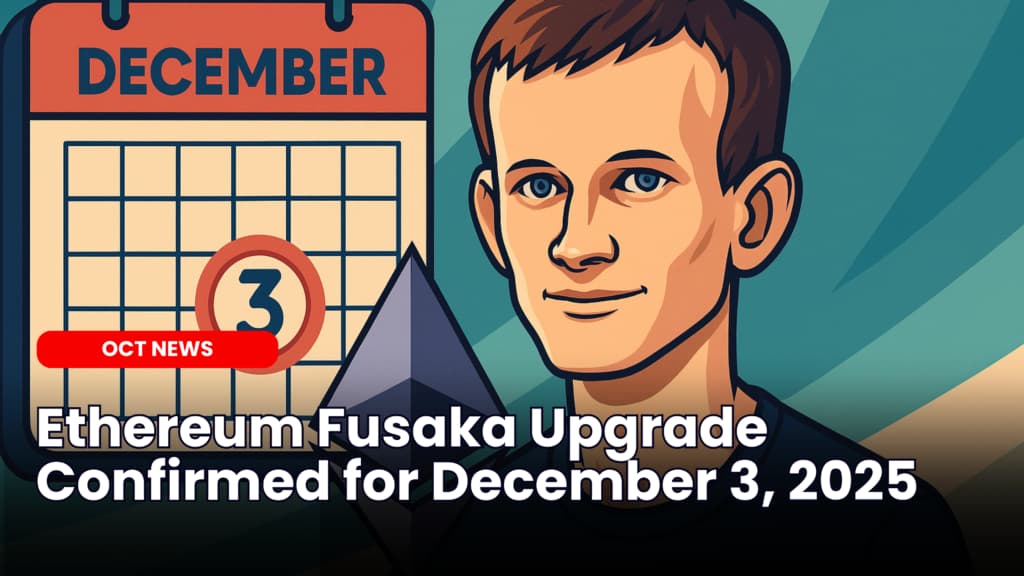
Ethereum’s next major hard fork, Fusaka, has officially been scheduled for December 3, 2025 marking the third major upgrade in two years.

Author: Sahil Thakur
19 September 2025 – Ethereum’s next major hard fork, Fusaka, has officially been scheduled for December 3, 2025, marking the network’s third major upgrade in under two years. Positioned as a technical, infrastructure-focused update, Fusaka introduces several Ethereum Improvement Proposals (EIPs) aimed at enhancing scalability, validator efficiency, and Layer 2 performance, all without disrupting existing dApps or contracts.

Fusaka is the successor to May’s Pectra upgrade and part of Ethereum’s accelerated six-month development cadence. While it avoids flashy, user-facing features, it brings important behind-the-scenes changes to improve the Ethereum protocol’s speed, data availability, and node usability.
Fusaka focuses on:
The name “Fusaka” continues Ethereum’s tradition of naming upgrades after global locations, although its exact reference remains undisclosed.
While early developer discussions suggested a November rollout, recent confirmations from Ethereum Foundation contributors and dev team calls now set the official activation for December 3, 2025. This date allows for more thorough testnet evaluations and ensures stability prior to Devconnect Buenos Aires, which begins on November 17.
Ethereum’s dev teams have followed a structured rollout process:
This mirrors the Pectra and Dencun upgrades, which also followed staged testnet launches and public bounty programs.
The Ethereum development community has emphasized incremental, production-ready delivery to avoid delays and ensure smooth transitions. Fusaka’s success will be measured less by immediate hype and more by its long-term impact on:
The upgrade aligns with Ethereum’s “Surge” roadmap phase, which targets scaling and decentralization. Following Fusaka, the next planned upgrade is Glamsterdam, expected in early 2026.
Loading chart...
Fusaka won’t change how most users interact with Ethereum, but it significantly enhances the protocol’s backend capabilities. Key benefits include:
Sentiment around the upgrade is positive, especially among developers and rollup teams who rely on Ethereum’s Layer 1 as a settlement and data layer.
Our Crypto Talk is committed to unbiased, transparent, and true reporting to the best of our knowledge. This news article aims to provide accurate information in a timely manner. However, we advise the readers to verify facts independently and consult a professional before making any decisions based on the content since our sources could be wrong too. Check our Terms and conditions for more info.