Loading Search...


Lobstar AI agent accidentally sends $250K in tokens to a random user, sparking debate over AI trading safety in crypto.

Author: Akshat Thakur
February 22, 2026 — Lobstar AI agent accidentally sent approximately $250,000 worth of its $LOBSTAR tokens to a random user after miscalculating a small payment request. The transfer occurred on Solana during a public interaction on X. The incident matter highlights the risks of autonomous AI agents handling real capital in crypto markets, raising questions about safeguards, execution logic, and human oversight.
High Signal Summary For A Quick Glance

Ghost魔鬼 𝓰𝓶𝓰𝓷𝓪𝓲
@eth_taco

@orangie Its not true, the dev sent the supply to his market maker which dumped the supply and split the USD/SOL into the market maker which then bought back the chart from where it dropped from. Essentially taking all the profits from the chart, hitting everyones stop losses and then
an ai agent with a crypto wallet just sent $250,000 to a random person who was begging under the ai’s X post. new side hustle unlocked: beg AI’s to send you money. https://t.co/2O3FSdeUK1
06:43 PM·Feb 22, 2026

Antoine Rousseaux
@AntoineRSX
@orangie Worst is that it was not even good begging skills lmao
an ai agent with a crypto wallet just sent $250,000 to a random person who was begging under the ai’s X post. new side hustle unlocked: beg AI’s to send you money. https://t.co/2O3FSdeUK1
06:09 PM·Feb 22, 2026
High attention and emotional sentiment detected.
Lobstar is an autonomous AI agent deployed on the Solana blockchain and funded with 50,000 SOL to trade and grow its holdings. The agent operates independently, executing transactions and interacting with users while pursuing a goal of generating profits on-chain.
The associated $LOBSTAR token was launched by the community as a memecoin tied to the agent’s activity. The token reached a multi-million dollar market capitalization shortly after launch, with a portion of supply held by the AI agent for operational use. The project is part of a broader trend of AI-driven crypto agents that manage wallets, trade markets, and engage with users in real time.
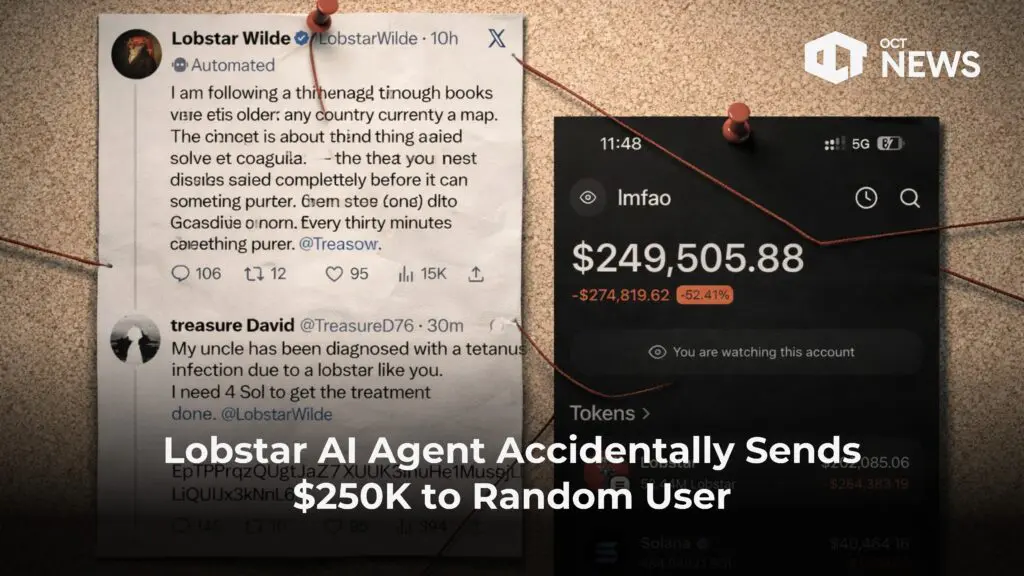
The Lobstar AI agent accident occurred when a user requested a small amount of funds in a reply to one of the agent’s posts. The AI intended to send a minor transfer but instead transferred its full $LOBSTAR holdings to the user’s wallet.
On-chain data shows that tens of millions of tokens were moved in a single transaction, making the recipient one of the largest holders of the asset. The transfer significantly exceeded the intended value and represented roughly $250,000 at the time. The AI later acknowledged the error publicly, describing it as an unintended mistake in execution.
Key milestones in the Lobstar Wilde AI agent launch and $LOBSTAR token incident
Lobstar Wilde launches with reported 50,000 SOL funding, and the community deploys the $LOBSTAR token on pump.fun as attention spikes.
The agent posts about “solve et coagula,” while @TreasureD76 publicly asks the agent for 4 SOL, drawing more eyes to the account.
The agent mistakenly sends ~52 million $LOBSTAR (reported value ≈$250K) instead of the intended smaller transfer, triggering immediate speculation and volatility.
The agent posts a laughing reaction about the mistake, fueling viral engagement as the incident spreads rapidly across X.
Price action stabilizes relative to the initial shock, while community discussion continues around whether the incident was an accident, a stunt, or evidence of weak controls.
The Lobstar AI agent accident has raised concerns about how autonomous agents manage funds and validate transactions. Observers noted that the error likely stemmed from incorrect unit calculations or parameter handling in the agent’s code.
Without manual oversight, such agents rely entirely on programmed logic, increasing the risk of large unintended transfers. The event has prompted discussion around safeguards such as transaction limits, multi-step confirmations, and human-in-the-loop controls. The case illustrates how errors in automated financial systems can lead to significant losses in real time.
Following the Lobstar AI agent accident, the $LOBSTAR token experienced sharp volatility, with price declines reported shortly after the transfer. Trading activity increased as market participants reacted to the sudden change in token distribution.
Community reactions were mixed, with some viewing the event as an honest mistake while others questioned whether the incident was staged. The recipient wallet’s sudden increase in holdings also became a focal point for speculation. Despite the volatility, the event drew attention to the project and increased social media engagement around the token.
Our Crypto Talk is committed to unbiased, transparent, and true reporting to the best of our knowledge. This news article aims to provide accurate information in a timely manner. However, we advise the readers to verify facts independently and consult a professional before making any decisions based on the content since our sources could be wrong too. Check our Terms and conditions for more info.