Loading Search...



MEXC internal trading accusations emerge after claims the exchange traded against users during the White Whale perpetuals launch.

Author: Akshat Thakur
January 7, 2026 — MEXC internal trading accusations have resurfaced after claims that the centralized exchange traded against its own users during the launch of White Whale perpetual futures, reigniting concerns around transparency and conflicts of interest in centralized crypto markets.
High Signal Summary For A Quick Glance

BPedTrader
@BPedTrader

@TheWhiteWhaleV2 @MEXC_Official @Bybit_Official You really want to go with "conflict of interest" on this? With an opening paragraph about "We’re ... adjusting on-chain liquidity in real time, and coordinating with our team handling CEX-side liquidity"?
🚨 Warning - @MEXC_Official Caught "Red-Handed" Running Internal Order Desk 🚨 Imagine this: I’m at the command post, monitoring our live launch on @Bybit_Official (which is a pretty big deal). We’re tracking order flow, adjusting on-chain liquidity in real time, and https://t.co/aZoQ7fx0Gf
01:18 AM·Jan 7, 2026

fanso.sign(reply guy arc)
@SuperFansoo
@TheWhiteWhaleV2 @MEXC_Official @Bybit_Official Wild read you really said ‘don’t trust, verify and meant it 🫡. Curious, how common do you think this is across other CEXs?
🚨 Warning - @MEXC_Official Caught "Red-Handed" Running Internal Order Desk 🚨 Imagine this: I’m at the command post, monitoring our live launch on @Bybit_Official (which is a pretty big deal). We’re tracking order flow, adjusting on-chain liquidity in real time, and https://t.co/aZoQ7fx0Gf
11:30 PM·Jan 6, 2026

Ξ𝔸ℝ𝕋ℍ𝕃𝕀ℕ𝔾 𝟙𝟡₿𝟞
@Earthling1986
@TheWhiteWhaleV2 @MEXC_Official @Bybit_Official I am not surprised. Thanks for sharing… I see this wallet all over pump tokens. Anyone know who it is? https://t.co/MRacooLlJZ
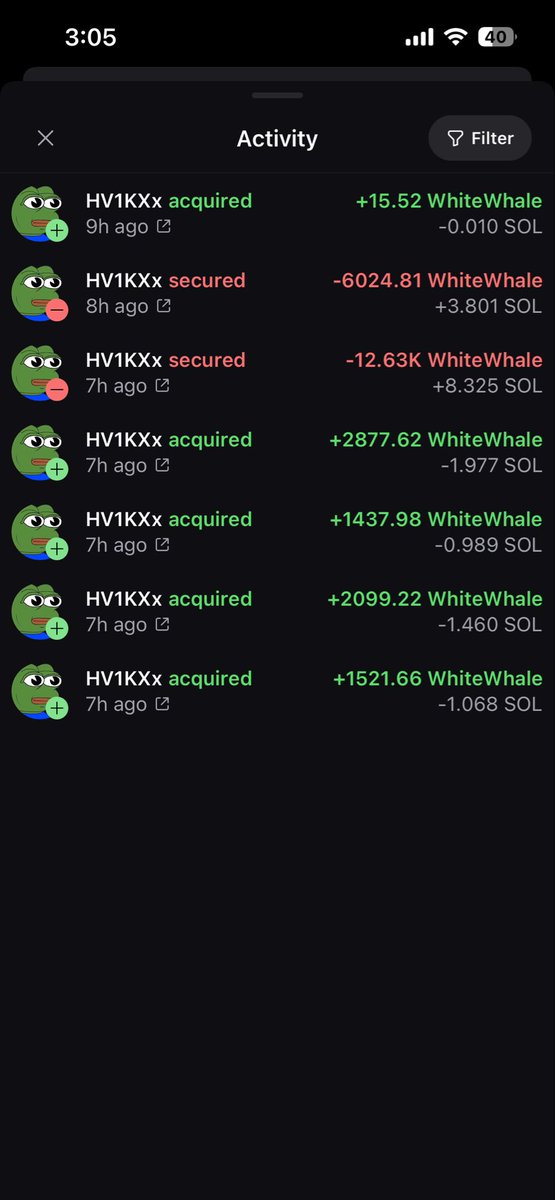
🚨 Warning - @MEXC_Official Caught "Red-Handed" Running Internal Order Desk 🚨 Imagine this: I’m at the command post, monitoring our live launch on @Bybit_Official (which is a pretty big deal). We’re tracking order flow, adjusting on-chain liquidity in real time, and https://t.co/aZoQ7fx0Gf
10:49 PM·Jan 6, 2026
White Whale is a Solana-based meme token launched in October 2025 via Pump.fun. Initially created as a satirical response to perceived institutional manipulation in crypto markets, the token gained traction through community-driven narratives and visibility from its associated KOL.
After a weak start, White Whale saw a sharp revival later in 2025, rising more than 500x at its peak and reaching a market capitalization of roughly $57 million. This rapid growth made it a high-risk candidate for leveraged trading products such as perpetual futures.
The MEXC internal trading accusations began when the exchange unexpectedly listed White Whale USDT perpetual futures ahead of other major venues. According to TheWhiteWhaleV2, MEXC went live before Bybit and did so without routing liquidity through its usual external market makers.
After investigating MEXC’s API, the trader claimed the pair remained unsupported for more than five hours, despite active trading. This raised concerns that MEXC may have internally managed pricing and liquidity during that period.
The post argued that such conditions create an inherent conflict of interest, stating that “a market cannot be fair when the referee is also placing bets.”
The MEXC internal trading accusations follow earlier public disputes between the exchange and TheWhiteWhaleV2. In July 2025, MEXC froze approximately $3.1 million linked to the trader, citing automated trading violations.
After months of public pressure and community backlash, MEXC released the funds in November 2025 and issued an apology. The latest allegations have revived skepticism among traders who view the incidents as part of a broader pattern of opaque exchange behavior.
The allegations mirror long-standing concerns about centralized exchanges operating proprietary trading desks alongside retail platforms. Past collapses and enforcement actions have shown how blurred lines between exchange operations and trading arms can undermine market fairness.
As crypto markets stabilize in 2026, episodes like this may accelerate migration toward decentralized trading venues, where onchain transparency reduces reliance on trust-based intermediaries.
Our Crypto Talk is committed to unbiased, transparent, and true reporting to the best of our knowledge. This news article aims to provide accurate information in a timely manner. However, we advise the readers to verify facts independently and consult a professional before making any decisions based on the content since our sources could be wrong too. Check our Terms and conditions for more info.



Relay Announces $17M Series B Funding With Relay Chain Launch
Strategy Inc. Q4 2025 Earnings Show Bitcoin Volatility’s Effect on Treasury
Clearpool 2026 Roadmap Targets Tokenized Credit
Rainbow Wallet Token: $RNBW Token Generation Event
Relay Announces $17M Series B Funding With Relay Chain Launch
Strategy Inc. Q4 2025 Earnings Show Bitcoin Volatility’s Effect on Treasury
Clearpool 2026 Roadmap Targets Tokenized Credit
Rainbow Wallet Token: $RNBW Token Generation Event