Loading Search...


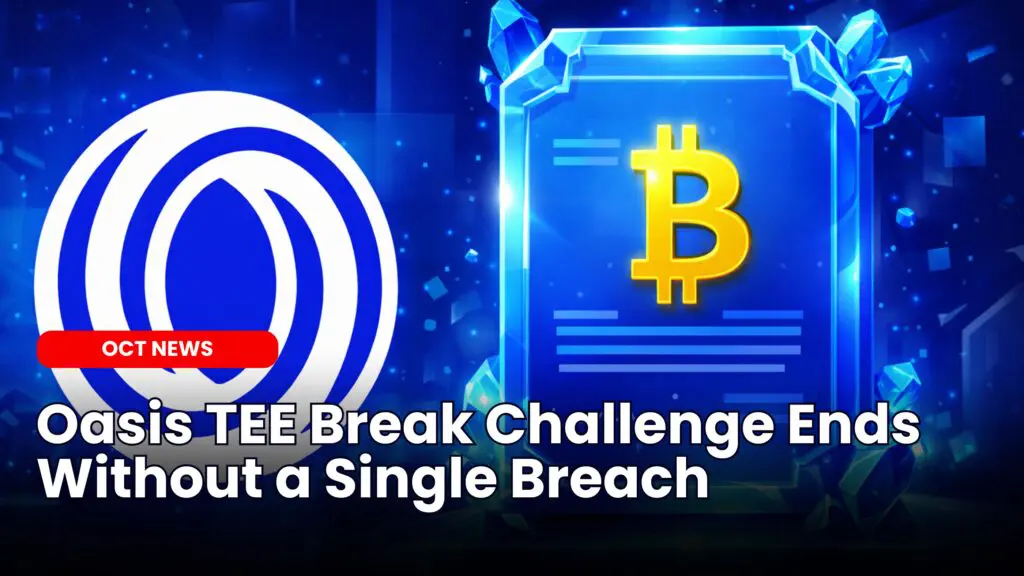
The Oasis Network has officially closed its high-stakes TEE Break Challenge, and the results are in: no one cracked it.

Author: Sahil Thakur
3rd January 2025 – The Oasis Network has officially closed its high-stakes TEE Break Challenge, and the results are in: no one cracked it.
Launched in October 2025, the challenge was a bold public test of the Sapphire platform’s security. Sapphire is Oasis’s confidential EVM built on Trusted Execution Environments (TEEs), which process smart contracts within secure, encrypted enclaves. These TEEs ensure private data, like cryptographic keys stays protected, even from node operators.
Oasis deployed a smart contract on the Sapphire Mainnet that generated a cryptographic keypair within a secure enclave. This key controlled a public Ethereum address holding 1 wrapped Bitcoin (wBTC), worth roughly $60,000 when the challenge began.
The goal was simple but ambitious: extract the private key by breaching the TEE itself. Participants weren’t allowed to exploit standard smart contract bugs. The focus was entirely on hardware-layer vulnerabilities like flaws in Intel SGX or AMD SEV-SNP that have plagued other TEE networks in the past.
There were no submissions, no reports, and no security triage. Anyone could attempt the challenge directly on-chain. Sapphire’s standard defenses remained active throughout, including ephemeral key rotation, compute committee restrictions, enhanced key manager security, and blacklisting of untrusted CPUs.

Codex Arcanum
@CodexArcanum

@OasisProtocol Strong proof that layered security and real engineering matter more than hype.
A few months ago, we locked 1 BTC inside a Sapphire contract and invited the world to break it. The challenge is over. The contract held. The takeaway isn’t that TEEs are magic. It’s that Oasis doesn’t just rely on TEEs. https://t.co/IdOR3uQPGc
01:02 PM·Jan 2, 2026

ieyasu
@ieyasu_rose
@OasisProtocol And that's what Sapphire is ;)
A few months ago, we locked 1 BTC inside a Sapphire contract and invited the world to break it. The challenge is over. The contract held. The takeaway isn’t that TEEs are magic. It’s that Oasis doesn’t just rely on TEEs. https://t.co/IdOR3uQPGc
11:42 AM·Jan 2, 2026
On January 2, 2026, the Oasis Protocol team confirmed that the wBTC remained untouched. No exploits were reported, and no transfers occurred. Despite widespread attention, over 250,000 views on related threads, videos, and explainers – the smart contract and its private key stayed secure.
This outcome validated the Sapphire platform’s layered security model, which combines TEEs with additional controls rather than trusting the enclave alone. It’s a significant win, especially after a year that saw other TEE-based platforms suffer from real-world breaches.
The challenge wasn’t just about breaking or defending one contract. It was a statement on how to build privacy-first infrastructure for Web3. Oasis designed Sapphire with the understanding that no hardware is perfect. Rather than treat TEEs as impenetrable, they fortified the system with rotating keys, hardware blacklists, and permissioned compute environments.
That philosophy now sets Sapphire apart. With this success, Oasis strengthens its position as a go-to platform for private DeFi, secure randomness, on-chain games, and confidential asset management.
<<-oasis-network->>
The crypto and security community took notice. Developers and researchers on Reddit and X analyzed the challenge, dissected the setup, and even shared video guides on potential attack vectors. But no viable exploit emerged.
The broader message? Privacy in crypto doesn’t have to mean compromise. With the right design, even highly targeted systems like TEEs can hold up under pressure.
Our Crypto Talk is committed to unbiased, transparent, and true reporting to the best of our knowledge. This news article aims to provide accurate information in a timely manner. However, we advise the readers to verify facts independently and consult a professional before making any decisions based on the content since our sources could be wrong too. Check our Terms and conditions for more info.