Loading Search...


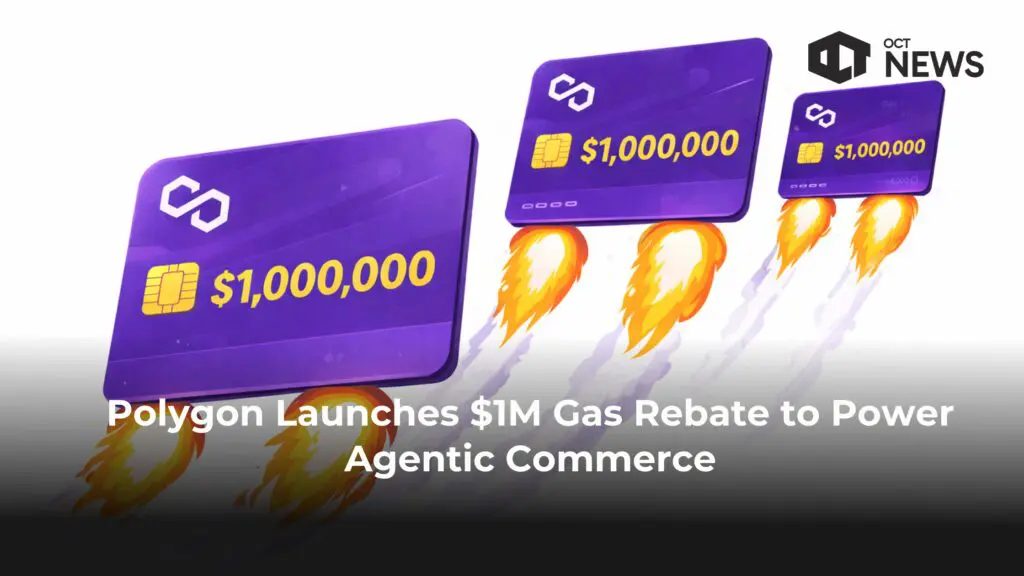
Polygon launches a $1M gas rebate program to power Polygon agentic commerce, enabling zero-fee AI agent transactions.

Author: Kritika Gupta
Steady attention without excessive speculation.
5th March 2026- Polygon has activated its long-awaited PIP-82 upgrade, introducing a $1 million gas rebate program designed specifically for AI-driven transactions. The initiative marks a major step toward Polygon agentic commerce, a concept where autonomous AI agents transact directly on blockchain networks. The program went live following the Lisovo hardfork and allows AI agents to transact on the Polygon network without paying base gas fees when they use Polygon x402 facilitators.
The initiative focuses on enabling “agentic commerce,” where autonomous AI agents execute transactions such as purchasing data, negotiating services, or paying for digital tasks without human intervention. Because these systems often perform extremely high volumes of small payments, transaction costs can become a major barrier. Polygon’s rebate program removes that friction by reimbursing 100 percent of base gas fees for qualifying transactions.
High Signal Summary For A Quick Glance

Eddy Leong
@MACAUEC

@0xPolygon @0xPolygon Love the x402 rebate program Idea: package common x402 payment/facilitator features as reusable “Skills” and publish them on ClawHub. Agents could simply npx install & call them — no reinventing the wheel. Smoother agent-to-agent transactions → more volume → rebates
NEW: Agents can transact for free on Polygon. Rebates are live for Polygon x402 facilitator txns, with up to $1,000,000 in gas fees. Straight to your agent's pocket. Buy, sell, and transact 24/7, without paying a single dollar in fees. Polygon is the home of agentic commerce. https://t.co/oyoynm0qAD
09:09 AM·Mar 5, 2026

Just Hopmans
@HopmansJust
@0xPolygon Polygon is the most generous chain out there giving away millions of pol to Computers and Companies meanwhile 98% of pol holders is at a loss. staking for inflated coins and reiving 0% of all priority fees. The future looks bright, but not for stakers! https://t.co/ELu1o8MsTt
You lock up capital. You take the price risk. You earn ~2.93% APY — from inflation only. The actual priority fees? Go elsewhere. Every month. By design. This is Polygon staking right now 33,796 delegators provide 99.66% of all staked POL, they get 0% of priority fees. Every
07:23 PM·Mar 4, 2026

portofino
@Metehanoz90
@0xPolygon Seriously? According to @sandepel’s PR team, $POL is still “undervalued.” 🤣 For 4 years, they’ve kept saying “#POL / $MATIC is undervalued,” yet the price has dropped 90% during that time. And they’re still repeating the same narrative. What a pathetic PR line. https://t.co/JLGvL6EteO

NEW: Agents can transact for free on Polygon. Rebates are live for Polygon x402 facilitator txns, with up to $1,000,000 in gas fees. Straight to your agent's pocket. Buy, sell, and transact 24/7, without paying a single dollar in fees. Polygon is the home of agentic commerce. https://t.co/oyoynm0qAD
05:57 PM·Mar 4, 2026
The launch of PIP-82 reflects the rapid growth of AI agent technologies. Increasingly, autonomous software programs are performing tasks that require payments, including buying datasets, paying for compute resources, and coordinating logistics. These automated systems can generate thousands of small transactions every day.
However, even low gas fees on Layer-2 networks can add significant cost when transactions occur at such scale. Therefore, developers have pushed for infrastructure that can support micro-transactions without economic friction.
Polygon responded by designing PIP-82 to recycle base gas fees and redirect them toward rebates for AI agent transactions. The proposal first appeared in February 2026 and quickly gained traction among developers building autonomous systems. Many observers view this upgrade as a key milestone in the evolution of Polygon agentic commerce.
Although Polygon has previously offered incentives to grow its ecosystem, this is the first initiative directly focused on AI-driven commerce. Earlier programs mainly targeted consumer markets. For example, Polygon collaborated with Binance in 2023 to offer zero trading fees and gas rebates for NFT transactions.
Historically, Polygon’s incentive campaigns have also triggered positive market reactions. The 2023 NFT rebate campaign coincided with a 15 percent increase in the price of POL, which was previously known as MATIC. Similarly, the 2024 builder grant program corresponded with higher network activity and fee growth.
The rebate program operates through Polygon x402 facilitators, which act as interoperability layers designed for AI agents. When an eligible transaction passes through these facilitators, the system automatically refunds the base gas fee.
Polygon funded the rebate pool with recycled network fees, and the total allocation currently stands at $1 million. The program will continue operating until the pool is exhausted. If funds remain unused, Polygon will burn them, which may strengthen the deflationary mechanics of the POL token.
To qualify, transactions must involve AI-driven economic activity and must route through verified x402 endpoints. For example, AI agents conducting automated payments through smart contracts can receive rebates directly in their wallets.
Polygon Labs estimates that the system could support millions of micro-transactions per day under this structure. Early integrations, including connections with AI-focused platforms such as Fetch.ai, already demonstrate zero-fee transaction execution.
The launch of PIP-82 highlights Polygon’s growing focus on agent-based digital economies. By eliminating base transaction fees for AI systems, the network lowers the barrier for startups and developers building autonomous financial applications.
Consequently, Polygon could strengthen its competitive position against other high-performance blockchain networks such as Solana and Base, which also compete for AI and automation infrastructure.
At the same time, analysts note potential risks. If demand grows rapidly, the rebate pool could deplete quickly. High transaction volumes from automated systems may also stress infrastructure during peak activity.
Our Crypto Talk is committed to unbiased, transparent, and true reporting to the best of our knowledge. This news article aims to provide accurate information in a timely manner. However, we advise the readers to verify facts independently and consult a professional before making any decisions based on the content since our sources could be wrong too. Check our Terms and conditions for more info.



Backpack Introduces On-Chain IPOs, Bringing Public Offerings to Solana
Polygon Launches $1M Gas Rebate to Power Agentic Commerce
Block Street $BSB Airdrop Sparks Backlash After Token Launch
Aztec Network Roadmap Unveils Privacy Smart Contract
Backpack Introduces On-Chain IPOs, Bringing Public Offerings to Solana
Polygon Launches $1M Gas Rebate to Power Agentic Commerce
Block Street $BSB Airdrop Sparks Backlash After Token Launch
Aztec Network Roadmap Unveils Privacy Smart Contract