Loading Search...


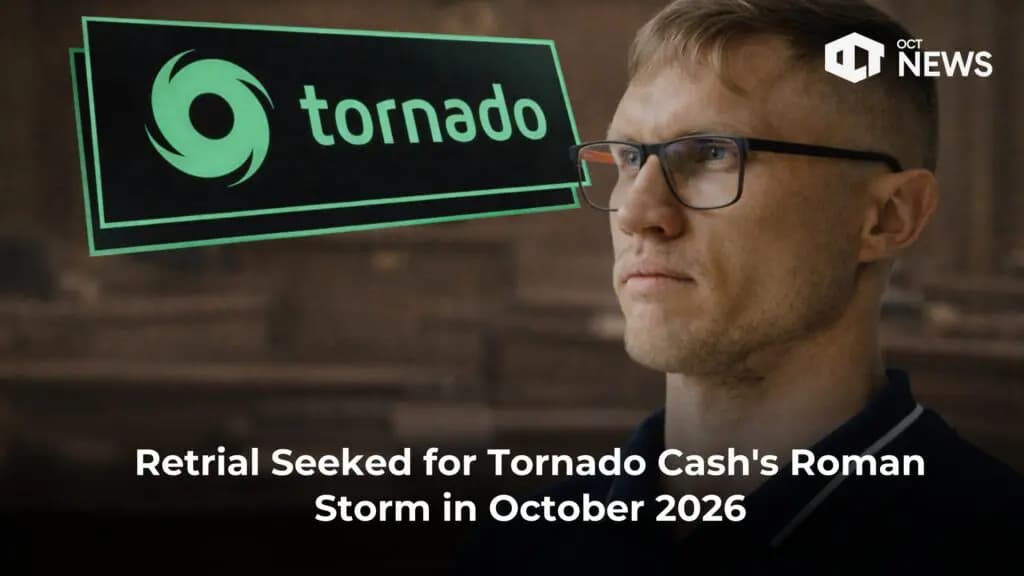
U.S. prosecutors have asked to schedule a retrial for Roman Storm on two major criminal charges that resulted in a hung jury in 2025.

Author: Sahil Thakur
10th March 2026 – U.S. prosecutors have asked a federal court to schedule a retrial for Roman Storm on two major criminal charges that resulted in a hung jury during his 2025 trial.
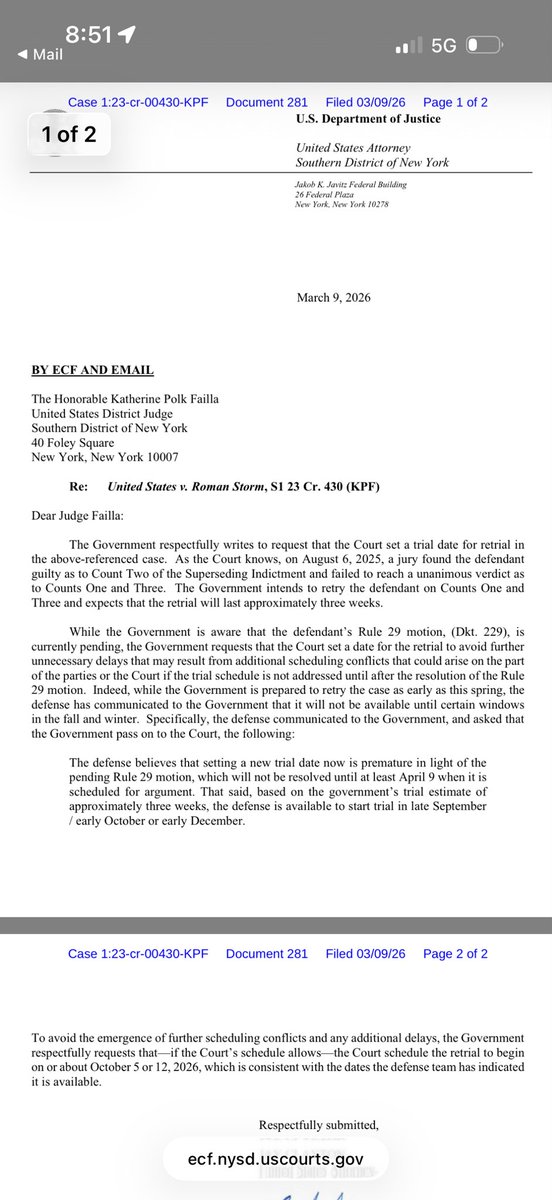
According to a March 9, 2026 court filing in the Southern District of New York, the U.S. Attorney’s Office intends to retry Storm on money-laundering conspiracy and sanctions-violations conspiracy charges. Prosecutors proposed October 5 or October 12, 2026 as potential start dates for the retrial.
High Signal Summary For A Quick Glance

Amanda Tuminelli
@amandatums

DOJ has decided it will retry Roman Storm in the fall. Despite failing to convince a jury the first time around, despite making obvious mistakes like calling irrelevant witnesses and not understanding the forensic analysis of their own blockchain evidence, and despite multiple https://t.co/MRZDHAugT8
01:14 AM·Mar 10, 2026

jasperthefriendlyghost.eth
@drjasper_eth
Free Roman Storm Protect Open-Source Devs https://t.co/EFh009rJBX
@haydenzadams @valkenburgh Can’t say enough how much we need this bill to pass. Protecting open-source devs is critical for US innovation. Ask me how I know.
05:48 PM·Feb 18, 2026
Storm co-founded Tornado Cash, a decentralized cryptocurrency mixer built on the Ethereum network.
The protocol allows users to deposit crypto and later withdraw the same amount to a different address, breaking the on-chain transaction trail. It uses zero-knowledge cryptography to provide privacy for blockchain transfers.
U.S. prosecutors argue that Storm and other developers knowingly created and promoted a service that helped criminals launder funds.
Authorities claim the protocol facilitated more than $1 billion in illicit transactions, including assets stolen by North Korean hacking group Lazarus Group.
Storm’s first trial took place in Manhattan between July and August 2025.
After four weeks of testimony, the jury delivered a mixed outcome. Jurors found Storm guilty of one charge: conspiracy to operate an unlicensed money-transmitting business.
However, the jury could not reach a verdict on two more serious counts: money-laundering conspiracy and sanctions-violations conspiracy.
Because the jury deadlocked on those charges, the judge declared a partial mistrial for those counts. Prosecutors now plan to retry Storm specifically on those unresolved charges.
Key milestones related to the Roman Storm / Tornado Cash case
Roman Storm and co-developers deploy Tornado Cash smart contracts, enabling private cryptocurrency transactions using zero-knowledge proofs.
The Office of Foreign Assets Control sanctions the Tornado Cash protocol, alleging it facilitated large-scale money laundering including funds tied to North Korean hackers.
U.S. prosecutors charge Storm with money laundering conspiracy, sanctions violations, and operating an unlicensed money transmitting business.
The federal court rejects Storm’s attempt to dismiss the charges before trial, allowing the case to proceed.
After legal challenges, U.S. authorities remove most sanctions tied directly to the Tornado Cash protocol.
Storm faces trial in Manhattan federal court over allegations that Tornado Cash facilitated more than $1 billion in illicit transactions.
The jury convicts Storm of operating an unlicensed money transmitting business but deadlocks on the money laundering and sanctions conspiracy charges.
Storm’s legal team submits Rule 29 motions seeking acquittal or a new trial, arguing insufficient evidence and First Amendment protections for open-source code.
The court plans to review Storm’s request to overturn the conviction or order a new trial.
Prosecutors seek to retry Storm on money laundering and sanctions conspiracy counts after the jury deadlocked in the original trial.
Storm’s legal team has asked the court to overturn the existing conviction through a Rule 29 motion for acquittal or a new trial.
The defense argues that Tornado Cash is non-custodial open-source software and that developers do not control how users interact with the protocol.
Lawyers also claim the case raises major First Amendment issues, arguing that writing and publishing code should be treated as protected speech.
According to the defense filings, Storm never directly controlled user funds and did not operate Tornado Cash as a traditional financial business.
The case has become one of the most closely watched legal battles in the crypto industry.
Supporters argue that prosecuting a developer for writing decentralized code could create dangerous precedent for open-source software and decentralized finance projects.
Several major organizations and individuals have publicly supported Storm’s defense. These include Vitalik Buterin, the Ethereum Foundation, the Electronic Frontier Foundation, Coin Center, and the DeFi Education Fund.
Industry advocates say the case could determine whether developers can be held liable for how others use decentralized tools.
Before the retrial proceeds, the court will first review Storm’s post-trial acquittal motion.
A hearing on that motion is scheduled for April 9, 2026. The judge could dismiss the conviction, order a new trial, or allow the verdict to stand.
Storm currently remains free on bail while the legal process continues.
If the court allows the retrial to proceed, prosecutors plan to pursue the two unresolved conspiracy charges later in 2026.
The outcome of the retrial could carry major consequences for the crypto ecosystem.
If prosecutors succeed, the case could strengthen arguments that developers can face criminal liability when their software is used for illicit activity.
However, if Storm’s defense succeeds, the ruling could reinforce protections for open-source developers building decentralized financial infrastructure.
Our Crypto Talk is committed to unbiased, transparent, and true reporting to the best of our knowledge. This news article aims to provide accurate information in a timely manner. However, we advise the readers to verify facts independently and consult a professional before making any decisions based on the content since our sources could be wrong too. Check our Terms and conditions for more info.



ZODL Raises $25M to Expand Zcash Privacy Ecosystem
Venice AI Burns 21Ky $VVV Token in Major Deflationary Move
Virtuals and Ethereum Release ERC-8183 for AI Agent Commerce
Pink Drainer Transfer Triggers Security Concerns Across Crypto
ZODL Raises $25M to Expand Zcash Privacy Ecosystem
Venice AI Burns 21Ky $VVV Token in Major Deflationary Move
Virtuals and Ethereum Release ERC-8183 for AI Agent Commerce
Pink Drainer Transfer Triggers Security Concerns Across Crypto