Loading Search...


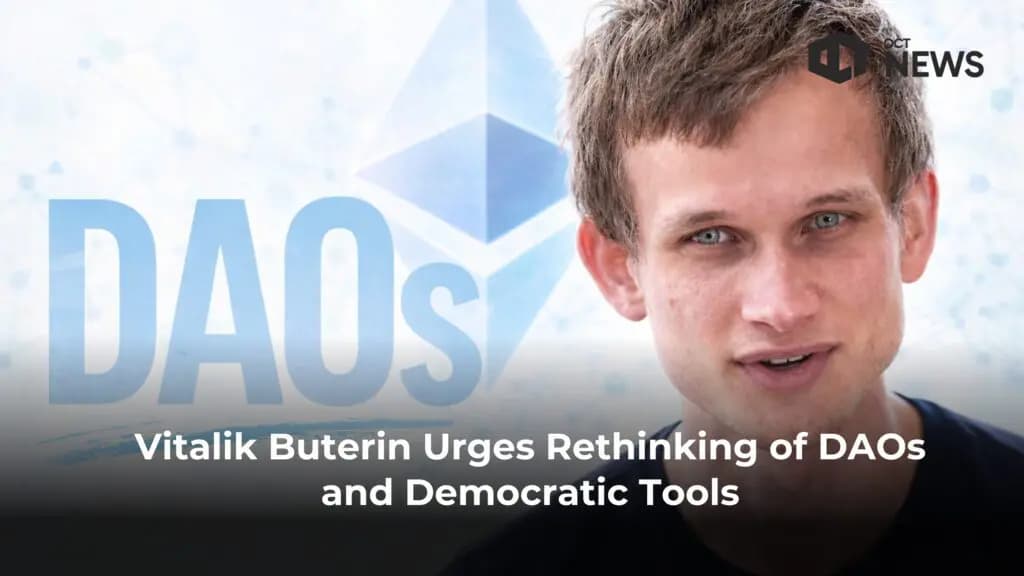
Vitalik Buterin has called for a renewed focus on decentralized democratic tools such as DAOs, quadratic funding and zk voting.

Author: Sahil Thakur
9th March 2026 – Vitalik Buterin has called for a renewed focus on decentralized democratic tools such as DAOs, quadratic funding, and zero-knowledge voting systems.
In a long thread posted on X on March 8, 2026, Buterin argued that the world is experiencing a growing “authoritarian wave.” At the same time, he said new technologies like AI and zero-knowledge cryptography could make decentralized governance tools more effective than ever.
The comments quickly gained attention across crypto circles, with several industry outlets highlighting the thread as a broader reflection on the future of governance in decentralized systems.
High Signal Summary For A Quick Glance

Kanro Fund
@Kanrofundoneth

@VitalikButerin I think we are both in chaotic era and ‘proof of value’ crisis. From a perspective on your last https://t.co/09bCmOjx7g article, Balance of Power, I got how important it is for us to find balance between things that may harm us rathet than defend. But where we are right now,
One thing that it is worth re-thinking is our perspective on when, and how, it makes sense to build "democratic things". This includes: * DAOs and voting mechanisms in DAOs * Quadratic and other funding gadgets * ZKpassport voting use cases, incl freedomtool type stuff, incl
11:59 PM·Mar 8, 2026

AltcoinAce
@AltcoinAce_X
@VitalikButerin feels like we moved from a “design better systems” era to a “who actually has power” era maybe the role of crypto tools now isn’t replacing institutions, but helping people coordinate and signal consensus in chaotic times
One thing that it is worth re-thinking is our perspective on when, and how, it makes sense to build "democratic things". This includes: * DAOs and voting mechanisms in DAOs * Quadratic and other funding gadgets * ZKpassport voting use cases, incl freedomtool type stuff, incl
11:34 PM·Mar 8, 2026

ProffEtherPrints
@ProffEtherPrint
@VitalikButerin The loss in hope is because everyone is just tired of lobbyists deciding what happens instead of their vote Inversely it should drive citizens to pish for better voting powers where lobbyists are out of the picture completely. No lobbying is good, it's just code word cor
One thing that it is worth re-thinking is our perspective on when, and how, it makes sense to build "democratic things". This includes: * DAOs and voting mechanisms in DAOs * Quadratic and other funding gadgets * ZKpassport voting use cases, incl freedomtool type stuff, incl
11:10 PM·Mar 8, 2026
In his thread, Buterin said interest in decentralized governance tools appears to have declined compared with earlier years of the crypto movement.
He listed several examples of what he called “democratic things,” including decentralized autonomous organizations, DAO voting mechanisms, quadratic funding models, and privacy-focused voting systems built with zero-knowledge technology.
He also pointed to voting experiments within social media platforms and attempts to apply decentralized governance to real-world political systems.
According to Buterin, enthusiasm around these ideas has faded partly because of growing disillusionment with democratic systems more broadly. He said the trend extends beyond politics and also affects corporations, nonprofits, and online platforms.
At the same time, he argued that concentration of power in founder-led organizations and centralized institutions has contributed to that shift.
Buterin contrasted the early 2000s and 2010s with today’s environment.
During that earlier period, many technologists believed large-scale democratic innovations could reshape governance. Ideas such as nationwide quadratic voting systems or large DAOs funding public goods felt realistic.
However, he said the current global environment feels more chaotic. In such conditions, he argued that democratic tools should focus less on rigid decision-making mechanisms and more on helping groups coordinate and express collective opinions.
Instead of strict binding votes, he suggested tools like anonymous polling systems, assurance contracts, and hybrid governance models that combine prediction markets with voting.
These approaches could help distributed communities organize their views even when political or institutional systems are unstable.
Buterin also highlighted the potential of privacy-focused voting systems built with zero-knowledge technology.
Such systems allow people to verify their eligibility to vote without revealing their identity. In his thread, he mentioned ZKpassport-style approaches and tools like Freedom Tool, which developers have used in experiments involving anonymous civic participation.
He suggested these technologies could give groups a credible collective voice even in politically sensitive environments.
One of Buterin’s most optimistic arguments focused on the role of artificial intelligence.
He said AI could dramatically increase participation in decentralized governance systems. According to Buterin, AI agents or “LLM shadows” trained on a person’s writing and actions could potentially vote or participate in governance processes on their behalf.
That approach could allow individuals to contribute input to large-scale decision-making without constantly monitoring proposals or debates.
He also noted that AI systems could incorporate private information into decision-making while still protecting confidentiality through cryptographic methods.
In effect, he suggested that AI could remove many of the practical barriers that currently limit participation in decentralized governance.
Buterin also discussed how governance systems should balance equality with diversity of viewpoints.
He argued that systems should ensure every group has at least some voice in decision-making, even if their influence is limited. At the same time, governance structures should encourage pluralism and avoid concentration of power among a single elite group.
Mechanisms such as quadratic voting could help surface a broader range of voices while preventing dominance by wealthy participants.
Despite the current skepticism around decentralized governance, Buterin said the next wave of democratic experimentation should begin sooner rather than later.
He argued that growing dissatisfaction with centralized power structures could eventually renew interest in decentralized alternatives.
However, he cautioned that future experiments must learn from earlier failures and adapt to today’s more complex and volatile environment.
According to Buterin, the combination of AI, stronger cybersecurity, and advanced cryptography creates new opportunities to design governance systems that were not technically feasible a decade ago.
If those tools are used effectively, he suggested, decentralized democratic models could become far more practical than previous attempts.
Our Crypto Talk is committed to unbiased, transparent, and true reporting to the best of our knowledge. This news article aims to provide accurate information in a timely manner. However, we advise the readers to verify facts independently and consult a professional before making any decisions based on the content since our sources could be wrong too. Check our Terms and conditions for more info.



Blockaid Exposes $230K Exploit on Gondi NFT Lending Protocol
$YELLOW Token Launch Activates Yellow Network Trading
MicroStrategy Bitcoin Purchase: 101st BTC Buy Announced
USDC on Ethereum Hits All-Time High with $1.7T Monthly Volume
Blockaid Exposes $230K Exploit on Gondi NFT Lending Protocol
$YELLOW Token Launch Activates Yellow Network Trading
MicroStrategy Bitcoin Purchase: 101st BTC Buy Announced
USDC on Ethereum Hits All-Time High with $1.7T Monthly Volume