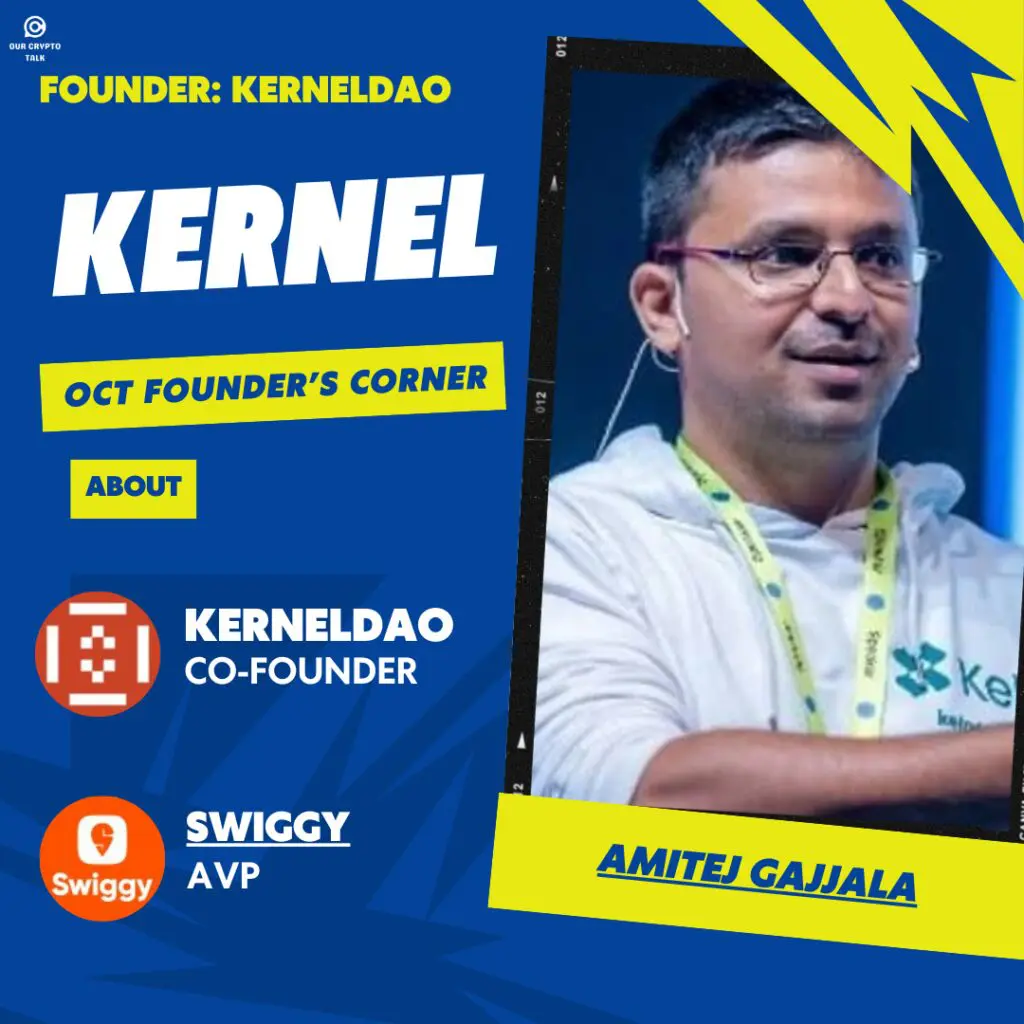
All the latest news and key insights you need from KernelDAO
What Is KernelDAO?
1. What Is KernelDAO?
KernelDAO is a multi-chain restaking ecosystem that helps users and developers maximize value from staked crypto assets while keeping them liquid. It combines three core pillars: Kernel (restaking infrastructure), Kelp (liquid restaking tokens), and Gain (automated yield vaults). This unified system boosts rewards, spreads economic security, and provides liquidity for staked assets.
2. Why KernelDAO Was Created
KernelDAO was designed to address key challenges in staking and DeFi:
Overcoming the low capital efficiency of staked assets, which are often locked and unusable elsewhere.
Providing shared security for protocols that cannot afford to bootstrap their own validator networks.
Solving the liquidity versus yield tradeoff by introducing tokenized liquid restaking derivatives.
Simplifying complex restaking and yield strategies for everyday users.
By offering shared economic security, liquid restaking tokens, and automated vaults, KernelDAO makes restaking more accessible and efficient.
3. How KernelDAO Works
User deposits assets – Users stake ETH, BNB, BTC derivatives, or liquid staking tokens into KernelDAO.
Kernel allocates security – Staked assets are restaked to secure validators, middleware, or decentralized apps.
$KERNEL is the native governance and utility token of KernelDAO, designed to unify incentives across all products. Its key roles include:
Governance – Token holders vote on validator selection, strategy allocation, and protocol upgrades.
Restaking security – $KERNEL can be staked to provide slashing insurance and shared security.
Incentives – Community rewards and airdrops represent over half of total supply.
Liquidity – Used in AMMs, liquidity mining, and protocol incentive programs.
Unified ecosystem utility – Powers Kernel, Kelp, and Gain as a single economic layer.
Social Pulse
Bearish50%
Bullish50%
Uros Popovic@popovicu94
⋯
@dhh is right.
There is an endless, tiring debate about definitions. What exactly is a "Linux distribution"? Does it require a package manager to count? What exactly is an OS? How far beyond kernel does it go?
None of that matters.
Technically, your Linux system is just two things:
1. The kernel
2. Userspace
The kernel starts one process: init (PID 1). Everything else: your shell, your browser, your background services, is just a child of that one process.
If you can build a kernel and an init, you have a distro.
I previously wrote a guide on building a "Micro Distro" (kernel + a single binary). It booted in seconds. It connected to the internet. It demystified the process.
The feedback was clear: People loved getting a system to boot ASAP, rather than the "Linux From Scratch" (LFS) approach, which forces you to compile toolchains and packages for a long time before you even get to boot something.
But "Micro" has limits. You can't run a proper shell script without bash. You can't compile code without gcc.
So, I’m working on the sequel.
I am writing a guide to build a more complex Linux distribution from scratch, but designed to be finished in hours, not days, and more intuitive.
We are moving beyond the toy examples. We are manually integrating:
The init system: We will implement runit. It’s modular and simple, avoiding the complexity of systemd.
The shell: A full bash environment (no more limited toy shells).
The tools: GCC, make, and coreutils.
We are going to build the hierarchy that Debian or Arch gives you for free, so you can see exactly how the sausage is made.
It’s a simplified, intuitive version of LFS that respects your time.
If you want to understand how your OS actually works, without the gatekeeping, stay tuned.
The deep dive drops in the upcoming weeks. 🤙
Uros Popovic@popovicu94
⋯
Your Linux distro is just two things:
1. The kernel
2. User-space binaries
Once the kernel is ready, it hands off to a SINGLE userspace process: init.
Everything else you run – your shell, your apps, your services – is a child of init.
This means you can build a Linux system with a "Hello World" init or a complex one like systemd. It's a beautiful example of modular design.
Want to build your tiny distro from scratch in 10 minutes? Here's a detailed writeup on how to do it:
Xlogin@Xlogin10
⋯
XLogin Antidetect Browser version [2.1.0.1] update:
1. Add the 140, 141 kernel;
2. Other fingerprint optimization.
Download link:
Free Trial:
Tutorials:
New users can test for 3 days free.
@XloginSupport
Moomiau@Moomiau
⋯
Popcorn kernel 2: electric boogaloo
Top Creators
OCT Timeline - KernelDAO
November 25, 2024
Binance Labs Funding Secured
Received funding from Binance Labs, strengthening core restaking infrastructure on BNB Chain.
April 14, 2025
Token Launch & Binance Megadrop
KERNEL token launched and participated in Binance Megadrop with 1.7M participants.
May 23, 2025
Listing on Crypto.com App
KERNEL listed on Crypto.com App, enabling purchases with over 20 fiat currencies.
July 2025
Strategic Airdrops and Ecosystem Fund
Allocated 1–2% of token supply to holders via strategic airdrops, boosting multi-chain security.