Loading Search...


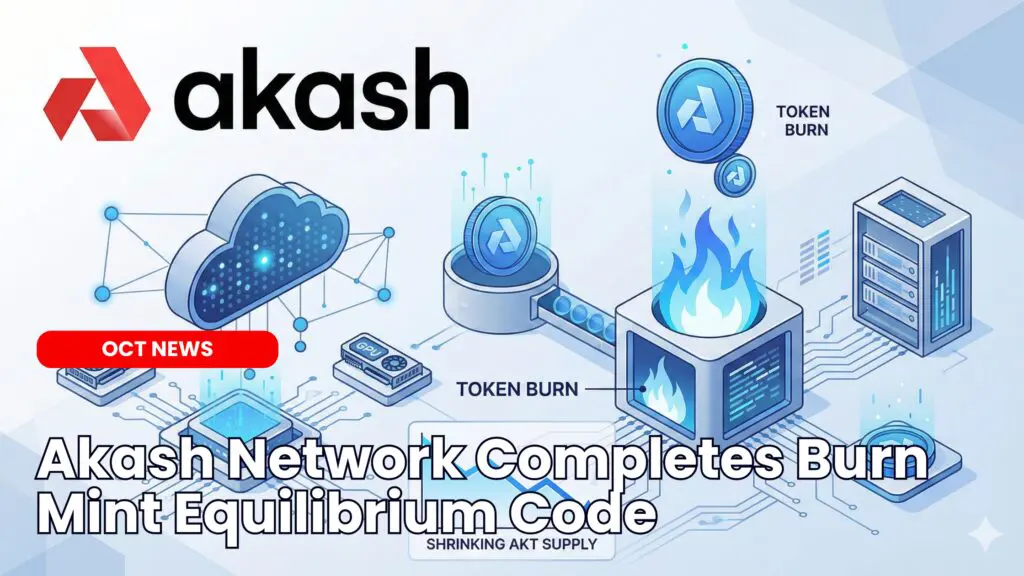
Akash Network completes Burn Mint Equilibrium code, linking AKT supply to real compute usage and setting the stage for usage-driven tokenomics.

Author: Tanishq Bodh
January 7, 2025 – Decentralized infrastructure projects entered 2026 with a clear focus on sustainability. Teams now prioritize models that tie token value to real usage. This shift has become especially visible across AI and decentralized compute networks, where demand continues to rise. In this environment, Akash Network ( AKT ) confirmed a key protocol milestone. On January 7, 2026, founder Greg Osuri announced the completion of core code for the network’s Burn Mint Equilibrium, or BME, model. The update pushes Akash closer to a system where token supply responds directly to compute demand.
High Signal Summary For A Quick Glance
Akash Network finalized development for its Burn Mint Equilibrium model and released public pull requests covering node software and SDK integrations. The announcement marks the transition from proposal to implementation after the community introduced BME in September 2025 through AEP-76.
Under BME, users pay for compute by burning AKT. The protocol converts the burned tokens into Akash Compute Tokens, or ACT, which track a USD value and function as stable compute credits. This design replaces earlier payment paths that allowed stablecoin usage without interacting with AKT.

The team will now open a dedicated testnet for community testing. Validators, developers, and users will review the logic and stress test the system. Akash expects mainnet activation in early 2026, assuming the test phase surfaces no critical issues.
Relative positioning against past updates or peers
BME changes how Akash captures value from its growing compute usage. Every deployment now removes AKT from circulation. Token supply links directly to real demand, not speculative activity.
For users, USD-denominated compute credits reduce pricing uncertainty. Teams can plan workloads without tracking token volatility. At the same time, the protocol still settles activity through AKT under the hood.
For investors and token holders, the model introduces a clear supply sink. If usage grows, burns scale with it. This aligns long-term token dynamics with network adoption instead of short-term incentives.
At a narrative level, BME reflects a broader 2026 trend. Infrastructure and DePIN projects now emphasize fundamentals, revenue, and usage-based economics.
Key milestones related to this development
Proposal outlines burning AKT to mint USD-pegged ACT for compute.
Upgrade simulation notes BME impact after shared security migration.
WASM contracts + Pyth oracle completed; burn/mint logic aimed for public testing in ~2 weeks.
Focus stays on WASM + oracle work enabling faster iteration and updates.
Migration proposal complements BME to reduce costs; community ties BME narrative to AKT recovery.
Community threads include BME alongside VMs and confidential computing priorities.
Node + SDK PRs released; next steps flagged: incentivized testnet, then mainnet deployment.
Several decentralized compute and rendering networks have begun experimenting with burn-and-mint designs. Most aim to balance stable user pricing with native token value capture. Akash differentiates itself through its focus on open, permissionless AI compute rather than specialized or enterprise-only workloads.
The timing also matters. Akash recently completed upgrades tied to shared security and cost efficiency. These changes reduce operational overhead and support higher throughput. Together with BME, they position the network to scale alongside rising AI demand in 2026.
Readers should watch the incentivized testnet launch, expected mid-January 2026, with guides soon from Akash Alpha. Key roadmap items include potential governance votes on BME parameters post-testing and mainnet rollout in Q1 2026. Monitor confirmations on bug-free testing and exchange listings for AKT amid burns. Risks: Delays from uncovered issues or low community participation; if burns underperform due to low usage, it could weaken deflation narrative. Conditions changing the narrative: High AI compute demand or successful shared security migration could amplify bullishness, while market downturns might delay adoption.
Our Crypto Talk is committed to unbiased, transparent, and true reporting to the best of our knowledge. This news article aims to provide accurate information in a timely manner. However, we advise the readers to verify facts independently and consult a professional before making any decisions based on the content since our sources could be wrong too. Check our Terms and conditions for more info.



Pump.fun Multi-Chain Expansion Signals Ethereum, Base, Monad, BSC Launch
DoubleZero Launches Edge for Real-Time Solana Shred Data
IXS Launches Tokenized Private Credit for SME Lending
Avantis Launches Daily AVNT Buyback and Burn
Pump.fun Multi-Chain Expansion Signals Ethereum, Base, Monad, BSC Launch
DoubleZero Launches Edge for Real-Time Solana Shred Data
IXS Launches Tokenized Private Credit for SME Lending
Avantis Launches Daily AVNT Buyback and Burn