Loading Search...


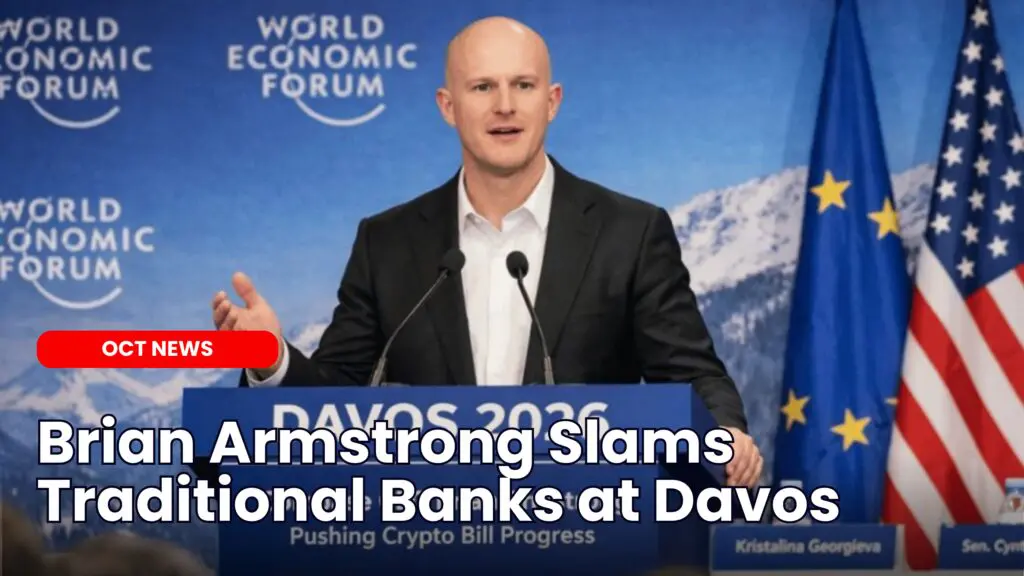
Brian Armstrong made a strong impression at the World Economic Forum (WEF) in Davos, Switzerland - calling Banks a "scam".

Author: Sahil Thakur
21st January 2026 – Coinbase CEO Brian Armstrong made a strong impression at the World Economic Forum (WEF) in Davos, Switzerland – calling Banks a “scam”. His visit centered on promoting cryptocurrency as a tool for financial reform and inclusion on a global scale.
High Signal Summary For A Quick Glance

Crypto Rover
@cryptorover

BULLISH: CEO of Coinbase Brian Armstrong just said the crash is temporary and Bitcoin is still going to $1,000,000. https://t.co/L7FDzc58BI

12:21 AM·Jan 21, 2026

Kodi (BMNR) 📌
@SweatyKodi
Brian Armstrong on CNBC Squawk Box straight up said: NYSE going to tokenized stocks and 24/7 trading is actually “PRO” crypto! Stocks on blockchain = faster trades, instant settlement, global access anytime. Tokenization wave incoming!!! 📷 @AltcoinDaily $ETH / $BMNR https://t.co/3EtOUcPaeo

10:33 PM·Jan 20, 2026

STEPH IS CRYPTO
@Steph_iscrypto
💥BREAKING: COINBASE CEO BRIAN ARMSTRONG AT 🇨🇭 DAVOS: “BANKS LEND YOUR DEPOSITS WITHOUT PERMISSION.” “THAT’S THE REAL SCAM.” https://t.co/VHy17zMM3A

08:20 PM·Jan 20, 2026
Armstrong outlined three core priorities during his visit. First, he aimed to discuss how crypto could modernize outdated financial systems and promote economic freedom. Second, he pressed for clear U.S. legislation that supports a healthy crypto market structure. Third, he emphasized the benefits of tokenization, arguing it could make capital markets more accessible and inclusive.
He summarized this vision by saying that the future of finance is being built for the people, not just traditional institutions.
On January 20, during a CNBC interview, Armstrong took direct aim at the banking sector. He criticized the common practice of fractional reserve banking, where banks lend out customer deposits without clear permission. He called this practice “the real scam” and pointed out that banks often earn around 5.7 percent from the Federal Reserve while offering depositors just 0.1 to 0.5 percent in return.
In contrast, he highlighted how crypto systems operate with one-to-one reserves and often offer higher stablecoin yields. According to Armstrong, traditional banks should stop lobbying against stablecoins and start competing on fair terms.
Armstrong also addressed the state of U.S. crypto regulation. Recently, Coinbase withdrew its support for the CLARITY Act, a proposed market structure bill. He cited several concerns with the current draft, including a potential ban on tokenized equities, restrictions on decentralized finance, and broad government access to user data.
Despite these setbacks, Armstrong stated that Coinbase is back in discussions with policymakers and bank CEOs. He remains optimistic that a revised version of the bill could pass in 2026, especially if the White House lends its support. He believes that the bill, as it stands, gives away too much to traditional financial institutions and does not reflect the needs of the crypto community.
Beyond legislation, Armstrong spoke about the potential of tokenization to address global wealth inequality. He explained that traditional capital markets tend to reward those with access, while billions of people are left behind. Tokenized assets, in his view, can open up investment opportunities to anyone with internet access, regardless of geography or income level.
To support this idea, Coinbase announced a new initiative. Working with Circle, they will help bring Bermuda’s entire economy onchain using USDC and Base. If successful, Bermuda will become the first nation to operate a fully onchain economy.
Armstrong expressed hope for more political progress in 2026. He welcomed the election of pro-crypto politicians such as Rep. Abigail Spanberger and Rep. Mikie Sherrill. Their presence in government, he noted, reflects a growing acceptance of cryptocurrency at the highest levels.
Finally, Armstrong reiterated his long-term outlook for Bitcoin. He predicted the asset could reach $1 million by 2030, citing its limited 21 million supply and growing global demand.
Throughout his time in Davos, Armstrong pushed for a shift in the global financial system. He positioned crypto as not just a technological innovation but a movement for fairness, transparency, and inclusion. His message was clear: finance needs an upgrade, and crypto is ready to lead the way.
As Brian Armstrong returns from Davos, all eyes are on whether his public criticism of banking practices will influence U.S. policy discussions. Negotiations around the revised CLARITY Act could gain momentum, especially if lawmakers address stablecoin rewards and DeFi provisions.
Meanwhile, Armstrong’s push to tokenize entire economies, like Bermuda’s, may accelerate real-world adoption. Expect heightened scrutiny from both regulators and banks, as crypto leaders double down on yield transparency and global access. If the White House signals support, a new wave of legislative clarity may arrive faster than expected.
Our Crypto Talk is committed to unbiased, transparent, and true reporting to the best of our knowledge. This news article aims to provide accurate information in a timely manner. However, we advise the readers to verify facts independently and consult a professional before making any decisions based on the content since our sources could be wrong too. Check our Terms and conditions for more info.



Crypto Trader $24M Wrench Attack Theft After Violent Assault
Polygon Launches $1M Gas Rebate to Power Agentic Commerce
Block Street $BSB Airdrop Sparks Backlash After Token Launch
Aztec Network Roadmap Unveils Privacy Smart Contract
Crypto Trader $24M Wrench Attack Theft After Violent Assault
Polygon Launches $1M Gas Rebate to Power Agentic Commerce
Block Street $BSB Airdrop Sparks Backlash After Token Launch
Aztec Network Roadmap Unveils Privacy Smart Contract