Loading Search...


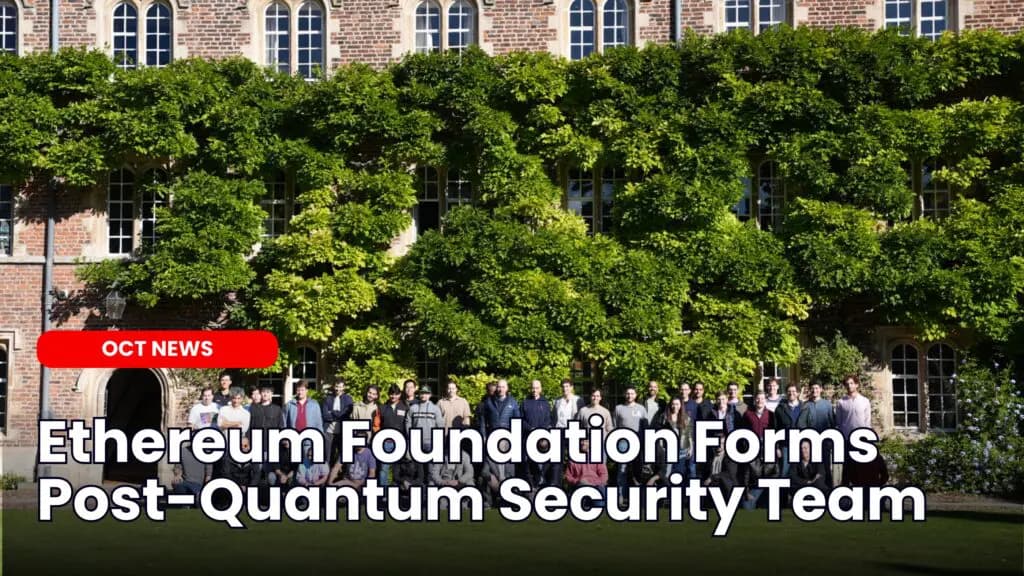
The Ethereum Foundation has launched a dedicated Post-Quantum (PQ) security team as announced by Justin Drake.

Author: Sahil Thakur
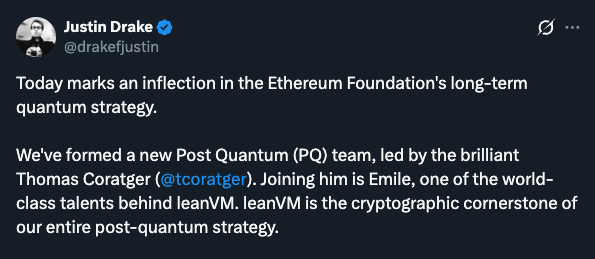
24th January 2026 – The Ethereum Foundation (EF) has launched a dedicated Post-Quantum (PQ) security team. Justin Drake, a prominent EF researcher, announced the initiative on January 24, 2026, describing PQ protection as a “top strategic priority.” This new team reflects growing concerns that quantum computers may soon threaten the cryptographic backbone of Ethereum and the broader blockchain ecosystem.
High Signal Summary For A Quick Glance

Teng Yan · Chain of Thought AI
@tengyanAI

Great that we're starting to think about the quantum risk in a serious way. 100% critical for our industry. It's really hard to be a long-term allocator in crypto if the terminal value our assets is 0. https://t.co/TDKM9LaBeZ
01:23 AM·Jan 24, 2026

lean Ethereum
@leanEthereum
Ethereum Foundation's long-term quantum strategy... https://t.co/3gid2Vc0dj https://t.co/yvVz6sEb9r
Today marks an inflection in the Ethereum Foundation's long-term quantum strategy. We've formed a new Post Quantum (PQ) team, led by the brilliant Thomas Coratger (@tcoratger). Joining him is Emile, one of the world-class talents behind leanVM. leanVM is the cryptographic
01:01 AM·Jan 24, 2026

sassal.eth/acc 🦇🔊
@sassal0x
Quantum is a very real threat for blockchains and it's coming sooner than most people think. The EF's new 'Post Quantum' team will ensure that Ethereum is able to defend itself against any and all quantum threats. Believe in somETHing. https://t.co/HRbHgQxtAW
Today marks an inflection in the Ethereum Foundation's long-term quantum strategy. We've formed a new Post Quantum (PQ) team, led by the brilliant Thomas Coratger (@tcoratger). Joining him is Emile, one of the world-class talents behind leanVM. leanVM is the cryptographic
08:08 PM·Jan 23, 2026
Thomas Coratger, a respected researcher with a deep focus on Ethereum’s technical evolution, now leads the PQ team. Emile, the core developer behind leanVM, a critical cryptographic engine has also joined. The initiative extends well beyond a single group, drawing in talent from across the Ethereum Foundation. Researchers such as Antonio Sanso (PQ transactions), Alex Hicks (formal verification and AI-assisted proofs), and Will Corcoran (PQ devnet coordination) will all contribute.
Drake himself continues to play a leading role as both advocate and organizer, working closely with EF teams and external collaborators.
The EF’s interest in PQ cryptography isn’t new. It dates back to a 2019 presentation on “Eth3.0 Quantum Security” at StarkWare Sessions. However, recent breakthroughs in quantum computing have accelerated the need for stronger defenses. Ethereum’s current reliance on elliptic curve cryptography (ECC)—including ECDSA and BLS signatures—leaves it vulnerable to attacks by quantum algorithms like Shor’s, which could eventually forge signatures and compromise user funds.
To counter this, Ethereum is exploring alternatives such as hash-based and lattice-based cryptography, multivariate schemes, and particularly zk-STARKs, which offer quantum resistance and eliminate the need for trusted setups.
The EF has outlined a comprehensive plan to make Ethereum fully post-quantum secure. Key initiatives include:
The foundation has also joined Coinbase’s PQ advisory board, underscoring its role in shaping broader industry standards.
Beyond the core PQ team, Ethereum Foundation–backed groups like ZKnox and Privacy & Scaling Explorations (PSE) continue to push technical boundaries:
EF has also awarded $12 million to STARKware to integrate zk-STARKs into Ethereum’s scaling roadmap—another layer of quantum resistance.
The EF plans to publish a detailed roadmap at pq.ethereum.org, laying out Ethereum’s transition to PQ security. The goal is ambitious: upgrade Ethereum’s cryptography with zero fund loss and zero downtime.
Several upgrades already point in this direction:
Vitalik Buterin has also emphasized quantum security in his vision for Ethereum’s long-term ossification and decentralization. In a January 2026 essay, he named “century-scale quantum resistance” as a key requirement for a self-sustaining Ethereum.
Our Crypto Talk is committed to unbiased, transparent, and true reporting to the best of our knowledge. This news article aims to provide accurate information in a timely manner. However, we advise the readers to verify facts independently and consult a professional before making any decisions based on the content since our sources could be wrong too. Check our Terms and conditions for more info.



Step Finance ShutDown After $40M Hack Ends Solana Era
Project 0 Upgrades Add PT Tokens and Multi-Venue Collateral
Austria Halts KuCoin EU Expansion Over Compliance Gaps
Fluid Protocol Sets Up Legal Foundation While DAO Keeps Full Control
Step Finance ShutDown After $40M Hack Ends Solana Era
Project 0 Upgrades Add PT Tokens and Multi-Venue Collateral
Austria Halts KuCoin EU Expansion Over Compliance Gaps
Fluid Protocol Sets Up Legal Foundation While DAO Keeps Full Control