Loading Search...


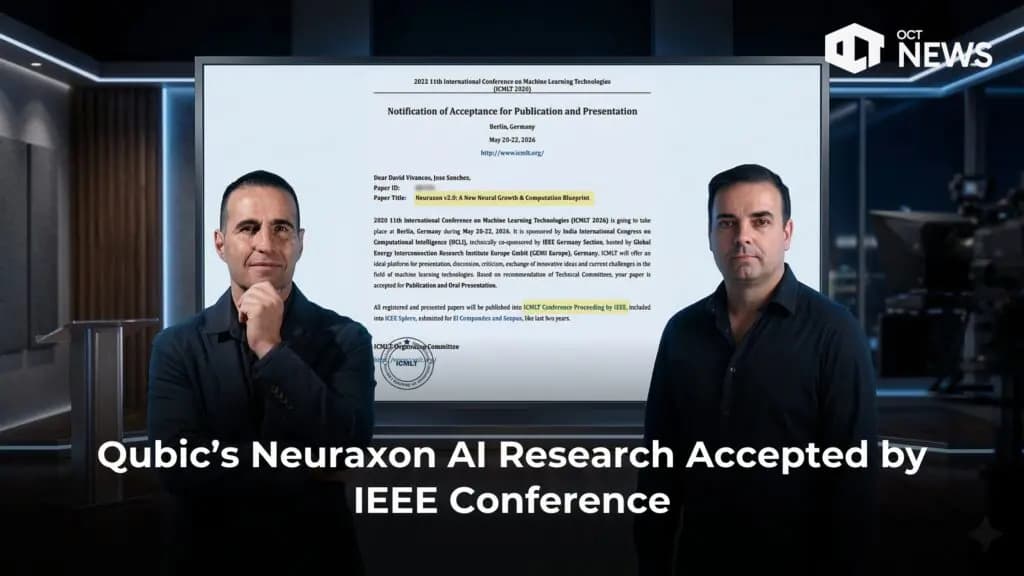
Qubic’s Neuraxon AI research earns acceptance at the IEEE-backed ICMLT 2026 conference, advancing decentralized AI development.

Author: Tanishq Bodh
March 15, 2026 – The intersection of blockchain and artificial intelligence continues to gain momentum as decentralized computing networks explore new ways to train and deploy AI systems. Academic recognition has become a critical step for projects seeking legitimacy beyond the crypto ecosystem. This week, Qubic Network announced a new milestone for its AI research initiative after Neuraxon AI got approved.
High Signal Summary For A Quick Glance
Steady attention without excessive speculation.
Qubic has confirmed that the International Conference on Machine Learning Technologies 2026 in Berlin has accepted its latest research on the Neuraxon AI architecture for presentation.
Scientific advisors David Vivancos and Dr. José Sánchez authored the paper, which focuses on neural architectures inspired by biological processes. Scopus, a major academic research database, will index the research.
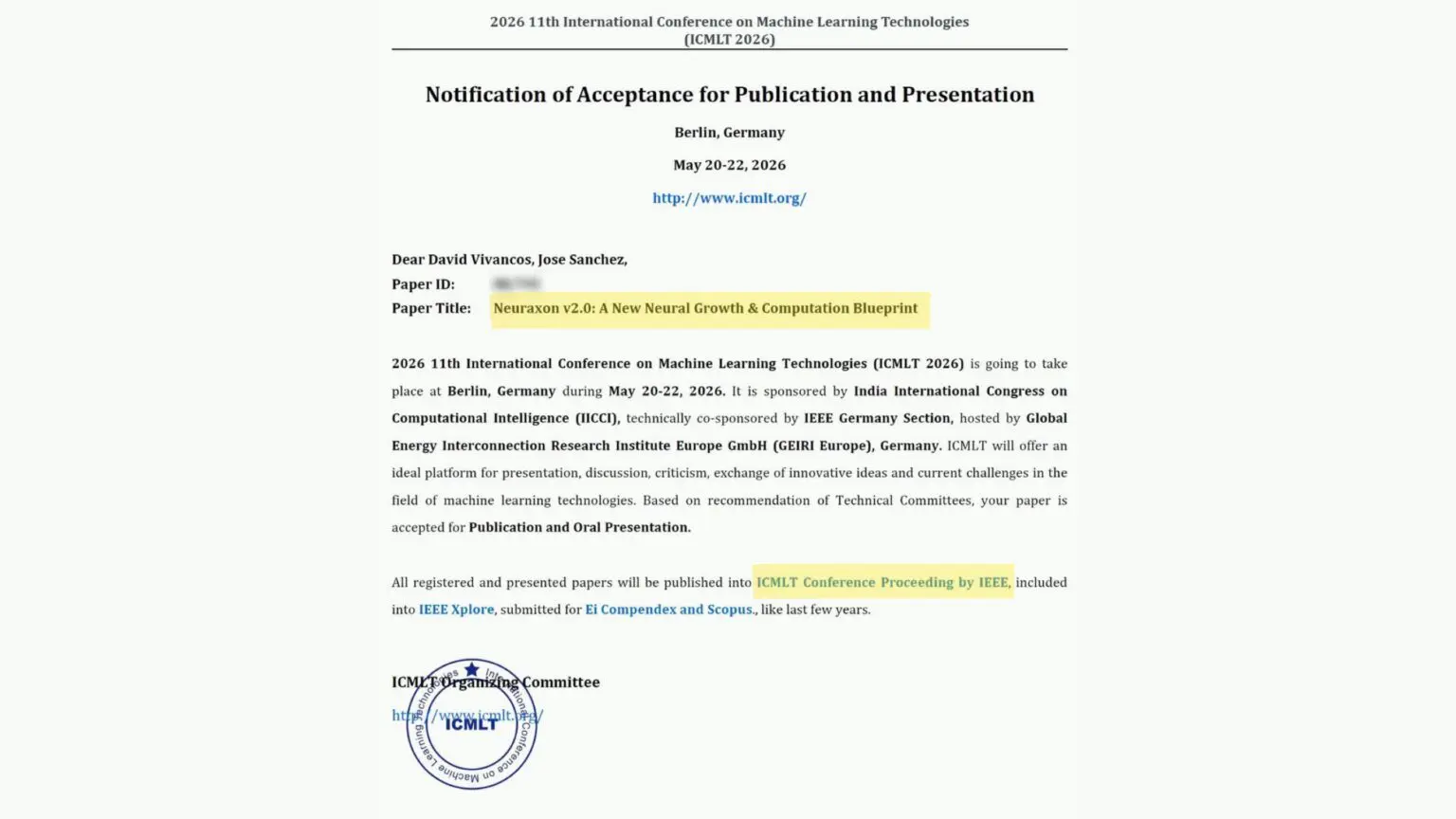
This milestone marks Qubic’s second IEEE-recognized conference acceptance. Earlier, the International Conference on Advanced Machine Learning and Data Science accepted the team’s previous work, with the event scheduled for July 2026 in Osaka.
The research centers on Neuraxon, Qubic’s experimental AI framework designed to evolve continuously through decentralized computing resources.
For the crypto-AI sector, peer-reviewed research provides credibility that goes beyond marketing claims. Academic validation can help bridge the gap between blockchain experimentation and mainstream scientific recognition.
Qubic’s model also introduces a different computing philosophy. Instead of traditional mining, its network uses “useful proof-of-work,” where computing power contributes to AI model training.
The Neuraxon architecture uses trinary logic states of +1, 0, and −1 to mimic biological neural systems. Developers argue this design improves stability and learning efficiency in continuous-time neural networks.
If the approach proves scalable, decentralized AI training networks could compete with centralized infrastructure controlled by large technology companies.
Qubic launched in 2024 as a blockchain platform focused on decentralized AI research. Its roadmap includes experiments in robotics, autonomous agents, and continuously evolving neural systems.
The network recently demonstrated a prototype system called NeuraxonMini, which applies the architecture to robotic decision-making without scripted instructions.
Several upcoming developments are scheduled for 2026. These include a Dogecoin mining integration in April and the beta release of Network Guardians governance tools in March.
While the concept of decentralized artificial general intelligence remains early-stage, the acceptance of Qubic’s research by IEEE conferences signals growing academic engagement with blockchain-based AI systems.
Our Crypto Talk is committed to unbiased, transparent, and true reporting to the best of our knowledge. This news article aims to provide accurate information in a timely manner. However, we advise the readers to verify facts independently and consult a professional before making any decisions based on the content since our sources could be wrong too. Check our Terms and conditions for more info.



Qubic’s Neuraxon AI Research Accepted by IEEE Conference
Injective Bug Bounty Dispute After Security Researcher Reports $500M Vulnerability
Pharos Network Secures Investment at $1B Valuation from GCL New Energy
Aave Releases Post Mortem Of $50M Swap Loss
Qubic’s Neuraxon AI Research Accepted by IEEE Conference
Injective Bug Bounty Dispute After Security Researcher Reports $500M Vulnerability
Pharos Network Secures Investment at $1B Valuation from GCL New Energy
Aave Releases Post Mortem Of $50M Swap Loss

Qubic
$0.00