Loading Search...


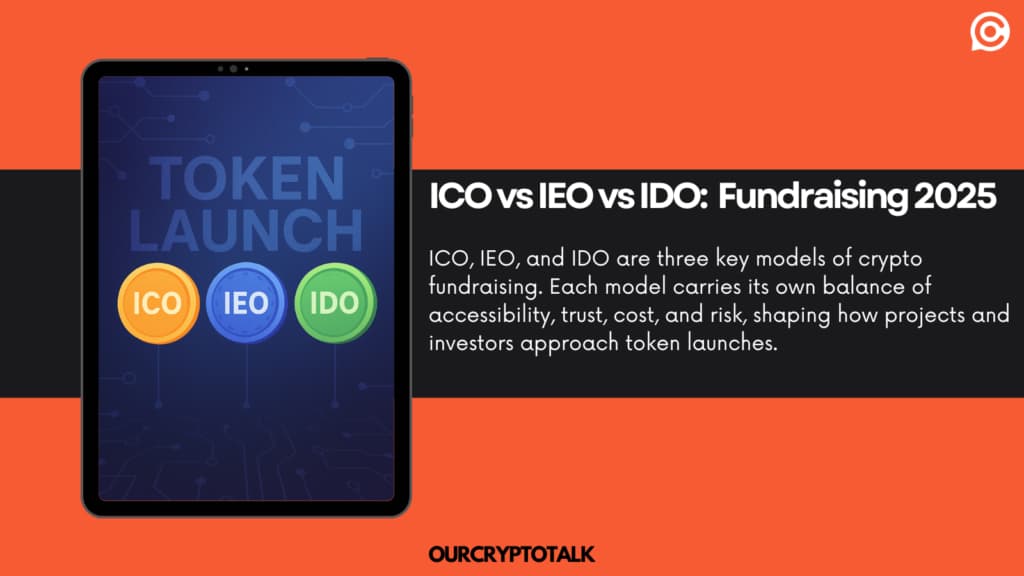
ICO vs IEO vs IDO explained: Compare platforms, risks, and opportunities for fundraising in 2025 and how projects raise funds.
 Chirag Sharma
Aug 28, 2025

Author: Chirag Sharma
Crypto fundraising has matured a lot, yet the first question for any team or investor still sounds simple. Which launch route makes the most sense right now. The answer depends on how you weigh trust, cost, speed, and audience. That is why a clear view of ICO vs IEO vs IDO is useful in 2025.
Let’s set the stage in plain language.

All three give early access to a project’s token. The similarities end there. ICOs maximize independence and global reach. IEOs import the trust and distribution of an exchange. IDOs keep everything on-chain and permissionless. In 2025, investors balance risk and access, while founders balance cost and credibility. Your choice will shape who can participate, how quickly the token trades, and how regulators look at you.
What you will get from this guide.
Keep an eye out for the keyphrase ICO vs IEO vs IDO. I will use it naturally so the piece stays SEO friendly without sounding robotic.
Understanding the timeline helps you avoid repeating old mistakes and spot the next wave earlier.
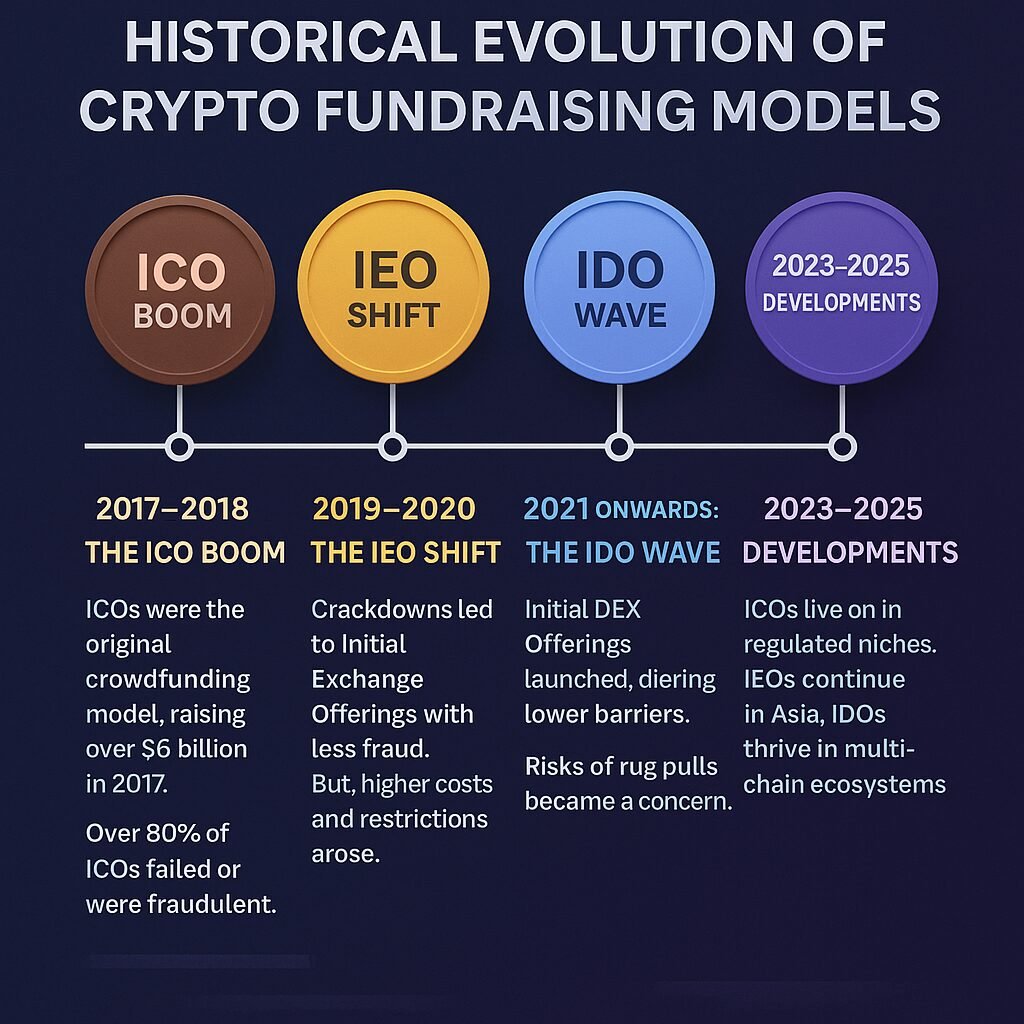
The evolution of token launch models in crypto is not a story of replacement but one of adaptation.
Each new model emerged as a response to the excesses, inefficiencies, or risks of the previous cycle, shaped by changing market conditions, regulatory pressure, and the maturity of both investors and builders.
From ICOs to IEOs to IDOs, the underlying question has always been the same:
how do you raise capital at scale while balancing access, trust, and efficiency?
To understand why these models still coexist today, it helps to look at how and why each phase unfolded.
Initial Coin Offerings took off because they dramatically lowered the barrier to fundraising.
At the time, a project did not need institutional backing, exchange relationships, or even a live product to raise capital.
A typical ICO setup included:
This structure appealed strongly to retail investors, who for the first time felt they had open access to early-stage innovation without relying on traditional venture capital or closed-door deals. The idea that anyone could participate, regardless of geography or accreditation status, aligned perfectly with crypto’s early ethos.
For teams, ICOs were even more attractive.
They retained full control over the fundraising process, avoided intermediaries, and could raise significant capital at a fraction of the cost required in traditional markets. The speed of execution was unmatched, with some projects raising millions within days or even hours.
Capital flowed aggressively.
Thousands of ICOs collectively raised billions of dollars, fueled by optimism and the belief that early participation in blockchain networks would mirror Ethereum’s earlier success.
However, the weaknesses of the model surfaced just as quickly.
Minimal oversight meant that accountability was often nonexistent.
Anonymous teams launched projects with little intention or ability to deliver.
Whitepapers were frequently recycled, roadmaps were vague, and many projects either failed quietly or disappeared entirely.
As losses mounted, investor confidence deteriorated.
By late 2018, regulators began paying closer attention, retail participants became more selective, and the market started demanding stronger signals of credibility.
The era of unchecked ICOs was coming to an end.
In the aftermath of the ICO collapse, centralized exchanges identified an opportunity to reintroduce trust into the fundraising process.
The idea behind Initial Exchange Offerings was straightforward.
If exchanges curated token sales, investors would feel safer, and projects would benefit from built-in distribution and liquidity.
Under the IEO model, exchanges imposed clearer standards.
For investors, this introduced a layer of assurance.
Participation required KYC through the exchange, which reduced bot activity and improved compliance. Importantly, tokens were listed immediately after the sale, ensuring liquidity from day one and eliminating uncertainty around future listings.
For projects, IEOs offered visibility and credibility but came with tradeoffs.
Costs increased significantly, including listing fees, revenue sharing, and the operational burden of meeting exchange requirements. Access was also restricted to users of a specific exchange, limiting participation to certain geographies and user bases.
Despite these limitations, IEOs played a critical role during this phase of the market.
They filtered out many low-quality projects, reduced obvious scams, and helped restore confidence at a time when trust in token launches was fragile.
The rise of decentralized finance fundamentally changed how token launches could be executed.
With the growth of automated market makers and decentralized exchanges, teams no longer needed centralized platforms to bootstrap liquidity or price discovery. This paved the way for Initial DEX Offerings.
Under the IDO model, projects could:
Permissionless access returned to the forefront.
Participation required only a wallet, removing centralized gatekeepers and aligning closely with crypto’s decentralized philosophy.
Liquidity was immediate, with trading enabled from the moment the pool went live. Communities could organize allowlists, fair launches, or tiered participation models depending on their goals.
However, risk did not disappear.
It shifted on-chain.
Smart contract vulnerabilities, liquidity manipulation, extreme volatility at launch, and MEV-related issues became common challenges, especially in the early days of IDOs.
Despite these risks, the model gained traction rapidly.
As multi-chain ecosystems matured and tooling improved, audits became more reliable, vesting mechanisms more transparent, and liquidity management more structured. IDOs proved especially effective for DeFi-native projects, gaming ecosystems, and community-driven launches that valued flexibility and global reach.
Today, the market is more balanced and pragmatic.
There is no single dominant launch model.
Instead, ICOs, IEOs, and IDOs coexist, each serving specific needs.
ICOs continue to exist in niche scenarios where teams prioritize full control and are prepared to operate within strict legal frameworks.
IEOs remain relevant in regions and segments where centralized compliance, consumer protection, and exchange-backed credibility are valued.
IDOs dominate the long tail of crypto innovation, particularly in DeFi, gaming, and community-first projects, due to their adaptability and compatibility with a multi-chain environment.
This context is why the comparison between ICOs, IEOs, and IDOs still matters.
The models did not replace one another.
They evolved to serve different tradeoffs between access, trust, and efficiency.
Understanding why a project chooses a particular launch model often reveals more about its priorities and long-term strategy than any marketing narrative ever could.
The best way to understand the differences is by looking at the mechanics.
Here’s a direct comparison:
Key Insights:
When people search for ICO vs IEO vs IDO, they often want a quick pros and cons list. But the real story is that each model looks different depending on whether you are an investor or a project founder. Let’s break it down from both sides.
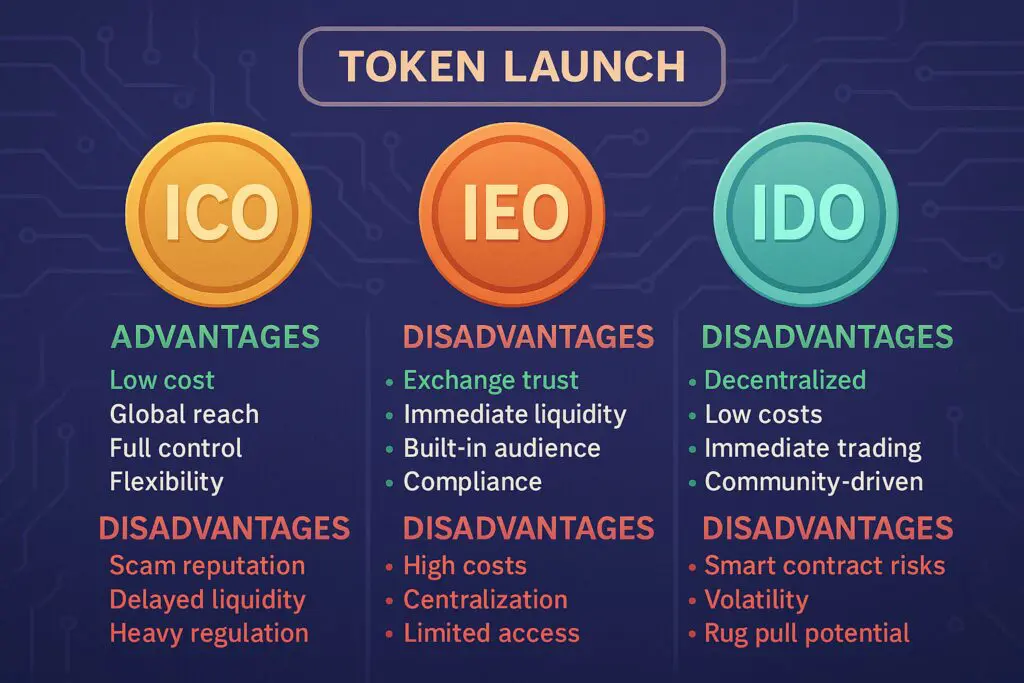
Quick Takeaway:
Investors who prioritize trust like IEOs, while risk-tolerant traders enjoy IDOs.
Founders with limited budgets lean toward ICOs or IDOs.
Founders chasing mainstream investors or large raises prefer IEOs.
Fundraising in crypto no longer lives in a vacuum. Governments, exchanges, and regulators are shaping the rules. Understanding how ICO vs IEO vs IDO fits into this legal patchwork is crucial.
ICOs carry the most regulatory baggage.
Result: ICOs are no longer the default choice. They survive in niches where teams want complete independence but are prepared to meet legal costs.
IEOs enjoy more regulatory protection because exchanges carry the compliance burden.
Result: IEOs are the most compliance-friendly option in 2025, though high fees remain the trade-off.
Decentralized exchanges are borderless, making IDOs tricky for regulators.
Result: IDOs thrive in the DeFi culture but could face more scrutiny in the next few years, especially as regulators push for on-chain identity solutions.
Bottom Line:
Regulation makes IEOs the safest option for compliance. ICOs carry the highest risk, and IDOs live in a grey zone. Investors should always ask how a project fits local laws before participating.
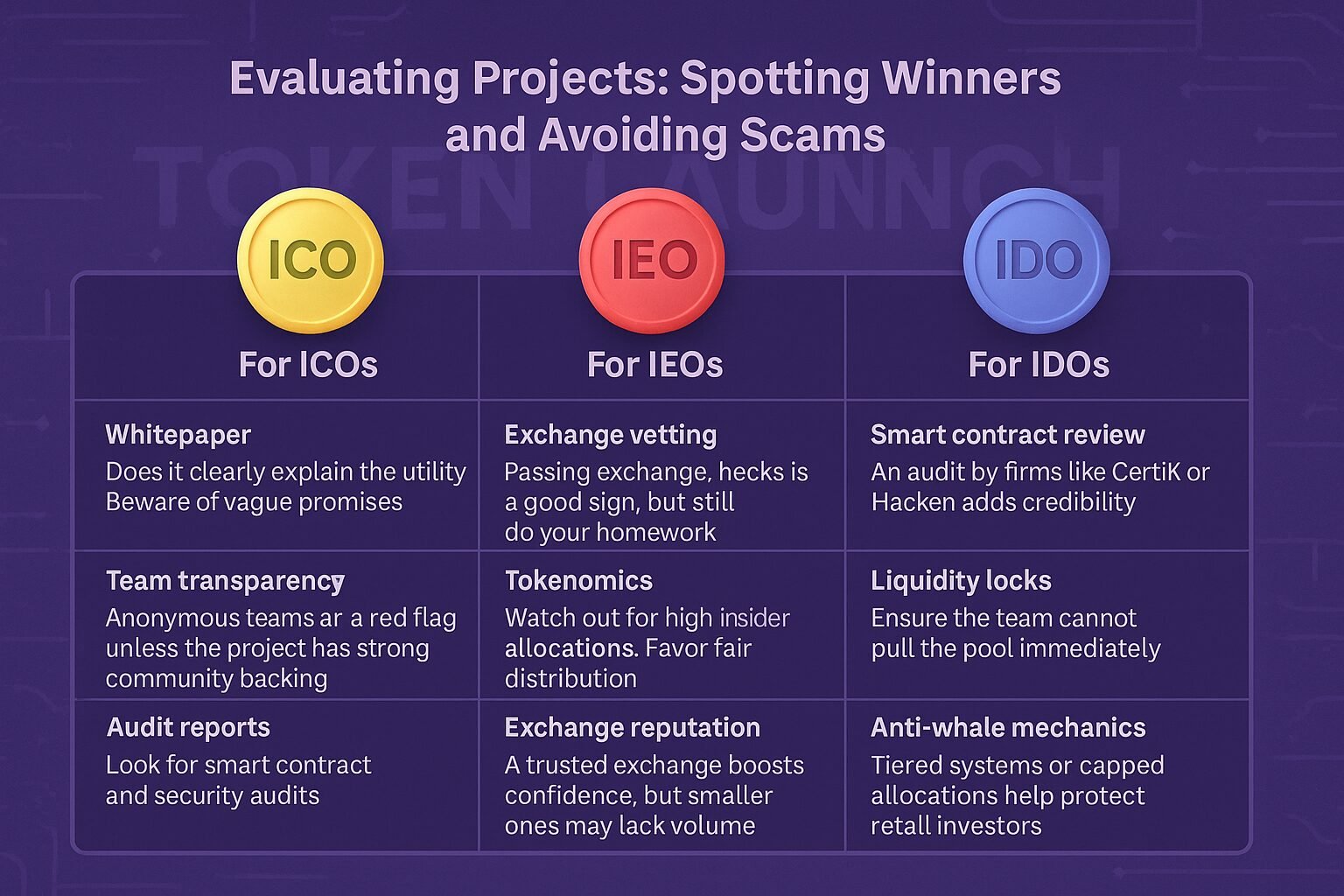
No matter which model a project uses, success depends on execution. Investors often lose money not because of the model but because they didn’t evaluate carefully. Here’s how to break it down for ICO vs IEO vs IDO.
When viewed over a longer time horizon, the discussion around ICOs, IEOs, and IDOs is not static. Token fundraising models have always evolved alongside market cycles, technological progress, and regulatory clarity. What worked in one phase often became inefficient or risky in the next, forcing both builders and investors to adapt.
The 2024–2025 period reflects this maturation clearly. Rather than introducing an entirely new launch model, the industry is refining existing structures, combining them with better tooling, and aligning them more closely with real demand. Several trends stand out as particularly influential in shaping how token launches are conducted today.
In earlier cycles, most projects chose a single blockchain to launch their token. This decision often dictated the project’s entire early trajectory, including liquidity depth, user demographics, and ecosystem partnerships. However, as the market has become increasingly multi-chain, this approach has started to feel restrictive.
In 2024 and 2025, multi-chain IDOs have become the default rather than the exception.
Projects now routinely launch across multiple networks simultaneously, using established launchpads to coordinate fundraising and distribution. Platforms such as Polkastarter, Spores Network, and TrustSwap enable teams to raise capital across Ethereum, BNB Chain, Solana, and newer Layer 1 ecosystems in parallel.
This shift serves several strategic purposes:
For investors, multi-chain IDOs also provide flexibility, as participation is no longer gated by holding assets on a specific blockchain. This model aligns well with a market where users are already active across several ecosystems rather than loyal to just one.
Artificial intelligence has emerged as the defining narrative of 2025, and token launches reflect this clearly. Capital is flowing aggressively into projects that combine blockchain infrastructure with AI-driven products and services.
Rather than abstract promises, recent AI-focused launches tend to emphasize tangible use cases, including:
This narrative has proven particularly effective in IDO environments, where early-stage innovation and community engagement matter more than traditional valuation models.
A notable example is HAiO, which raised approximately $100,000 in July 2025 through an IDO on Spores Network. The project focuses on AI-generated music combined with NFT-based licensing, illustrating how AI narratives are increasingly intersecting with creator economies and intellectual property management.
The broader takeaway is that AI tokens are no longer speculative placeholders. They are increasingly tied to products that users can test, interact with, and evaluate shortly after launch.
Tokenization of real-world assets has moved beyond theoretical discussions and pilot experiments. In 2024 and 2025, RWA-focused projects have shown consistent fundraising traction, particularly through curated launchpads and compliant sale structures.
Projects are now actively tokenizing assets such as:
These launches appeal to a broader investor base. Crypto-native participants are attracted by yield and diversification, while institutions are increasingly comfortable engaging with tokenized assets that mirror familiar financial products.
Launchpads that specialize in RWA offerings have gained visibility because they emphasize transparency, compliance, and predictable cash flows. In contrast to earlier cycles, RWA tokens are being positioned less as speculative bets and more as infrastructure for long-term capital markets integration.
One of the strongest behavioral shifts in recent token launches has come from retail investors themselves. After repeated cycles where early insiders and whales captured disproportionate upside, demand for fairer distribution models has grown significantly.
As a result, modern IDOs increasingly implement mechanisms designed to reduce concentration risk:
These structures are not perfect, but they represent a clear attempt to balance open access with sustainable token distribution. Projects that ignore these expectations often face immediate backlash from communities that have become far more educated and vocal than in earlier cycles.
Another notable trend in 2024–2025 is the rise of hybrid launch models that blend elements of ICOs, IEOs, and IDOs. Some projects conduct private or compliant sales for institutional participants, followed by public IDOs for community distribution. Others launch via IDOs first and later pursue centralized exchange listings for broader liquidity.
Regulatory awareness plays a larger role in these decisions. Teams are more deliberate about jurisdictional exposure, KYC requirements, and disclosure standards, particularly when targeting long-term adoption rather than short-term hype.
The current phase of token launches reflects a more mature and pragmatic industry. Rather than chasing novelty, projects are optimizing for reach, resilience, and credibility. Multi-chain distribution, AI-driven utility, real-world asset integration, and fairer allocation models all point toward a market that has learned from previous excesses.
The evolution from ICOs to IEOs to IDOs is no longer about replacing models. It is about choosing the right combination of tools to match a project’s goals, audience, and regulatory reality.
And in that sense, the fundraising story in 2024–2025 is less about experimentation and more about refinement.
The flip side of AI hype is AI-assisted scams. Deepfake founders, auto-generated whitepapers, and AI-based rug pulls emerged in 2024. Investors must stay sharp.
It’s tempting to think ICOs, IEOs, and IDOs tell the whole story. But innovation never stops. The next two to three years will likely bring hybrid approaches that blend the best of each model.
Imagine this flow:
This hybrid balances trust and access. Several pilot projects in late 2025 are already testing this format.
Security Token Offerings (STOs) have been around since 2018, but adoption lagged. With MiCA in Europe and friendlier US regulations in 2025, STOs may see a revival. They suit tokenized equity, debt, and RWAs where legal backing matters.
Expect IDOs to integrate optional compliance layers. Tools like on-chain KYC NFTs or zk-proof identity checks could let projects remain decentralized while keeping regulators satisfied.
Future projects won’t just be “AI tokens.” They’ll embed AI into fundraising itself. For example:
Bottom Line: The battle isn’t ICO vs IEO vs IDO anymore. It’s about how these models blend and adapt to technology and regulation.