Loading Search...


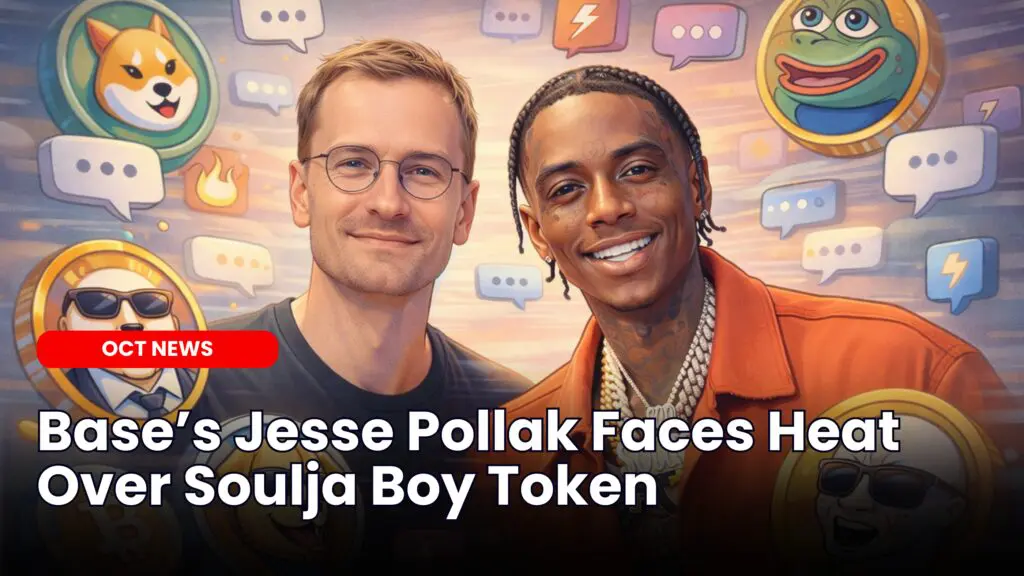
Jesse Pollak, is facing growing backlash after he publicly revealed a $1,500 investment in a new memecoin tied to rapper Soulja Boy.

Author: Sahil Thakur
17th December 2025 – Jesse Pollak, the co-founder of Coinbase’s Layer 2 network Base, is facing growing backlash after he publicly revealed a $1,500 investment in a new memecoin tied to rapper Soulja Boy. The token, which launched on the Base network, quickly attracted attention and controversy due to Soulja Boy’s history of promoting failed and fraudulent crypto projects.
Pollak framed his investment as a way to showcase Base’s creator monetization tools. He shared his purchase on X (formerly Twitter), stating it demonstrated how artists could instantly earn using on-chain platforms. He also highlighted Soulja Boy’s comparison of Base with platforms like TikTok and Instagram, suggesting Base provided faster and more transparent payouts.
However, this move did not sit well with much of the crypto community.
Soon after Pollak’s announcement, prominent blockchain investigator ZachXBT stepped in. He resurfaced his detailed April 2023 report that linked Soulja Boy to a long list of scams, including rug pulls and undisclosed paid promotions. ZachXBT questioned why someone with such a reputation was being promoted by a high-profile figure like Pollak.
According to the research, Soulja Boy had promoted at least 73 tokens and launched 16 NFT collections between 2021 and 2023. Many of those tokens were eventually abandoned or crashed in value. Projects like RapDoge, Flokinomics, The Life Token, and SafeMars all featured in his promotional posts, many of which were paid.
Leaked documents indicated that Soulja Boy charged up to $12,000 per Instagram post and $10,000 per X promotion. ZachXBT estimated the rapper earned more than $730,000 from crypto promotions during the last bull run alone.
Soulja Boy, whose real name is DeAndre Cortez Way, has built a notorious track record in the crypto world. During the 2021 hype cycle, he became one of the most active celebrities in promoting NFT drops and obscure tokens. However, many of these projects either failed to deliver on promises or disappeared altogether, leaving investors with losses.
Some of the NFT collections he promoted were later removed from OpenSea, while others failed to launch entirely. Several of the tokens he supported turned out to be short-lived schemes that spiked in value briefly before crashing.
In some cases, Soulja Boy faced regulatory scrutiny. He was among a group of celebrities charged by the U.S. SEC in 2023 for failing to disclose compensation related to crypto promotions. Critics often pointed to his campaigns as examples of how celebrity influence can be exploited to deceive retail investors.
In response to the renewed criticism, Soulja Boy issued a public apology. He said he was unaware that one of the handlers who paid him to promote past projects had ties to scams. Also admitted to lacking crypto knowledge at the time and said he relied on third parties to manage promotions.
He also stated that he has since educated himself and now approaches crypto opportunities with greater caution. “At the time, I was doing paid promos without understanding the crypto space the way I do now,” he wrote on X.
Despite Soulja Boy’s apology, the community reaction to Pollak’s endorsement remained largely negative. Many users criticized the Base co-founder for giving credibility to a celebrity with such a controversial track record. Some even called it a betrayal of Base’s builder-first philosophy.
Others warned that such stunts harm long-term trust in the Base ecosystem, especially at a time when Coinbase is trying to bring Web3 to a mainstream audience. Several users said that promoting meme tokens with a history of scams damages the credibility of the platform and diverts attention from more meaningful projects.
Pollak defended his actions by saying he wanted to normalize on-chain content monetization. However, the response to his explanation was mostly dismissive.
This incident adds to the broader debate around celebrity memecoins and the risks they pose. Over the years, most celebrity-backed tokens have lost nearly all their value. Often, insiders profit while retail users get left holding the bag.
While no regulatory action has been reported yet, the incident has sparked renewed scrutiny around how crypto platforms engage with influencers. It also highlights the ongoing tension between community trust and hype-driven marketing tactics.
Our Crypto Talk is committed to unbiased, transparent, and true reporting to the best of our knowledge. This news article aims to provide accurate information in a timely manner. However, we advise the readers to verify facts independently and consult a professional before making any decisions based on the content since our sources could be wrong too. Check our Terms and conditions for more info.