Loading Search...


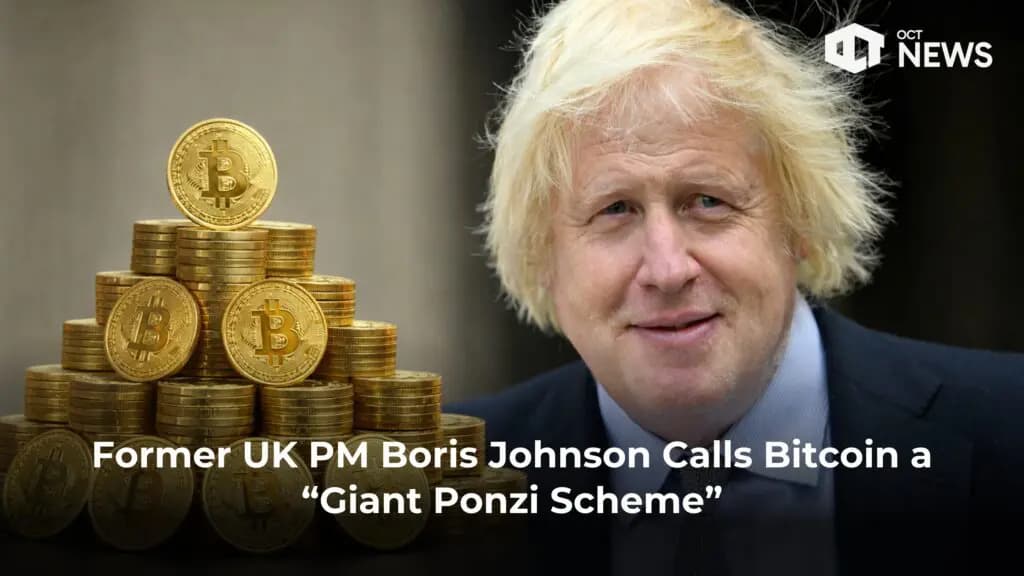
Former UK Prime Minister Boris Johnson has publicly criticized Bitcoin, calling it a “giant Ponzi scheme” in a new opinion column.

Author: Sahil Thakur
14th March 2026 – Former UK Prime Minister Boris Johnson has publicly criticized Bitcoin, calling it a “giant Ponzi scheme” in a new opinion column.
Johnson published the column on March 13, 2026. The article appeared in the Daily Mail and quickly spread across social media after he shared the headline on X. His post attracted millions of views and triggered a wave of reactions from both critics and supporters of cryptocurrency.
In the post, Johnson wrote that he had long suspected Bitcoin was a Ponzi scheme. He also said recent stories about people losing money in crypto made him more convinced that the industry relies on new investors to keep prices rising.
High Signal Summary For A Quick Glance

CJK
@CJKonstantinos

@BorisJohnson If you're a UK bitcoiner and wondering why Americans can get Bitcoin Powered Mortgages And be debt free in less than a decade, when you slave for 30+ Well, its your leaders & laws.
I've long suspected Bitcoin is a giant Ponzi scheme and now I'm hearing tales of woe that make me fear I'm right. https://t.co/rTny2NBaYB
10:46 PM·Mar 13, 2026

WIZZ🥷 ( beware scammers )
@CryptoWizardd
@BorisJohnson When is the next covid lockdown party at your house?
I've long suspected Bitcoin is a giant Ponzi scheme and now I'm hearing tales of woe that make me fear I'm right. https://t.co/rTny2NBaYB
08:58 PM·Mar 13, 2026

All Thyme High
@all_thyme_high
@BorisJohnson Fiat money is a scam, when the government doesn’t have enough it just prints more. You literally cannot just “print” Bitcoin. I expected more from someone I considered relatively bright.
I've long suspected Bitcoin is a giant Ponzi scheme and now I'm hearing tales of woe that make me fear I'm right. https://t.co/rTny2NBaYB
06:23 PM·Mar 13, 2026
Steady attention without excessive speculation.
Johnson opened the column with a personal story from his village in Oxfordshire. According to him, a local resident approached him for help after losing money in Bitcoin.
The man, described as a former businessman and churchgoer, said he invested £500 after meeting someone in a pub who promised the money would double quickly. Instead, the investment became increasingly complicated.
Over the next three and a half years, the man paid repeated fees to try to recover his funds. However, the money never returned. By the end of the process, Johnson wrote that the man had lost about £20,000 and was struggling with everyday expenses.
Johnson also claimed that other people in the village experienced similar problems. Despite the losses, he said the man still seemed tempted to invest more in hopes of recovering the money.
Johnson then shifted to a broader critique of Bitcoin itself. He argued that the asset lacks intrinsic value and depends mainly on collective belief.
He described Bitcoin as nothing more than a string of numbers stored across computers. Because the system is decentralized, he said there is no authority responsible for managing it or protecting investors.
Johnson argued that traditional money derives trust from governments or institutions. He used examples such as Roman coins and modern currencies, which rely on state backing and public authority.
In contrast, he said cryptocurrencies operate without clear accountability. As a result, he argued that investors have no one to blame if prices collapse or if funds disappear.
Johnson also compared Bitcoin to assets like gold or even collectibles such as Pokémon cards. According to him, those items have cultural or physical appeal that people recognize easily, while Bitcoin does not.
Johnson concluded that stories of people losing money in crypto will eventually erode public confidence.
He argued that when ordinary investors, especially older individuals, lose savings through crypto-related scams or failed investments, the reputation of the entire industry will suffer.
In his view, this process could eventually lead to widespread disillusionment with cryptocurrencies.
Bitcoin advocates quickly pushed back against Johnson’s claims.
Michael Saylor responded directly on X. He argued that Bitcoin cannot be a Ponzi scheme because it lacks a central operator who promises returns. In a traditional Ponzi scheme, a single entity collects money from investors and pays earlier participants using funds from new ones.
Saylor said Bitcoin operates differently. The network is decentralized, open source, and governed by transparent rules that anyone can verify. There is no issuer, promoter, or central authority controlling payouts.
Many members of the crypto community echoed similar arguments. They pointed out that the scams Johnson described often involve fraudulent intermediaries or phishing schemes rather than the Bitcoin protocol itself.
Johnson’s comments revived a long-running debate about the nature of cryptocurrencies.
Critics often argue that Bitcoin lacks intrinsic value and depends heavily on speculation. Supporters counter that decentralization, transparency, and fixed supply distinguish it from fraudulent schemes.
The exchange between Johnson and prominent crypto figures quickly spread across the industry, with analysts noting the irony that the UK government explored crypto-friendly policies during Johnson’s time as Prime Minister.
Our Crypto Talk is committed to unbiased, transparent, and true reporting to the best of our knowledge. This news article aims to provide accurate information in a timely manner. However, we advise the readers to verify facts independently and consult a professional before making any decisions based on the content since our sources could be wrong too. Check our Terms and conditions for more info.



Dubai Token2049 Cancelled Amid Middle East Geopolitical Conditions
Across Protocol Plans Potential Move from DAO to U.S. C-corp Structure
Former UK PM Boris Johnson Calls Bitcoin a “Giant Ponzi Scheme”
Quant CEO Announces ISO’s First Global Blockchain Interoperability Standard
Dubai Token2049 Cancelled Amid Middle East Geopolitical Conditions
Across Protocol Plans Potential Move from DAO to U.S. C-corp Structure
Former UK PM Boris Johnson Calls Bitcoin a “Giant Ponzi Scheme”
Quant CEO Announces ISO’s First Global Blockchain Interoperability Standard