Loading Search...


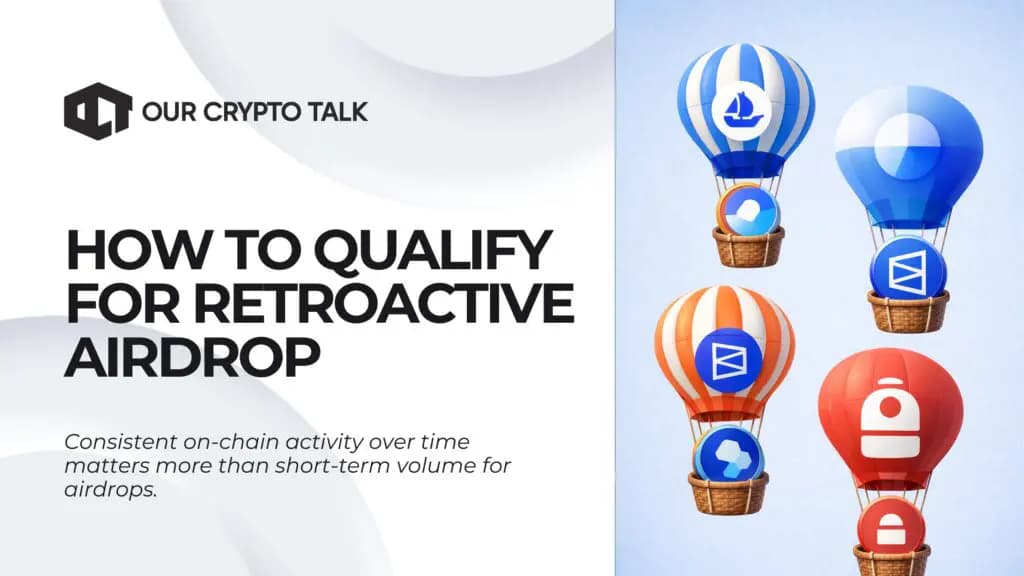
Learn how to qualify for retroactive airdrops in 2026. This strategy guide covers time-weighted activity models, Sybil risks, and top protocol targets to watch.

Author: Kritika Gupta
Many crypto users still remember the frustration of watching the Uniswap airdrop unfold while realizing they had missed it by simply not using the protocol early. That regret has since turned into a powerful lesson across Web3: meaningful rewards often go to those who participate before incentives become obvious. Today, retroactive airdrops are no longer viewed as lucky surprises. Instead, they are increasingly seen as strategic outcomes for users who position themselves early.
This guide exists because the rules of airdrop qualification have changed. The early playbook from 2021 and 2022 focused on quick transactional activity such as bridging small amounts, executing a few swaps, and exiting. At the time, that approach worked because protocols prioritized growth metrics and raw transaction counts. However, it no longer reflects how modern qualification frameworks operate.
In 2026, most major protocols use time-weighted activity models. They evaluate how consistently a wallet interacts with an ecosystem over weeks and months instead of focusing only on short-term volume. The regular engagement across different applications signals genuine product usage. This factor has become central to many retroactive scoring systems.
At the same time, Sybil detection has become far more sophisticated. Protocol teams now analyze funding sources, behavioral clustering, automation signatures, and transaction timing patterns. Also, thousands of wallets can be excluded from distributions if activity appears scripted or opportunistic.
Readers already understand that airdrops exist. What they need instead is a clear and practical framework for positioning today. Specifically, they want to know which protocols show strong distribution potential, what on-chain behaviors matter most, and how to build consistent participation that aligns with modern qualification models. This guide addresses that new reality.
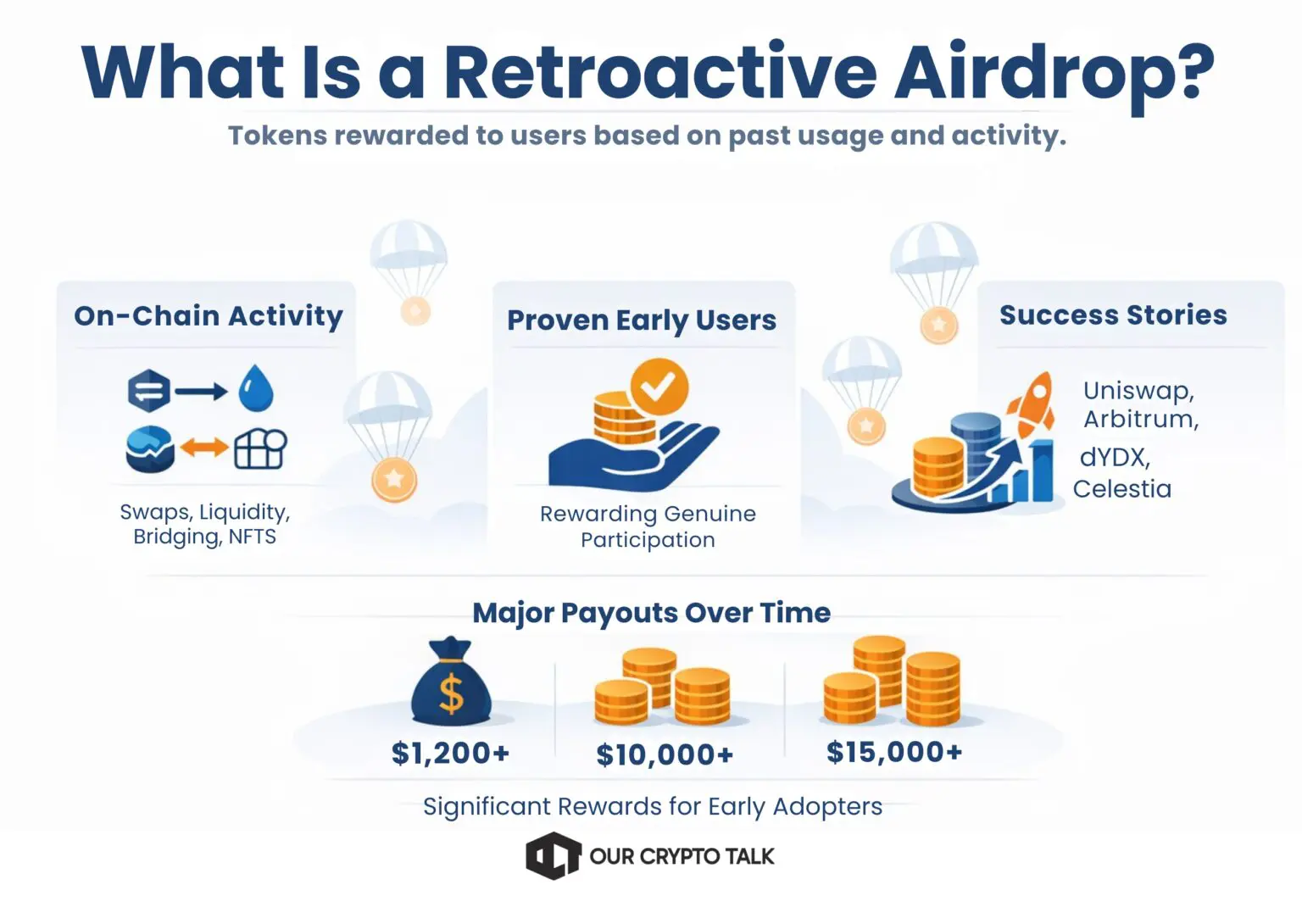
A retroactive airdrop occurs when a crypto protocol distributes tokens to users after they have already used the product. Typically, teams reward past on-chain activity such as swaps, liquidity provision, bridging, governance participation, or NFT interactions. Instead of promising incentives upfront, protocols look back at historical usage and allocate tokens to genuine early adopters.
Uniswap established this model in September 2020 when it distributed 400 UNI tokens to every wallet that had interacted with the platform. At claim time, this allocation was worth roughly $1,200 to $1,400. As a result, the event proved that simply using emerging DeFi products early could generate meaningful financial rewards. Since then, several major retroactive airdrops have reinforced the trend.
For example, Arbitrum’s March 2023 distribution delivered roughly $1,500 to more than $10,000 per wallet depending on bridge volume and ecosystem activity. Similarly, dYdX rewarded active perpetual traders with thousands of dollars in DYDX tokens in 2021. Later, Celestia’s October 2023 drop gave rollup and data-availability users allocations often worth $2,000 to $15,000.
Because of these outcomes, users now treat early participation as strategic positioning rather than casual experimentation. In other words, the next major airdrops are already being earned by users who know where to engage.
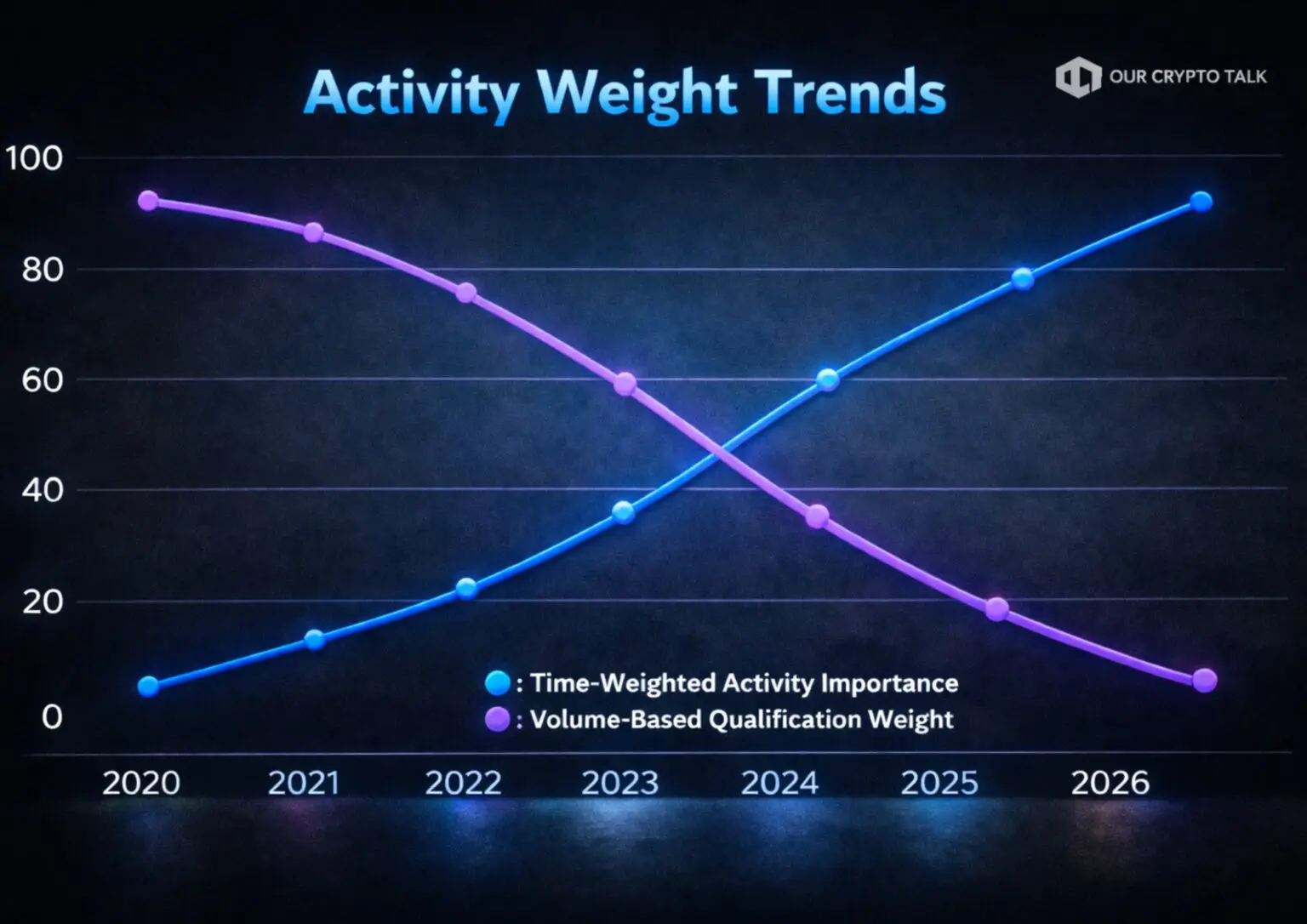
The biggest shift in airdrop qualification since the early DeFi cycle involves the move from volume-based activity to time-weighted participation. Older guides from 2022 to 2024 still recommend simple farming tactics such as bridging a small amount, executing a few swaps, and exiting. At the time, this reflected how protocols evaluated users between 2020 and 2023 when raw transaction count and capital flow acted as primary growth signals.
Under the old system, users could interact intensively over a short period and still qualify for meaningful allocations. A common playbook involved bridging $100 to a new network, performing several token swaps, adding liquidity once, and then withdrawing funds. The qualification often depended on activity bursts instead of sustained engagement.
From 2024 onward, protocols began implementing time-weighted scoring models. These frameworks reward wallets that demonstrate consistent usage patterns across several months. For instance, a user who interacts with a protocol once or twice per month for eight months will usually rank higher than someone who performs fifty transactions in a single day. This happens because real users return gradually, explore features, and engage as ecosystems evolve.
This shift occurred because Sybil farming made volume-based qualification unreliable. Attackers began automating thousands of wallets to simulate organic activity and extract token allocations. High-profile cases involving projects such as LayerZero and zkSync showed that short-term volume spikes could be manufactured at scale.
The practical takeaway for any retroactive airdrop strategy in 2026 is straightforward. Consistency matters more than size. Small and varied interactions repeated over time create stronger qualification signals than one large farming session. Users who start building routines today align naturally with modern evaluation frameworks.
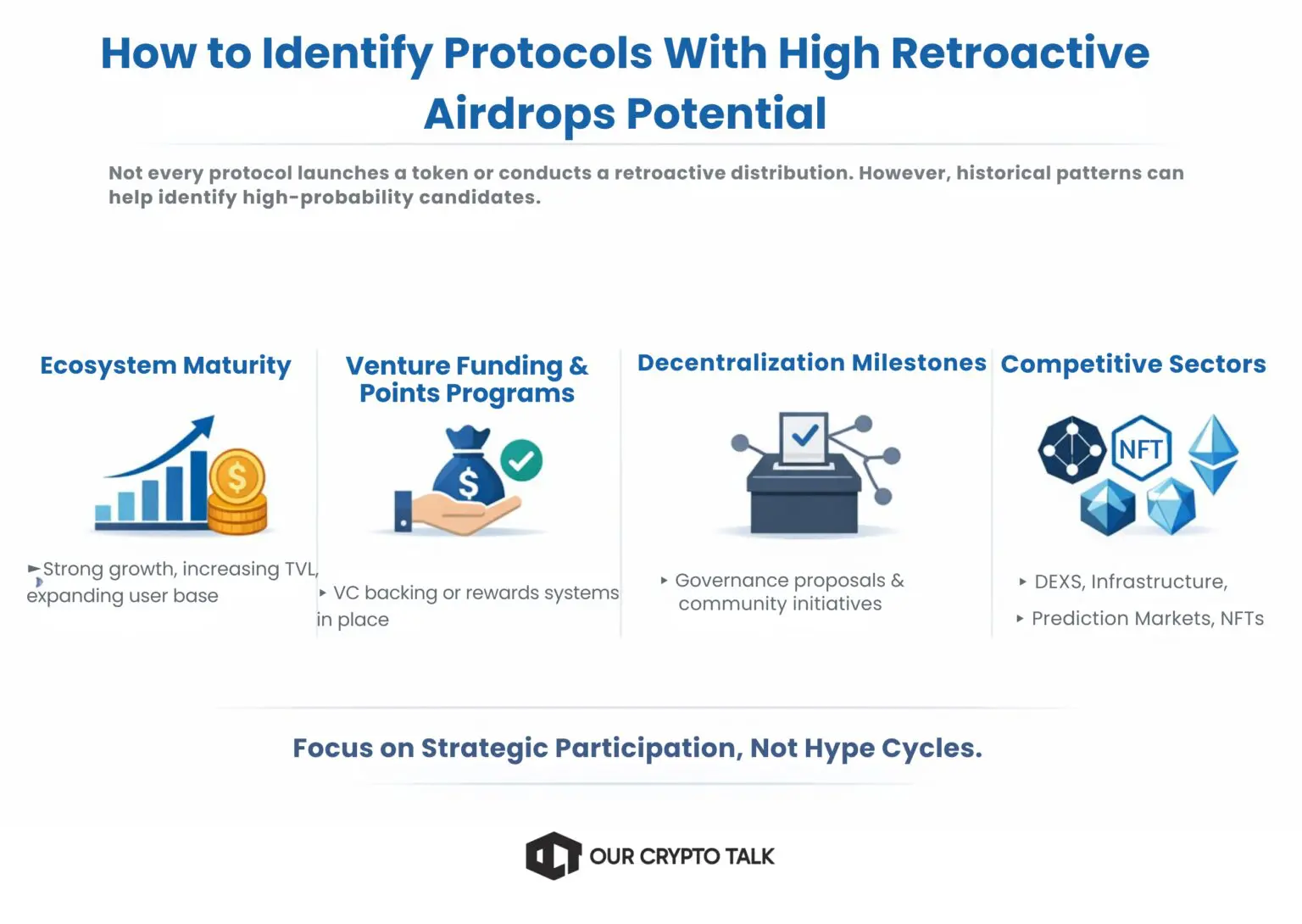
Not every protocol launches a token or conducts a retroactive distribution. However, historical patterns can help identify high-probability candidates.
Protocols that reward early users often reach product-market fit before tokenization. For instance, strong transaction growth, rising total value locked, and expanding user bases indicate ecosystem maturity without incentives.
Many potential candidates also receive venture funding or ecosystem grants. Because of this support, teams can delay token launches while focusing on adoption. Similarly, points programs or informal reward structures may signal preparation for future distributions.
Decentralization milestones provide additional clues. Governance proposals, community voting systems, and ecosystem expansion initiatives frequently precede token releases.
Furthermore, competitive sectors such as decentralized exchanges, infrastructure layers, prediction markets, and NFT platforms historically show higher distribution likelihood. Tokens in these sectors often strengthen network effects and user retention.
By monitoring these indicators, users can focus on strategic participation instead of reacting to hype cycles.
No airdrop is confirmed or guaranteed. Instead of assuming certainty, users should focus on protocols that match historical patterns linked to retroactive rewards. These patterns typically include strong product-market fit, real user activity, meaningful on-chain usage, and either no token or an incentive framework that still rewards early participation. To evaluate whether a protocol is worth your time, use our Farm or Pass Framework as a decision-making companion.
It remains one of the strongest names in this category, although it no longer fits the strict no-token narrative. The platform has announced the upcoming SEA token and connected engagement to its rebuilt OS2 experience and rewards program. The thesis has shifted from speculation about token launch to positioning for potential ecosystem incentives. Relevant activity includes listing NFTs, placing bids, buying assets, and using newer token-trading features consistently.
Base continues to stand out as a positioning target because the chain shows rapid growth while still lacking a native token. Since Base supports low-cost transactions and strong builder activity, users can maintain regular engagement without high expenses. Practical positioning includes bridging through official infrastructure, using native DEXs such as Aerodrome or BaseSwap, minting NFTs, and interacting with multiple applications over time.
It also presents a compelling case because it combines real product usage with mainstream attention. Although its help center states that the platform has not announced token plans, this reinforces its product-first positioning. Users seeking exposure to potential retroactive rewards should focus on genuine trading activity, diversification across event categories, and liquidity participation where relevant.
Backpack has already moved beyond speculation. Its ecosystem includes active points programs, reward campaigns, and a token generation framework that allocates supply to points participants and Mad Lads holders. The sustained exchange activity, wallet usage across supported networks, and consistent campaign participation remain key positioning behaviors.
Other ecosystems with strong usage, low fees, and meaningful interaction depth also deserve attention. Ultimately, users should prioritize protocols with real adoption and practical utility. This approach aligns positioning strategies with realistic qualification potential.
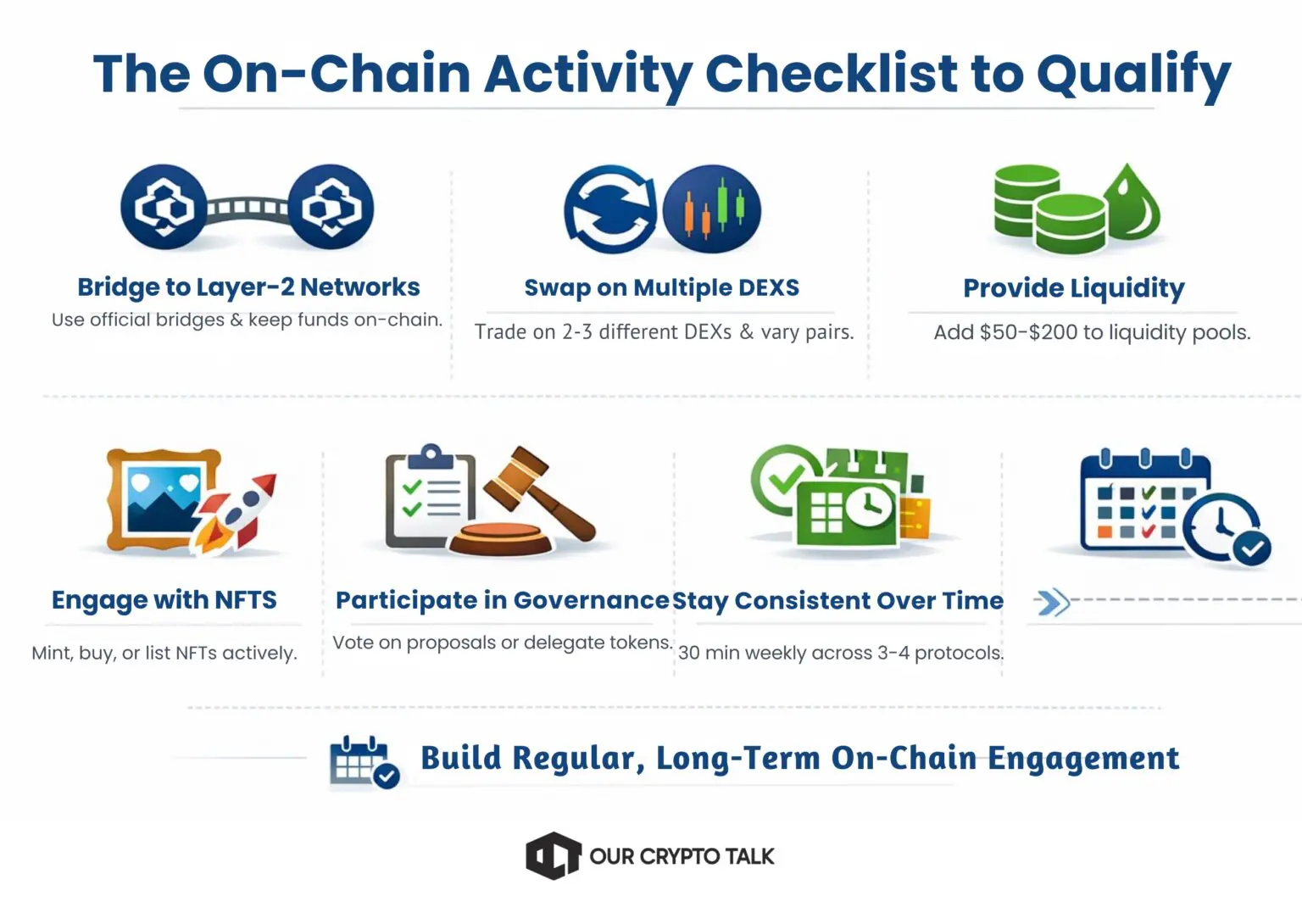
Retroactive airdrops qualification in 2026 depends less on one-time farming and more on building a repeatable and natural on-chain routine. Protocols increasingly reward wallets that demonstrate consistent engagement across multiple products and months. The users should treat this as structured DeFi participation rather than a short sprint. For pre-mainnet protocols, participating in testnets can add meaningful on-chain history to your record.
Start by bridging assets to target Layer-2 networks such as Base using official bridges. Afterward, leave funds on-chain instead of withdrawing them immediately. This signals commitment and enables deeper interaction with native applications.
Next, swap tokens on multiple decentralized exchanges within the same network. Use two or three native DEXs instead of repeating trades on a single platform. In addition, vary trade sizes, token pairs, and timing across weeks. This diversification increases contract interaction depth and reduces the appearance of scripted behavior.
Users can also provide small liquidity positions with modest allocations such as $50 to $200. Liquidity provision demonstrates longer-term engagement and often differentiates real users from short-term traders. Monitoring and rebalancing positions periodically further strengthens usage signals.
NFT interaction also helps expand ecosystem exposure. Minting, listing, buying, or transferring NFTs shows exploration beyond token swaps. Historically, many retroactive distributions rewarded wallets that interacted across multiple verticals.
When governance mechanisms exist, users should vote on proposals or delegate tokens. Governance participation reflects alignment with decentralization goals and strengthens qualification potential.
Maintaining this workflow across several months remains essential. Setting a recurring weekly reminder to interact for around 30 minutes across three or four protocols can build meaningful on-chain history while keeping costs manageable.
Retroactive qualification does not require large financial commitments. Historical distributions show that behavioral consistency often matters more than capital size.
Users with smaller budgets benefit from focusing on fewer ecosystems while maintaining regular interaction patterns. Periodic swaps and modest liquidity positions can still generate strong engagement signals.
Meanwhile, higher-capital participants can diversify across multiple networks, explore derivatives platforms, or engage in governance initiatives that require deeper token exposure. However, sustainable participation always matters more than aggressive deployment. Overextending capital for uncertain rewards increases financial risk without guaranteeing better qualification outcomes.
Modern retroactive airdrops no longer reward wallets based purely on activity volume. Instead, protocol teams run advanced on-chain analysis to identify Sybil farming patterns. Understanding disqualification triggers remains essential for anyone trying to qualify safely.
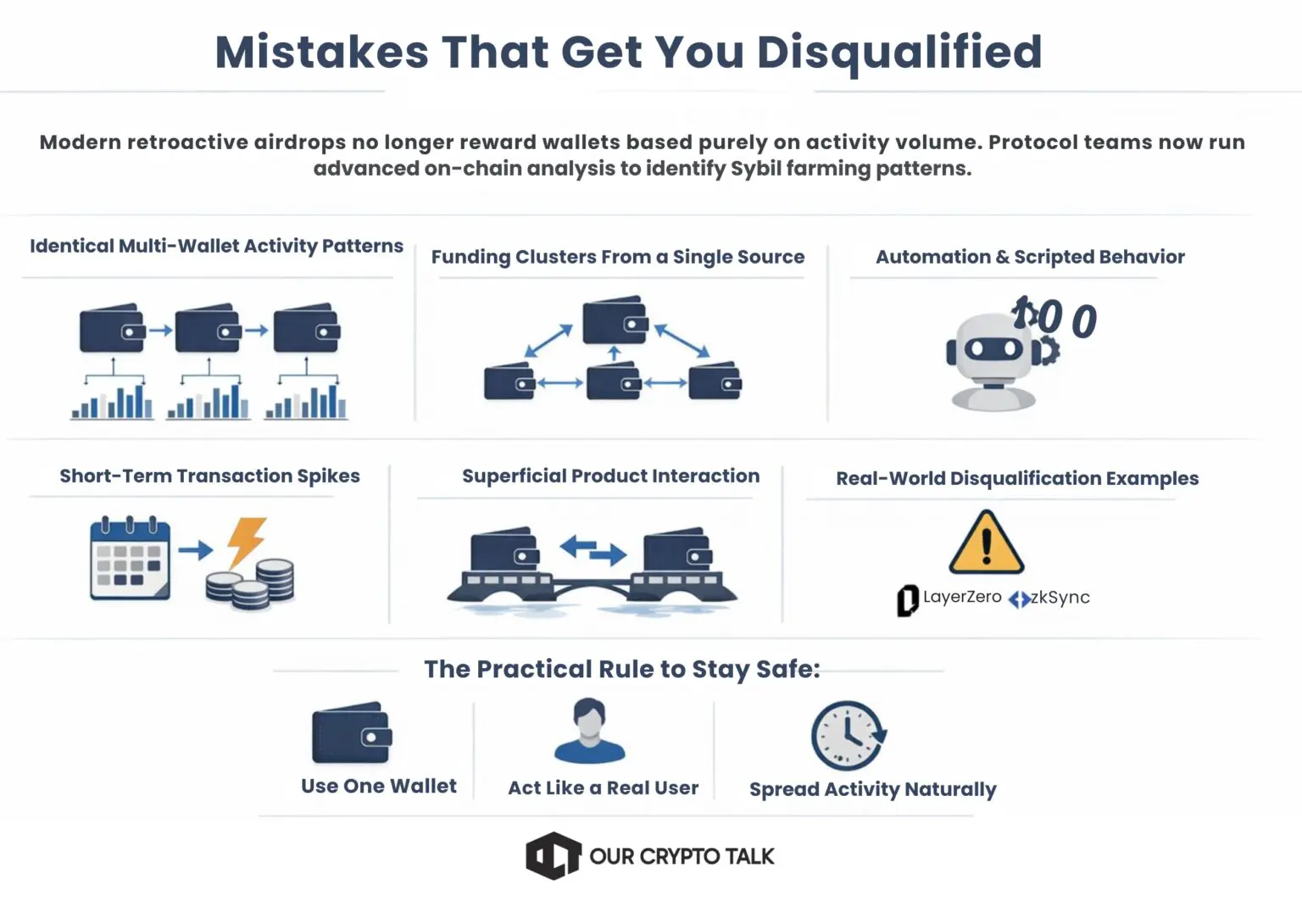
The most common trigger involves running multiple wallets with identical activity patterns. When several addresses perform the same swaps, interact with the same protocols in the same order, and use nearly identical transaction amounts within short time windows, clustering algorithms flag them as linked wallets. As a result, this remains one of the strongest Sybil signals in recent distributions.
Another major thing comes from funding multiple wallets from a single source. If ten or more wallets receive ETH or stablecoins from one originating address and then begin interacting with the same ecosystem, analysts often group them into farming clusters. Consequently, transaction lineage analysis makes it difficult to isolate these wallets later.
Protocols also flag wallets that rely on scripted automation or known Sybil tools. For example, batch transactions, perfectly optimized gas usage, rigid interaction sequences, and mechanical timing patterns differ from natural user behavior. Therefore, forensic teams increasingly use behavioral fingerprinting to detect such activity.
Short-term activity spikes can also reduce eligibility. Performing dozens or hundreds of transactions in one day followed by long inactivity resembles farming rather than genuine exploration. In contrast, real users interact gradually as they test features, manage liquidity, or discover new applications over time.
Finally, never using the actual product creates another red flag. Bridging assets into a network and immediately bridging them back without meaningful interaction signals superficial engagement. Protocols increasingly prioritize depth of usage over simple contract touches.
Recent examples highlight the stakes. LayerZero flagged roughly 800,000 wallets as potential Sybils during its qualification process. Likewise, zkSync’s token distribution triggered controversy after large numbers of wallets received reduced allocations or exclusions due to suspicious behavioral patterns.
Therefore, the safest approach remains simple. Use one wallet. Use it like a real person. Spread activity naturally over time. Genuine usage not only increases scoring potential but also reduces disqualification.
Positioning for retroactive airdrops can generate rewards. However, it also involves financial and operational risks. Treating airdrop activity as guaranteed profit often leads to poor decisions.
Smart contract risks represent the most direct threat. Even established protocols can experience exploits, oracle failures, or liquidity vulnerabilities. Early ecosystem participation often involves interacting with contracts that have not faced heavy market stress.
Market volatility also plays a role. Providing liquidity or holding tokens on emerging networks exposes users to volatility. In particular, impermanent loss can significantly reduce returns during sharp price swings. In some cases, maintenance costs may exceed eventual airdrop value.
Gas and opportunity cost should also be considered. Although Layer-2 fees remain relatively low, repeated interactions across multiple chains accumulate expenses. Capital locked in farming routines might generate higher returns elsewhere.
Allocation uncertainty adds another layer of risk. Protocols can change qualification criteria, take snapshots earlier than expected, or choose not to launch tokens at all. Some teams also reduce rewards for wallets that appear inactive or automated.
Finally, time commitment matters. Building meaningful on-chain history requires discipline and consistent engagement over months without guaranteed outcomes.
Retroactive airdrops continues to shape participation incentives across decentralized ecosystems. Modern qualification frameworks reward sustained engagement, authentic behavior, and ecosystem contribution instead of short-term transaction intensity.
Protocols already showing growth and active usage are the ones most likely to reward early participants. The users who build consistent on-chain history today can improve their positioning for potential future rewards.
Strategic participation requires patience and structured routines. Since time remains the hardest factor to replicate artificially, starting early allows users to align naturally with qualification models that prioritize long-term ecosystem involvement.
Note: No airdrop discussed in this guide is confirmed or guaranteed. Interacting with any protocol involves smart contract risk and gas fees. This is educational content, not financial advice. Always do your own research before committing funds.