Loading Search...


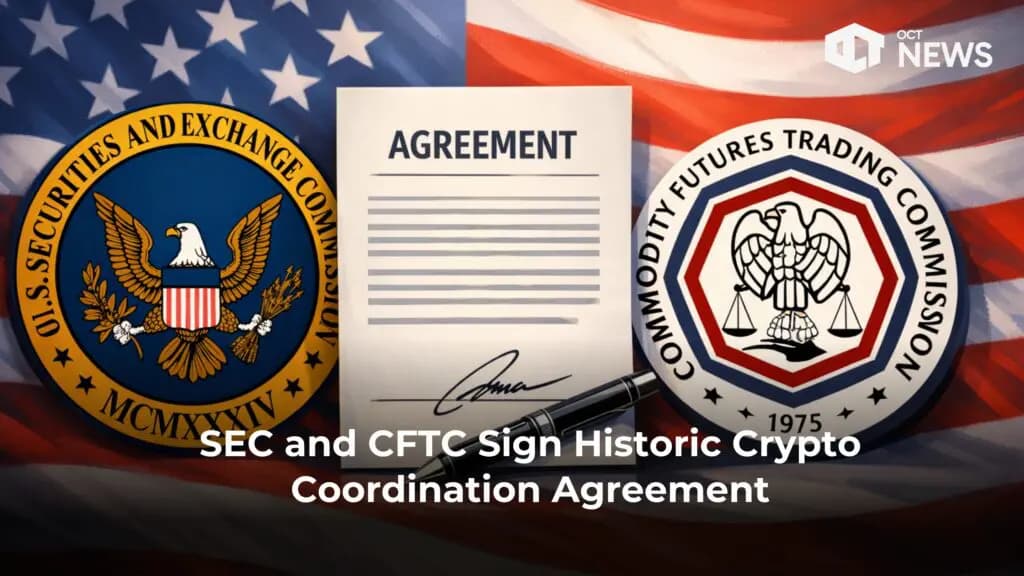
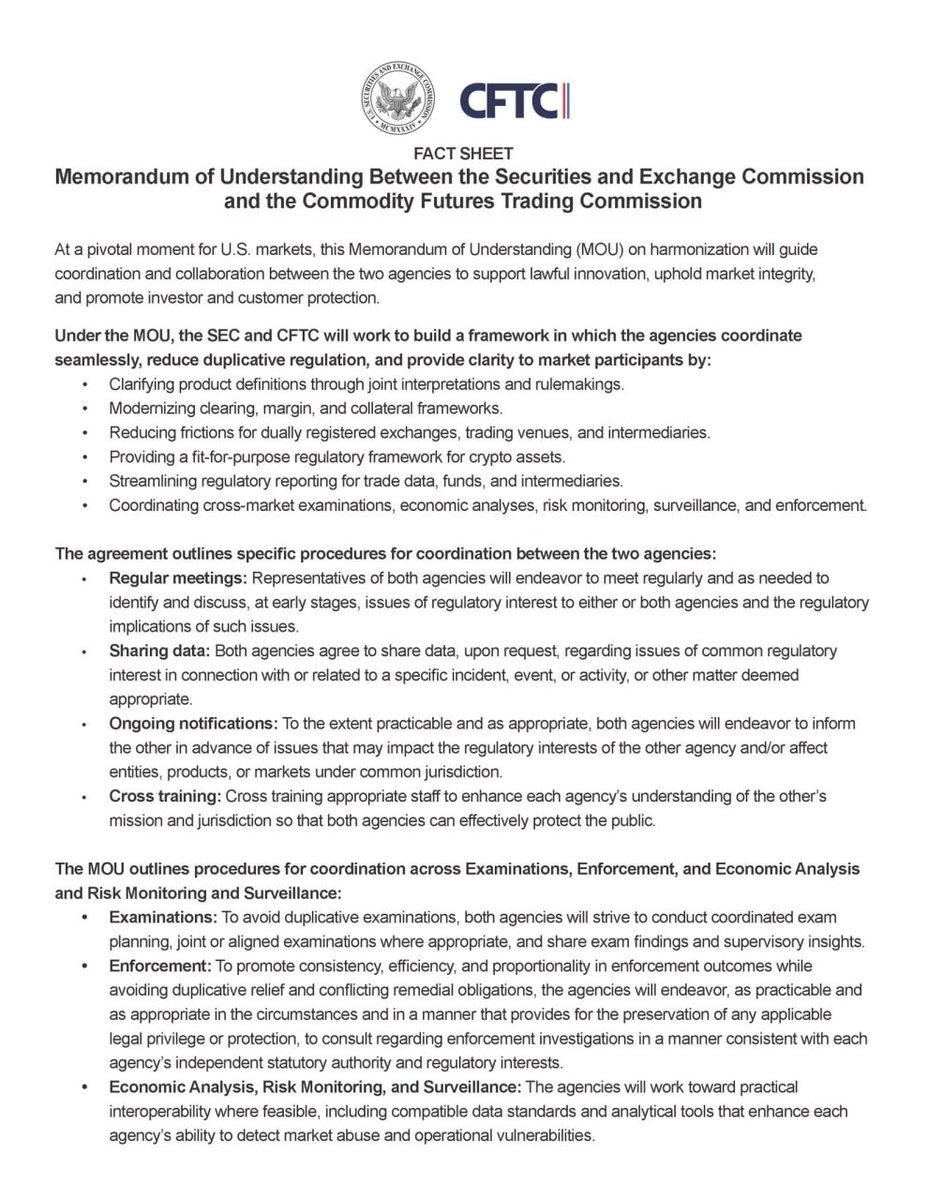
The U.S. SEC and the CFTC signed a new MoU to strengthen coordination on crypto other overlapping areas of financial oversight.

Author: Sahil Thakur
12th March 2026 – The U.S. SEC and the CFTC signed a new Memorandum of Understanding to strengthen coordination on crypto digital asset regulation and other overlapping areas of financial oversight.
The agreement replaces a previous cooperation framework from 2018. SEC Chairman Paul S. Atkins and CFTC Chairman Michael S. Selig announced the update jointly.
High Signal Summary For A Quick Glance

Cointelegraph
@Cointelegraph

🇺🇸 TODAY: SEC and CFTC sign an MOU to coordinate crypto regulation and support new product development. https://t.co/u5rJ5mr66W
12:00 AM·Mar 12, 2026

First Squawk
@FirstSquawk
U.S. SEC AND CFTC HAVE ANNOUNCED A HISTORIC MEMORANDUM OF UNDERSTANDING BETWEEN THE TWO AGENCIES.
08:36 PM·Mar 11, 2026

SwanDesk
@SwanDesk
JUST IN: Paul Atkins says the US SEC will deepen coordination with the CFTC, including joint meetings and firm exams. https://t.co/CsGcaABaDh

06:32 PM·Mar 10, 2026
High attention and emotional sentiment detected.
The new memorandum aims to improve collaboration between the two agencies while supporting lawful innovation, protecting investors and customers, and maintaining market integrity.
Officials said the framework will also promote fair notice to market participants and encourage innovation with what they described as the minimum effective level of regulation needed to keep U.S. financial markets competitive.
Alongside the memorandum, the agencies launched a Joint Harmonization Initiative designed to coordinate rulemaking, examinations, and enforcement efforts.
The initiative will be co-led by Robert Teply at the SEC and Meghan Tente at the CFTC.
Digital assets are one of the primary focus areas of the initiative, reflecting the growing overlap between the two agencies in regulating crypto markets.
The memorandum itself is not legally binding. However, it establishes formal mechanisms for cooperation, including regular meetings, data sharing procedures, advance notifications for new financial products, and cross-agency training.
For years, the SEC and CFTC operated with overlapping authority in areas involving digital assets.
The SEC regulates securities and applies tests such as the Howey standard to determine whether a financial instrument qualifies as an investment contract. The CFTC oversees commodities markets, including futures and derivatives trading.
Many crypto assets have existed in a regulatory gray zone between those frameworks.
Some tokens have been treated as securities by the SEC, while others such as Bitcoin and often Ethereum have generally been viewed as commodities overseen by the CFTC.
That split created regulatory uncertainty for companies operating in the digital asset sector.
Exchanges and trading platforms often faced the possibility of dual registration requirements and conflicting compliance rules.
The lack of clear jurisdiction also led to parallel investigations, inconsistent enforcement strategies, and lengthy debates over how specific assets should be classified.
As a result, companies often faced higher compliance costs and legal risks while attempting to launch new products in the United States.
The new agreement introduces structured cooperation to address those issues.
One goal is to create clearer boundaries between securities and digital commodities through joint interpretations and coordinated rulemaking.
The agencies also plan to reduce duplicative compliance burdens by coordinating examinations and allowing substituted compliance for firms that fall under both regulatory regimes.
Enforcement efforts will also be better aligned. Instead of separate investigations, the agencies will consult each other before pursuing overlapping cases and may coordinate strategies when addressing fraud or market abuse.
The agreement also supports innovation by creating pathways for companies to consult regulators before launching new products.
In addition, the agencies will share market data, collaborate on surveillance efforts, and coordinate the use of analytics tools.
The memorandum and the Joint Harmonization Initiative outline six priority areas where the agencies will work together.
The first is clarifying digital asset product definitions through joint interpretations and rulemaking.
The second focuses on modernizing clearing, margin, and collateral frameworks used in derivatives and trading infrastructure.
Third, the agencies aim to reduce regulatory friction for exchanges, intermediaries, and trading platforms that currently face overlapping oversight.
Fourth, they plan to develop a regulatory framework tailored to crypto assets and other emerging financial technologies.
Fifth, they intend to streamline regulatory reporting for trading data, funds, and intermediaries.
Finally, the agencies will coordinate cross-market examinations, economic research, risk monitoring, surveillance activities, and enforcement actions.
The agreement builds on earlier initiatives launched by both regulators in recent months.
These include “Project Crypto” at the SEC and the CFTC’s “Crypto Sprint,” which both aimed to accelerate policy development for digital asset markets.
The memorandum also serves as an interim solution while Congress continues debating legislation such as the Digital Asset Market Clarity Act, which would more clearly define regulatory authority over crypto markets.
Because that legislation remains stalled in the Senate, regulators are moving ahead with coordination efforts that do not require new laws.
Major regulatory milestones in U.S. crypto oversight involving the SEC and CFTC
First, the CFTC said virtual currencies like Bitcoin count as commodities. As a result, it claimed authority over crypto derivatives and anti-fraud oversight.
Next, the SEC said some blockchain tokens can qualify as securities. That move set the tone for years of token regulation and enforcement.
Then, the CFTC cleared the way for major exchanges to launch Bitcoin futures. So, crypto derivatives entered regulated U.S. markets in a big way.
After that, the SEC created FinHub to work more directly with blockchain builders, startups, and digital asset firms. In turn, the agency built a formal channel for fintech outreach.
The SEC then explained how the Howey Test applies to digital assets. Because of that, the market got a clearer, though still debated, roadmap for token classification.
Later, the SEC filed its landmark case against Ripple. That lawsuit pushed the securities-versus-commodities debate into the center of the crypto industry.
Then came a major breakthrough. The SEC approved the first U.S. spot Bitcoin exchange-traded products, which opened a regulated path for mainstream Bitcoin exposure.
Next, the SEC created a dedicated Crypto Task Force. Its job was to improve policy coordination and bring more clarity to digital asset oversight.
At that point, both agencies moved closer together. They launched joint efforts to align crypto oversight and reduce the long-running conflict between securities and commodities rules.
Then, the CFTC introduced a pilot program for tokenized collateral. So, the agency began exploring how assets like Bitcoin and Ether could fit into regulated derivatives infrastructure.
Finally, the two agencies signed a new cooperation agreement and launched a Joint Harmonization Initiative. As a result, they now have a clearer framework for coordinated crypto rulemaking, exams, and enforcement.
The new framework is expected to reduce regulatory uncertainty for companies operating in the U.S. crypto sector.
Businesses may gain clearer guidance on how digital assets are classified and what regulatory requirements apply to trading platforms and intermediaries.
Coordinated oversight could also lower compliance costs for companies that previously needed to navigate both regulatory regimes independently.
Market participants expect the agreement could make it easier to launch new financial products and increase institutional participation in digital asset markets.
Early reactions from industry observers have been largely positive, with many describing the agreement as a significant step toward a unified regulatory framework for crypto in the United States.
Overall, the memorandum marks a major shift from the previous period of regulatory rivalry toward a more collaborative approach between the country’s two main financial market regulators.
Our Crypto Talk is committed to unbiased, transparent, and true reporting to the best of our knowledge. This news article aims to provide accurate information in a timely manner. However, we advise the readers to verify facts independently and consult a professional before making any decisions based on the content since our sources could be wrong too. Check our Terms and conditions for more info.