Loading Search...


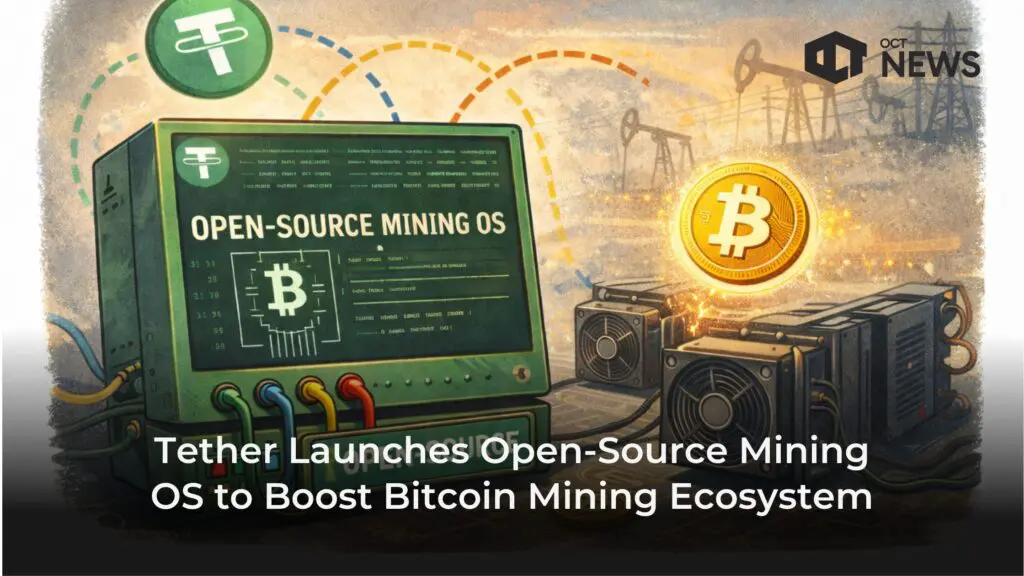
Tether launches an open-source mining OS to improve efficiency, lower barriers and expand the Bitcoin mining ecosystem.

Author: Arushi Garg
In a bold move to democratize the Bitcoin mining ecosystem, Tether launches its open-source Mining OS (MOS) on February 2, 2026, during the Plan ₿ Forum in Lugano, Switzerland, aiming to empower miners of all scales with efficient, peer-to-peer tools for managing hardware, energy, and data integration.
High Signal Summary For A Quick Glance
Tether launches its open-source Mining OS (MOS) as part of its push into the Bitcoin mining ecosystem, which began in May 2023 with plans for renewable-powered operations in Uruguay to diversify beyond stablecoins. In November 2023, Tether pledged $500 million over six months to build mining facilities and become a major global miner.
MOS was built internally to manage large-scale mining by integrating hardware, energy, and data systems. However, high energy costs led Tether to shut its Uruguay sites in late 2025, accelerating a shift toward open-source, collaborative tools for the broader Bitcoin mining ecosystem.
While Tether hasn’t open-sourced mining software before, the move mirrors earlier efforts like Braiins OS. Past mining announcements drew mixed reactions—praised for diversification but questioned due to regulatory risks. Bitcoin rose roughly 20% after the November pledge, though broader market momentum was the main driver.
Key milestones in Tether’s Bitcoin mining ecosystem and Mining OS launch
Tether announces plans to enter Bitcoin mining in Uruguay, citing renewable energy strategy and diversification beyond stablecoins.
Tether commits $500M over six months to build mining facilities and acquire meaningful exposure to global Bitcoin hash power.
Tether finalizes its $500M mining investment just before the Bitcoin halving, expanding operations across Latin America.
Tether announces plans to open-source its mining operating system by Q4 2025 to lower barriers for smaller miners and boost decentralization.
Rising energy costs reportedly force Tether to close Uruguay mining operations, shifting strategy toward more efficient global deployments.
Tether launches its open-source Mining OS at the Plan ₿ Forum, integrating hardware, energy, and operational data for peer-to-peer mining management.
As Tether launches its open-source Mining OS (MOS), coverage has focused on features and decentralization, but less on security risks. Open-sourcing MOS improves transparency, yet it also exposes critical infrastructure to faster exploitation if vulnerabilities especially in P2P layers are discovered without strong audits and ongoing maintenance.
Another underplayed issue is regulatory risk. Given Tether’s history of scrutiny, deeper involvement in mining software could attract renewed attention from regulators and raise concerns around market influence or conflicts of interest, potentially slowing institutional adoption.
Our Crypto Talk is committed to unbiased, transparent, and true reporting to the best of our knowledge. This news article aims to provide accurate information in a timely manner. However, we advise the readers to verify facts independently and consult a professional before making any decisions based on the content since our sources could be wrong too. Check our Terms and conditions for more info.



Vitalik Buterin Says Ethereum’s Original L2 Vision No Longer Works
Cathie Wood’s ARK Sees Opportunity in Crypto Slump, Adds More Stocks
Moscow Exchange to Launch SOL, XRP, and TRX Crypto Futures
Arbitrum DAO Account Recovery After X Account Compromise
Vitalik Buterin Says Ethereum’s Original L2 Vision No Longer Works
Cathie Wood’s ARK Sees Opportunity in Crypto Slump, Adds More Stocks
Moscow Exchange to Launch SOL, XRP, and TRX Crypto Futures
Arbitrum DAO Account Recovery After X Account Compromise