Loading Search...


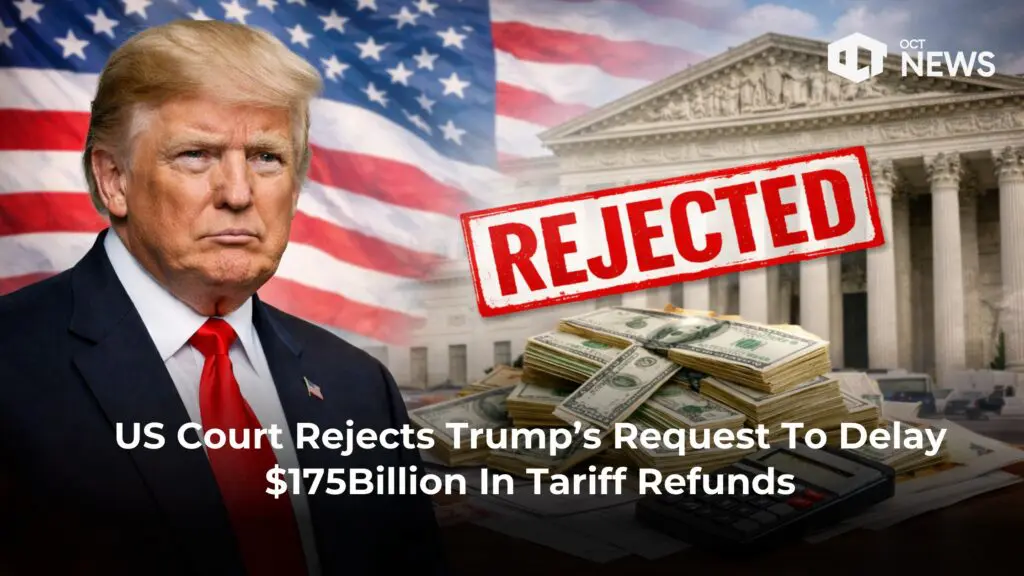
U.S. Court denies Trump’s request to delay $175 billion in tariff refunds, deepening the ongoing legal fight over trade policy.

Author: Arushi Garg
3rd March, 2026 – A U.S. appeals court has rejected a request to delay about $175 billion in tariff refunds linked to policies introduced under Donald Trump. The tariffs, imposed under emergency powers during his presidency, were later ruled illegal for going beyond executive authority.
With refunds now moving forward, billions could return to U.S. businesses, adding liquidity to the economy. For crypto markets, this may raise inflation concerns and push some investors toward assets like Bitcoin as a hedge against a weaker dollar.
High Signal Summary For A Quick Glance

Defi-Don
@TradingwithDon

@BullTheoryio I thought citizens paid tariffs that money don’t go back to us?
BREAKING: 🇺🇸 U.S. court rejects Trump’s request to delay $175 billion in tariff refunds. Companies can now move forward with reclaiming duties they were required to pay. If fully processed, this would mark the largest trade related payout in U.S. history. https://t.co/k4gxQYv7GO
08:35 PM·Mar 2, 2026

GallantFox
@SAHtoshiDude
@BullTheoryio How do these companies get a “refund” when they passed the tariffs on to the consumer?
BREAKING: 🇺🇸 U.S. court rejects Trump’s request to delay $175 billion in tariff refunds. Companies can now move forward with reclaiming duties they were required to pay. If fully processed, this would mark the largest trade related payout in U.S. history. https://t.co/k4gxQYv7GO
07:38 PM·Mar 2, 2026

Mike
@tradesoftoday
@BullTheoryio So corporations get refund checks, not citizens? That's bull crap
BREAKING: 🇺🇸 U.S. court rejects Trump’s request to delay $175 billion in tariff refunds. Companies can now move forward with reclaiming duties they were required to pay. If fully processed, this would mark the largest trade related payout in U.S. history. https://t.co/k4gxQYv7GO
06:36 PM·Mar 2, 2026
High attention and emotional sentiment detected.

The tariffs at the center of the US Court Tariff Refunds case were introduced during Donald Trump’s presidency under the International Emergency Economic Powers Act (IEEPA). They targeted a wide range of imports and generated more than $130 billion in revenue. Importers and small businesses later challenged the policy, arguing the law was misused and exceeded presidential authority.
In August 2025, a federal appeals court upheld a lower court decision against the tariffs, raising the possibility of refunds estimated at up to $175 billion. On February 20, 2026, the Supreme Court ruled most of the tariffs illegal. A request for a 90-day delay was later denied on March 2, 2026, allowing refund proceedings to move forward.
Key milestones in the legal challenges to Trump-era IEEPA tariffs and the refund pathway
During Donald Trump’s presidency, broad tariffs are imposed on imports using the International Emergency Economic Powers Act, generating significant revenue and triggering immediate legal disputes from affected businesses.
Importers and companies file lawsuits arguing the tariffs exceed presidential authority under IEEPA, leading to early court rulings that deem many measures unlawful.
A federal appeals court affirms a lower court’s decision against the tariffs, strengthening the pathway for refunds that some economic analyses estimate could total around $175 billion.
The U.S. Supreme Court rules most tariffs illegal, opening the door to refund processes without prescribing a specific implementation mechanism.
The U.S. Court of Appeals for the Federal Circuit denies the administration’s 90-day delay request, allowing proceedings for relief to move forward in the U.S. Court of International Trade.
The US Court Tariff Refunds process is moving forward, but key details are still unclear. The timeline, payout method, and whether businesses will receive interest have not yet been confirmed. Any delays or disputes over calculations could slow the return of funds to the economy.
There is also concern about the broader budget impact. A $175 billion payout could increase pressure on the U.S. deficit and borrowing needs. How the government manages this strain may influence market confidence and investor behavior in the months ahead.
U.S. Court of International Trade updates: Watch for updates on how the court plans to handle the $175B refunds. If the process moves quickly, more money could enter the economy sooner, which may affect inflation and crypto demand.
New Trump tariff plans: Follow reports about possible temporary 15% tariffs on imports. Legal challenges or global pushback could increase trade uncertainty and support crypto as a safe-haven option.
Congress response: Monitor Senate Democrats pushing for full refunds with interest, and any bipartisan action on new tariffs. Policy changes could impact government spending and Bitcoin flows.
Market signals to watch: Keep an eye on inflation data, the U.S. dollar, and crypto price moves. Refund payouts and tariff changes could pressure traditional markets and influence digital assets.
Our Crypto Talk is committed to unbiased, transparent, and true reporting to the best of our knowledge. This news article aims to provide accurate information in a timely manner. However, we advise the readers to verify facts independently and consult a professional before making any decisions based on the content since our sources could be wrong too. Check our Terms and conditions for more info.



Venice AI Becomes Recommended Model Provider for OpenClaw
Prediction Markets Shows First Monthly Decline Since August
$OM to $MANTRA Token Upgrade Completed with 1:4 Split
US Court Rejects Trump’s Request To Delay $175Billion In Tariff Refunds
Venice AI Becomes Recommended Model Provider for OpenClaw
Prediction Markets Shows First Monthly Decline Since August
$OM to $MANTRA Token Upgrade Completed with 1:4 Split
US Court Rejects Trump’s Request To Delay $175Billion In Tariff Refunds