Loading Search...


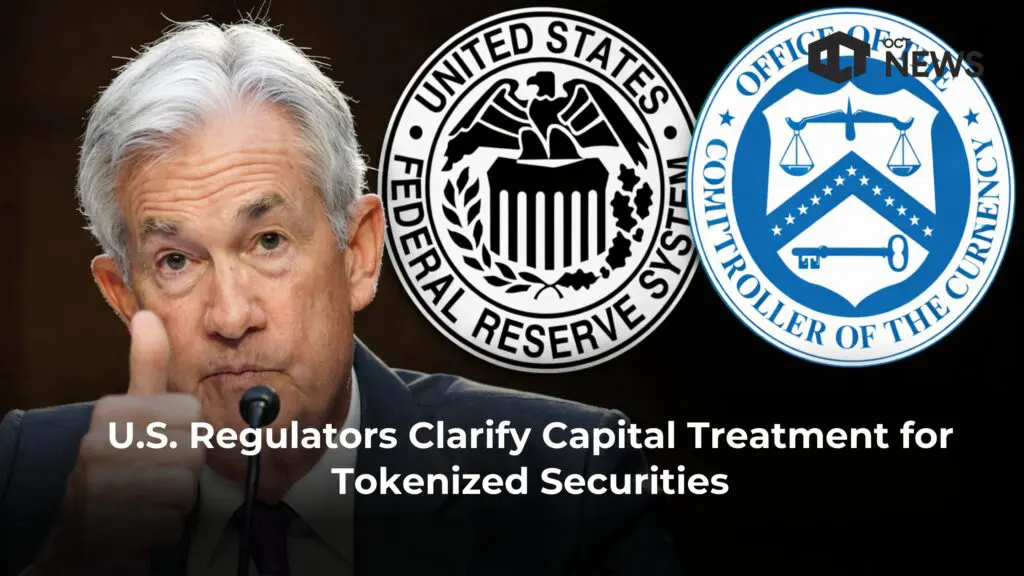
U.S. banking regulators have issued new guidance clarifying how tokenized securities should be treated under bank capital rules.

Author: Sahil Thakur
6 March 2026 – U.S. banking regulators have issued new guidance clarifying how tokenized securities should be treated under bank capital rules. The Federal Reserve, the Office of the Comptroller of the Currency (OCC), and the Federal Deposit Insurance Corporation (FDIC) released the joint clarification on March 5, 2026.
The agencies published updated interagency FAQs explaining that the capital framework for banks is “technology neutral.” In practice, that means banks should treat eligible tokenized securities the same way they treat traditional securities for regulatory capital purposes.
The guidance does not introduce a new rule. Instead, it clarifies how existing capital regulations apply when securities are issued or traded using blockchain or distributed ledger technology.
High Signal Summary For A Quick Glance

Money Ape
@TheMoneyApe

SUPER BULLISH FOR CRYPTO 🚀 U.S. REGULATORS FED, OCC, & FDIC SAID TOKENIZED SECURITIES WILL BE TREATED THE SAME AS TRADITIONAL SECURITIES. NOW BANKS CAN HOLD, TRADE, & USE TOKENIZED ASSETS AS COLLATERAL WITHOUT EXTRA PENALTIES. WALL STREET TRILLIONS IN ASSETS COMING ON CHAIN. https://t.co/G6R5hgskpu
01:17 AM·Mar 6, 2026

Ash Crypto
@AshCrypto
BREAKING: 🇺🇸 The US just quietly gave banks the green light to hold tokenized securities and this is a BIG. The Fed, OCC and FDIC just released a joint statement. Three of America's most powerful financial regulators speaking with one voice. The message was simple. Tokenized https://t.co/FFq1Gh5hR1

09:43 PM·Mar 5, 2026
The clarification focuses specifically on tokenized versions of traditional financial instruments.
Eligible tokenized securities are digital representations of assets such as stocks, bonds, funds, or U.S. Treasuries. These tokens must grant holders the same legal rights as the traditional version of the asset under applicable law.
If those rights are identical, banks can apply the same regulatory capital treatment. In other words, holding a tokenized Treasury or tokenized stock does not change the risk weight compared with holding the conventional version.
Regulators emphasized that the underlying technology does not affect this treatment.
“The technologies used to issue and transact in a security do not generally impact its capital treatment,” the Federal Reserve stated in the guidance.

Another key point in the clarification concerns the blockchain infrastructure used to issue tokenized assets.
The agencies said the capital rules apply equally whether the tokenized security runs on a permissioned private blockchain or a public network such as Ethereum or Solana.
As long as the token represents a legally recognized security with identical rights, the regulatory treatment remains the same.
The guidance also confirms that tokenized securities can qualify as financial collateral for credit risk mitigation. Banks may use them as collateral under the same standards applied to traditional securities, provided other regulatory requirements are satisfied.
Despite widespread excitement on social media, the announcement does not mean banks can freely hold cryptocurrencies like Bitcoin or Ether without regulatory capital charges.
The clarification applies only to tokenized securities. These are digital versions of existing financial assets.
Native crypto assets that do not represent traditional securities remain subject to separate regulatory frameworks. In many cases, those assets still carry extremely high risk weights under bank capital rules.
The agencies also stressed that banks must continue to follow standard risk management practices and comply with all applicable laws.
Tokenized assets that do not provide the same legal rights as their traditional counterparts fall outside the scope of the clarification.
Although the announcement does not change the underlying capital rules, it removes a major source of uncertainty.
Banks now have explicit regulatory confirmation that tokenizing traditional assets will not create additional capital penalties. That certainty could encourage more financial institutions to experiment with blockchain-based settlement and asset issuance.
Industry analysts say the clarification could accelerate the growth of tokenized real-world assets, often referred to as RWAs. These include tokenized Treasuries, corporate bonds, money market funds, and other traditional instruments.
Several projects already operate in this space, including tokenized Treasury products and blockchain-based funds.
The clarification also reflects a broader regulatory shift in the United States over the past year.
In 2025 and early 2026, regulators and lawmakers took several steps that many view as more supportive of digital asset innovation. These include the passage of the GENIUS Act, which established a federal framework for stablecoins.
At the same time, agencies have moved away from some of the restrictive policy statements issued during earlier phases of crypto market turmoil.
Together, these changes signal a growing willingness among regulators to allow blockchain technology to integrate with traditional financial infrastructure.
Reaction from the crypto industry has been overwhelmingly positive.
Many commentators framed the guidance as a major step toward bringing traditional financial assets on-chain. Supporters argue that trillions of dollars in stocks, bonds, and other securities could eventually move onto blockchain-based systems.
However, the announcement is best understood as a regulatory clarification rather than a sweeping policy change.
Banks already had capital rules for securities. The regulators simply confirmed that those same rules apply when the securities exist in tokenized form.
Even so, the guidance removes a key barrier to adoption. With clearer regulatory treatment, financial institutions may now feel more comfortable exploring tokenized markets and blockchain-based settlement systems.
Our Crypto Talk is committed to unbiased, transparent, and true reporting to the best of our knowledge. This news article aims to provide accurate information in a timely manner. However, we advise the readers to verify facts independently and consult a professional before making any decisions based on the content since our sources could be wrong too. Check our Terms and conditions for more info.



Kaito Studio Beta Goes Live, Expands Creator Opportunities Beyond X
Jupiter Card Goes Live Expanding Solana Into Everyday Payments
Kazakhstan Central Bank $350M Crypto Portfolio Plan
idOS Network Faces Scam Allegations After Token Crash
Kaito Studio Beta Goes Live, Expands Creator Opportunities Beyond X
Jupiter Card Goes Live Expanding Solana Into Everyday Payments
Kazakhstan Central Bank $350M Crypto Portfolio Plan
idOS Network Faces Scam Allegations After Token Crash