Loading Search...


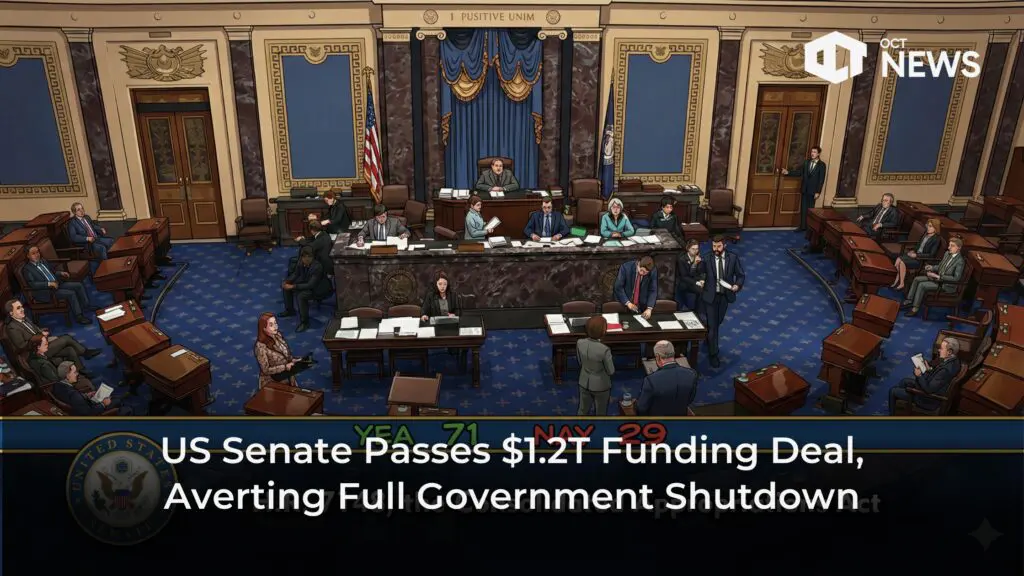
The US Senate passes a $1.2 trillion bipartisan funding deal, avoiding a major government shutdown and stabilizing federal operations.

Author: Tanishq Bodh
January 31, 2025 – Washington moved away from a fiscal cliff late Thursday as lawmakers raced to avoid another disruptive shutdown. Markets and policy watchers had closely tracked the deadline, given its implications for federal operations, regulation, and economic stability. In a late-night vote, the US Senate approved a sweeping bipartisan spending package, temporarily stabilizing the federal government through the rest of fiscal year 2026.
High Signal Summary For A Quick Glance
On January 30, 2026, the Senate passed a $1.2 trillion spending agreement by a 71–29 vote, just hours before the midnight shutdown deadline.and the package funds most federal agencies through September 30, 2026.
Five full-year appropriations bills cover roughly 96 percent of government operations. These include Defense, Health and Human Services, Transportation, State, and Financial Services. This deal also extends funding for the Department of Homeland Security by two weeks to allow further negotiations on immigration policy.

Source: United States Senate
President Donald Trump endorsed the agreement on Truth Social, urging continuity in core government functions. Senate leaders from both parties backed the compromise after intense negotiations.
Despite Senate approval, a brief partial shutdown may still occur over the weekend. The House remains in recess and is scheduled to reconvene on February 2. Essential services will continue, and furloughed workers would receive back pay.
Overall, the deal reduces immediate fiscal risk. Without it, a prolonged shutdown would disrupt defense operations, healthcare programs, and transportation funding. Instead, avoiding that outcome supports short-term economic confidence and also preserves operational continuity. From a policymaker perspective, the agreement signals renewed bipartisan coordination after months of gridlock. However, the temporary DHS extension still highlights unresolved tensions around immigration oversight.
As a result, lawmakers have postponed deeper structural disagreements rather than resolving them. For markets, fiscal stability remains important because shutdown risks historically delay data, disrupt contracts, and raise uncertainty. Therefore, removing that overhang may support risk assets, including crypto, especially as regulatory developments continue to shape sentiment.
Timeline of events from the previous shutdown to the current funding standoff
The U.S. government shuts down at midnight after the Senate fails to pass competing continuing resolutions.
The shutdown stretches beyond a month with repeated failed votes and closed-door negotiations.
The Senate and House pass an amended continuing resolution, ending the 43-day shutdown.
Congress releases a multi-agency funding plan covering Commerce, Energy, Justice, EPA, and NASA.
The Senate Agriculture Committee publishes revised crypto legislation and schedules markup.
Senate Democrats push to split DHS funding, increasing the risk of another shutdown.
The Senate Agriculture Committee advances the crypto bill as funding negotiations intensify.
The Senate passes a funding package, but a House recess leads to a partial shutdown at midnight.
Overall, the funding deal follows a turbulent budget cycle. Previously, a 43-day shutdown in October 2025 furloughed nearly one million workers and ended only with a temporary fix. Since then, Congress has relied on partial funding bills to manage pressure and therefore avoid another disruption. Against that backdrop, immigration policy drove the latest standoff, as Democrats pushed DHS accountability while Republicans demanded enforcement safeguards. Ultimately, leaders separated DHS funding so that the broader package could remain intact.
The immediate focus is the House vote on February 2 to formally pass the funding package and lock in shutdown avoidance, followed closely by the February 13 deadline for resolving the DHS extension and ICE reform negotiations. Beyond fiscal stability, momentum now shifts to the Senate Banking Committee’s upcoming markup and a potential full Senate vote on crypto market structure legislation, which could confirm an expanded role for the Commodity Futures Trading Commission. However, the path remains fragile. Democratic resistance over stablecoin provisions, conflicts-of-interest clauses, or a breakdown in DHS talks could stall progress, while last-minute amendments or House delays would quickly flip the narrative back toward political risk and renewed uncertainty.
Our Crypto Talk is committed to unbiased, transparent, and true reporting to the best of our knowledge. This news article aims to provide accurate information in a timely manner. However, we advise the readers to verify facts independently and consult a professional before making any decisions based on the content since our sources could be wrong too. Check our Terms and conditions for more info.



Crypto Market Adds $150B+ After Jane Street Lawsuit
CrowdWalrus Goes Live Introducing Crowdfunding to Sui
MegPrimePay Token launching on 26th Feb On Uniswap & Coinbase DEX
BBRL Polygon Launch: Banco Braza Expands BRL Stablecoin
Crypto Market Adds $150B+ After Jane Street Lawsuit
CrowdWalrus Goes Live Introducing Crowdfunding to Sui
MegPrimePay Token launching on 26th Feb On Uniswap & Coinbase DEX
BBRL Polygon Launch: Banco Braza Expands BRL Stablecoin