Loading Search...


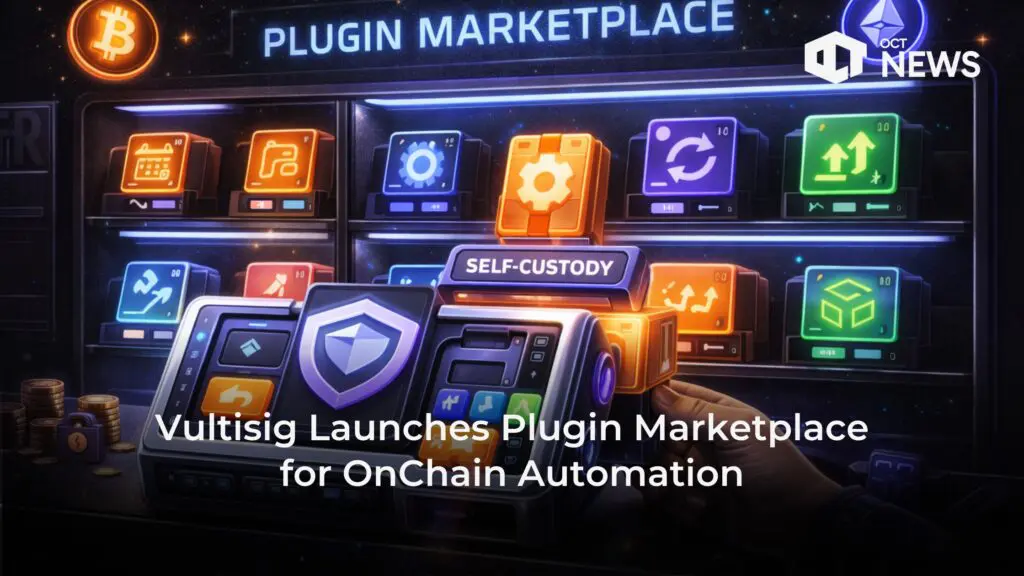
Vultisig Plugin Marketplace launches self-custodial on-chain automation for DCA and recurring payments across 30+ blockchains.

Author: Kritika Gupta
High attention and emotional sentiment detected.
3rd February 2026- Vultisig, a self-custodial crypto wallet built on multi-party computation (MPC), has officially launched its Plugin Marketplace, a new platform that enables on-chain automation while keeping users in control of their funds. The update was announced on February 2, 2026, and Vultisig is positioning it as the first fully self-custodial automation marketplace that works across more than 30 blockchains.
Most importantly, the Plugin Marketplace allows users to automate DeFi strategies like dollar cost averaging (DCA) and recurring transfers without compromising private key security. Unlike many automation tools that rely on centralized execution layers or risky wallet approvals, Vultisig designed this system to enforce automation rules directly through cryptographic mechanisms.
High Signal Summary For A Quick Glance

The Wolf of Defi ⚡️
@thewolfofdefi

The wallet for AI agents is officially here! 🤖🔥 @vultisig just launched the Plugin Marketplace. On-chain, multi-chain automation, without giving up your keys. Until now you had no good option: ▪️CEXs for automation (no custody) ▪️Bots (hand over your seed) ▪️Smart contracts https://t.co/UK8dPsq0QF
https://t.co/BvDXgAWzQF
07:31 PM·Feb 2, 2026

Rain
@raintures
Self‑custodial automation has always sounded good on paper… But the security model never really held up. What stands out with @vultisig Plugin Marketplace is the architecture. Threshold signatures + a dedicated verifier that cryptographically enforces your rules on every https://t.co/Lpu0TVQmP0
https://t.co/BvDXgAWzQF
04:10 PM·Feb 2, 2026
Vultisig built the Plugin Marketplace as part of a broader push to make self-custody both safer and more functional for everyday crypto users. The team behind Vultisig includes builders associated with THORChain, and Vultisig gained traction after launching a seedless, multi-device wallet in 2025. That wallet uses threshold signature schemes (TSS), which removes the single point of failure that typically exists in seed phrase wallets.
In addition, Vultisig introduced the $VULT token in October 2025 at a low fully diluted valuation, while expanding integrations for cross-chain swaps and DeFi tools. These steps laid the groundwork for more advanced automation. Roadmaps published in late 2025 already highlighted the marketplace as a major milestone, especially because the goal was to solve a long-standing trade-off in crypto: automation usually requires either centralized trust or dangerous key exposure.
Until now, most recurring purchase tools and automation bots have come with security compromises. Centralized exchanges offer recurring buys but require custody. Meanwhile, automation bots often demand full key access or persistent approvals that can expose users to unnecessary risk. Therefore, Vultisig is targeting a gap in the market by offering automation that keeps users fully self-custodial.
Key milestones related to this development
Vultisig launches its multi-device self-custodial wallet using MPC and threshold signatures to remove seed phrase risk.
Vultisig roadmaps position self-custodial automation as a key next step to expand secure wallet functionality.
The $VULT token goes live and becomes the ecosystem layer for marketplace incentives and long-term value capture.
Vultisig unveils the world’s first self-custodial on-chain automation marketplace across 30+ blockchains.
The marketplace launches with Recurring Swaps for DCA and Recurring Sends for recurring payments and payroll execution.
Builders roll out new plugins such as limit orders, yield strategies, and AI-driven automation with fee sharing for builders and $VULT holders.
Loading chart...
The Plugin Marketplace uses threshold signatures to maintain security during automation. Users install plugins that operate under predefined conditions. At the same time, the system assigns signing authority across multiple parties so that no single component can execute transactions alone.
In practice, the marketplace distributes control through shared signing. A plugin holds one share of the signing process, while a dedicated verifier system holds another share. As a result, a transaction only executes if the proposal matches user-defined rules and the verifier confirms compliance. This structure supports a proposed and verified workflow, which aims to prevent unauthorized or out-of-scope execution.
At launch, Vultisig introduced automation options such as Recurring Swaps for DCA and Recurring Sends for payroll-style transfers. The marketplace supports major ecosystems alongside broader multi-chain coverage.
Vultisig designed the marketplace as an open builder platform, which allows developers to create automation plugins for a range of strategies. For example, builders can develop yield automation, limit order execution, treasury management tools, cross-chain strategies, and AI-assisted automation.
In parallel, Vultisig introduced a fee distribution model intended to grow participation and reward contribution. The system allocates 70% of fees to builders and directs 30% of fees to $VULT holders. Consequently, adoption could strengthen both the plugin ecosystem and the token’s utility narrative if activity scales over time.
From a broader DeFi standpoint, this launch supports the shift toward replacing custodial automation with cryptographically enforced self-custodial automation. If the marketplace proves reliable at scale, it could reduce dependence on centralized execution services and lower the attack surface created by risky permissions and compromised keys.
Our Crypto Talk is committed to unbiased, transparent, and true reporting to the best of our knowledge. This news article aims to provide accurate information in a timely manner. However, we advise the readers to verify facts independently and consult a professional before making any decisions based on the content since our sources could be wrong too. Check our Terms and conditions for more info.