Loading Search...


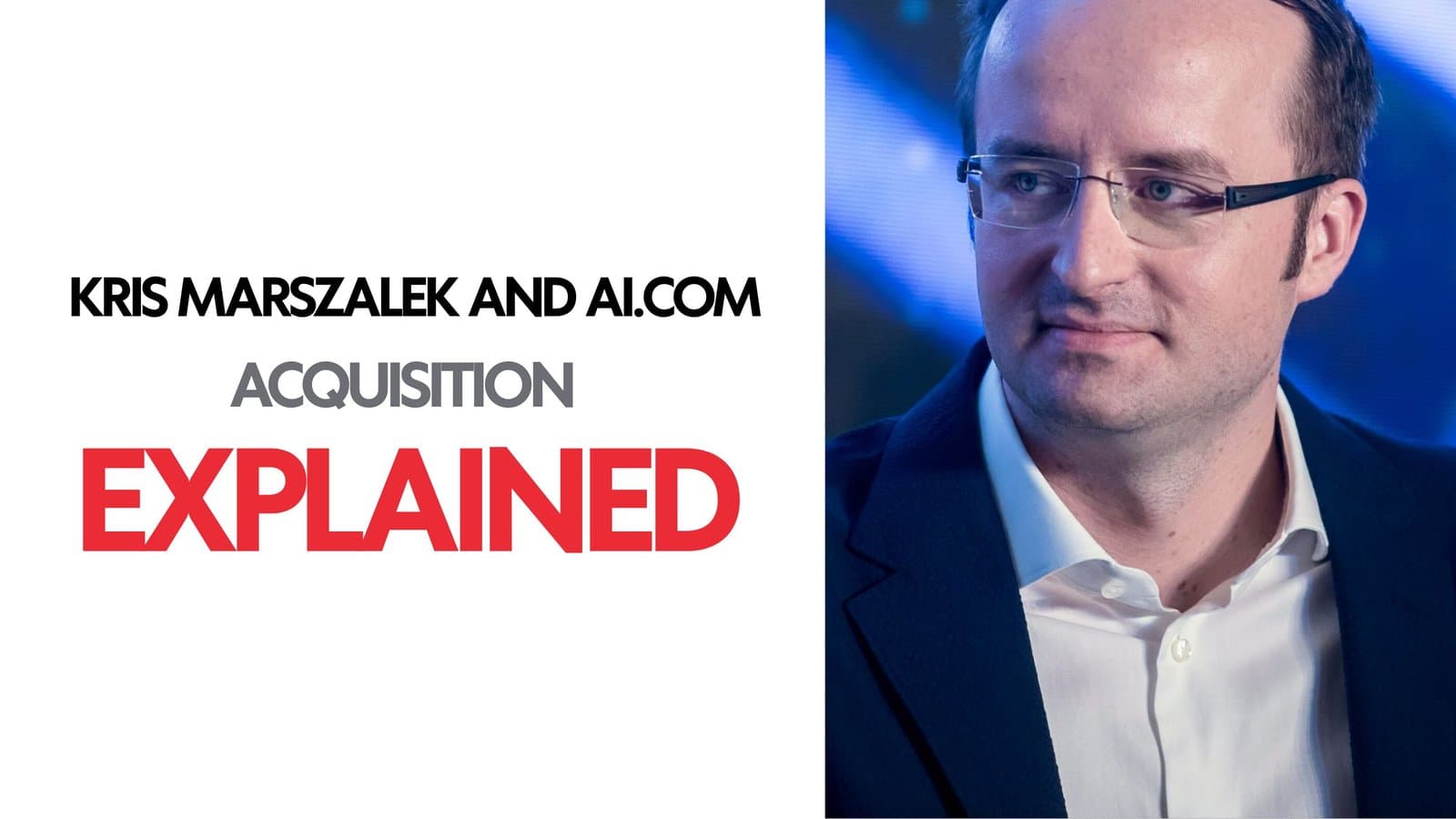
In this article, we explore how crypto.com co-founder Kris Marszalek got his hands on the ultra premium ai.com domain for $70 million.

Author: Sahil Thakur
Crypto entrepreneur Kris Marszalek, co-founder and CEO of Crypto.com, made headlines after buying the ultra-premium domain AI.com for a reported $70 million. He unveiled the purchase with a flashy Super Bowl commercial. Since then, the move has sparked widespread attention across tech and crypto circles. This report explores Marszalek’s background and his long-standing focus on bold branding. It also traces his history with high-profile domain deals. In addition, it examines the AI.com acquisition, the Super Bowl debut, the claimed $500 million offer that followed, and the open questions surrounding his strategy.
Kris Marszalek is a Polish-born entrepreneur known for building companies and placing large branding bets. Early in his career, he focused on e-commerce. He founded BEECRAZY, which sold for about $21 million in 2013. Later, he became CEO of Ensogo, a daily deals platform similar to Groupon. However, Ensogo shut down abruptly in 2016. The closure left customers and merchants stranded. Marszalek resigned the same day. Although some accused the company of fraud, a spokesperson said he was not involved in the shutdown decision.
After that setback, Marszalek shifted into cryptocurrency. In 2016, he co-founded Monaco. The company later rebranded as Crypto.com. Under his leadership, Crypto.com grew into a major global exchange. It now claims more than 150 million users. Much of this growth came from aggressive marketing. For example, Marszalek bought the Crypto.com domain in 2018 for a reported $10 million. That deal signaled his belief in owning category-defining names. He also signed celebrity endorsements, including actor Matt Damon. In addition, he spent $700 million to secure naming rights to the former Staples Center in Los Angeles, now Crypto.com Arena. Together, these moves cemented his reputation as a marketer willing to spend heavily to build brand dominance.
Most recently, Marszalek made his boldest move yet. In 2025, he acquired the two-letter domain AI.com for roughly $70 million. The purchase set a new public record for domain sales. The deal was brokered by domain veteran Larry Fischer. It was reportedly paid entirely in cryptocurrency. As a result, the sale surpassed earlier records, including CarInsurance.com at $49.7 million and Voice.com at $30 million.
The seller was Malaysian entrepreneur Arsyan Ismail. Reports suggest he chose Marszalek’s vision over higher competing bids. In an interview with the Financial Times, Marszalek said he was taking a long-term view of AI, spanning 10 to 20 years. According to Fischer, assets like AI.com rarely come to market more than once. For Marszalek, the domain represents control over a critical category touchpoint. He views it in the same way he once viewed Crypto.com. By owning defining names in emerging industries, he aims to avoid commoditization and instead build enduring category brands.
However, the domain is more than a branding asset. Marszalek is developing AI.com as a consumer platform for autonomous AI agents. In February 2026, the company launched a beta version of the service. Users can create a private, personal AI agent in just a few steps. These agents go beyond conversation. They can take actions across apps and online services.
For example, an agent can organize work, send messages, and run workflows. It can also trade stocks, manage calendars, or update online profiles. All actions follow the user’s instructions. Over time, each agent can improve itself. It can build new capabilities when it encounters missing functions. Those improvements can then be shared across the broader network.
Marszalek describes the goal as a decentralized network of billions of agents that continuously self-improve. In his view, this system could accelerate progress toward artificial general intelligence. The emphasis on decentralization reflects his background in crypto, although details remain limited. For now, the service is free to join, allowing users to reserve an AI agent handle. Later, paid subscription tiers will unlock advanced features.
Looking ahead, Marszalek plans to integrate AI.com agents into financial services. This could include links to crypto or fintech products. He has also hinted at new social platforms where humans and AI agents interact side by side. Overall, his strategy mirrors his earlier crypto push. He wants to make a complex technology simple, accessible, and mainstream for everyday users.

To launch AI.com publicly, Marszalek chose one of advertising’s biggest stages. He debuted the platform during Super Bowl LX. In the fourth quarter of the 2026 broadcast, AI.com aired a 30-second commercial. The ad urged viewers to sign up for a personal AI agent. Reports estimate the combined cost of production and airtime at roughly $7 to $10 million. Once again, the spend highlighted Marszalek’s willingness to invest heavily in marketing.
The timing also mattered. AI-themed commercials made up nearly one-quarter of all Super Bowl ads that year. Even so, AI.com stood out. It delivered the most direct pitch and effectively served as the platform’s national launch.
Almost immediately, public reaction followed. Curiosity spiked, and traffic surged as the ad aired. However, the sudden influx overwhelmed the site. Many visitors encountered 504 gateway timeout errors. Servers struggled to handle the load. Shortly after, Marszalek posted on social media about “insane traffic levels.” He admitted that demand exceeded expectations despite advance planning. By the next day, he said the team was scaling infrastructure and planned to roll out the live product within 48 hours.
At the same time, criticism surfaced online. Early visitors found a sparse beta experience. The site focused mainly on reserving a username. Yet it also required Google login and credit card details for verification. Some observers called this a sign of peak AI hype. Others raised concerns about originality. They noted similarities between AI.com’s interface and an open-source AI agent project called OpenClaw. This fueled skepticism about how much proprietary technology powered the platform.
In response, an AI.com spokesperson pushed back. The company said the product combines proprietary code with enhanced open-source components. It also claimed to have added security improvements. Despite the rough rollout, the Super Bowl debut succeeded in one key way. It put AI.com at the center of the conversation. People talked about it widely, even if many were simply asking what it was supposed to become. The launch once again showed Marszalek’s flair for dramatic, high-visibility marketing.
Soon after the launch, Marszalek made another striking claim. He said someone offered more than $500 million for AI.com shortly after he purchased it for $70 million. In a February 10 interview, he explained that a rival bidder approached him once the deal closed. According to Marszalek, that party wanted to buy the domain immediately.
He went further, suggested he could have pushed the price to $1 billion if profit had been his goal. He added that he was fully committed to building the platform instead. The claim remains unverified. Still, it reflects the intense competition and perceived value surrounding elite AI domains.
The statement also aligns with earlier comments from broker Larry Fischer. Fischer said the previous owner turned down substantially higher offers to sell to Marszalek. The identity of the alleged $500 million bidder remains unknown. Speculation ranges from major tech firms to wealthy entrepreneurs chasing AI assets. If the offer was real, Marszalek passed on a potential sevenfold return. That decision suggests he believes AI.com could eventually be worth far more. While the offer itself remains speculative, his public comments make one thing clear. He views AI.com as a future billion-dollar asset, not a quick flip.
Now that AI.com is live, even in an early state, attention is turning to what comes next. The project has strong backing from one of crypto’s most aggressive marketers. Marszalek’s history with Crypto.com shows he can take an early-stage idea and push it into the mainstream. He did this through product positioning and large-scale promotion. He believes the same approach can work for AI. His stated goal is to mainstream AI agents, much as he helped normalize crypto trading.
If autonomous agents become the next major tech shift, owning AI.com could prove valuable. The domain gives Marszalek a powerful entry point. It also acts as a trust signal for users curious about AI. He is clearly positioning AI.com as a category leader from day one. Still, the outcome remains uncertain. As one publication noted, the $70 million price may look brilliant if the AI boom continues. On the other hand, it could become a symbol of excess if enthusiasm around crypto and AI fades. The upside is large, but so is the risk.
One clear advantage is Marszalek’s resources and patience. He has said he is working on a 10 to 20 year timeline. That mindset allows him to tolerate short-term volatility. Running Crypto.com and AI.com in parallel could also create synergies. For example, AI agents could integrate crypto payments. The platforms could also cross-promote to Crypto.com’s massive user base.
However, the challenges are real. Managing two large companies in fast-moving industries will test any executive. In addition, the AI platform space is already crowded. Well-funded players such as OpenAI, Anthropic, and many startups compete for attention. For AI.com to succeed, it must offer more than a premium domain. The product needs to deliver real utility. Its agents must reliably complete tasks, improve over time, and earn user trust. This is especially critical if users link financial accounts or personal data. The rocky beta launch suggests meaningful technical work still lies ahead.
In the end, Marszalek’s AI.com purchase and Super Bowl debut reflect his familiar playbook. He prefers to go big from the start. The bet assumes AI agents will be as transformative as crypto once was. He has put $70 million behind the idea that owning AI.com creates a lasting advantage. Current interest from alleged bidders suggests others see that value too.
If Marszalek executes well, AI.com could become the default gateway to everyday AI use. That would mirror how Crypto.com became a recognizable name in crypto trading. If execution falls short, the project could join a long list of overhyped tech bets. Either way, the move has already reshaped conversations around domain investing and AI entrepreneurship. For now, the focus shifts to execution. The next few years will determine whether this costly domain turns into a thriving platform or a cautionary tale.