Loading Search...


Bitcoin drops below $65,000 after a sharp selloff that began late February 22 during U.S. trading and accelerated in early Asia hours.

Author: Sahil Thakur
High attention and emotional sentiment detected.
23 February 2026 – Bitcoin drops below $65,000 after a sharp selloff that began late February 22 during U.S. trading and accelerated in early Asia hours.
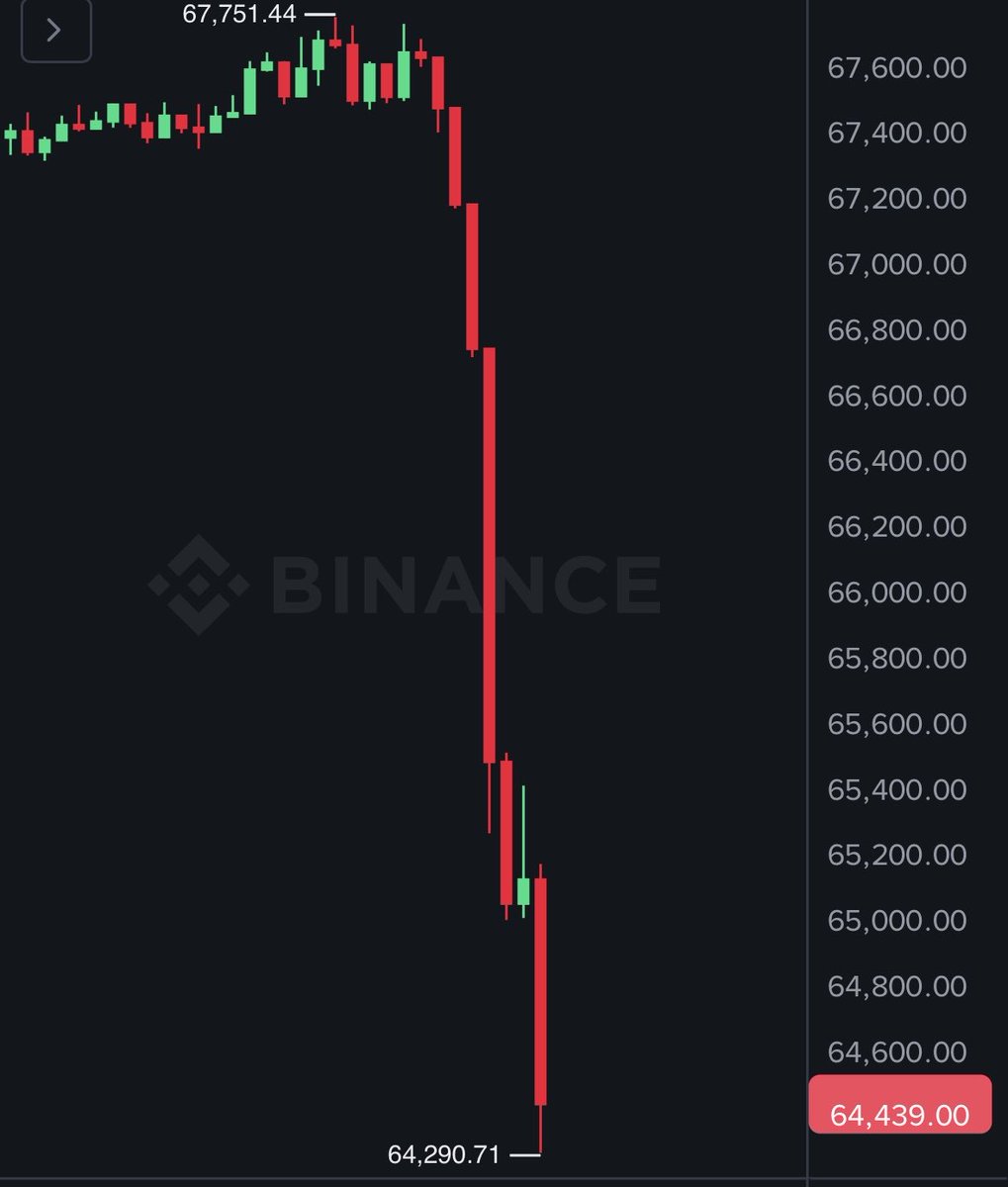
The price dropped from roughly $67,600–$68,000 to as low as $64,300 within hours. At one point, Bitcoin fell more than 5% in under two hours. As of early February 23 trading, BTC hovered between $64,500 and $64,900, down roughly 4–5% on the day.
The move pushed Bitcoin to its lowest level since early February. Year-to-date, the asset is now down approximately 24–26%. From its October 2025 all-time high above $125,000, Bitcoin has corrected nearly 47–50%.
At the same time, nearly $230–360 million in leveraged long positions were liquidated, amplifying the decline.
High Signal Summary For A Quick Glance

The ₿itcoin Therapist
@TheBTCTherapist

*Bitcoin crashes to $65,000* People who have been hodling since 2021: https://t.co/CYMXT2mZmD

02:29 AM·Feb 23, 2026

Watcher.Guru
@WatcherGuru
JUST IN: Bitcoin falls under $65,000 https://t.co/3Weocglc5q
01:48 AM·Feb 23, 2026

The Kobeissi Letter
@KobeissiLetter
BREAKING: Bitcoin falls below $65,000 as $230 million worth of levered longs are liquidated in 60 minutes. https://t.co/l7UFqggKOE

01:30 AM·Feb 23, 2026
The selloff did not come from a single headline. Instead, several macro shocks hit an already fragile crypto market at once.
First and most importantly, President Trump escalated global tariff policy.
After the U.S. Supreme Court struck down his earlier emergency tariffs under IEEPA, Trump pivoted quickly. He reimposed duties under Section 122 authority and raised blanket global tariffs to 15%, up from the prior 10% proposal.
However, confusion followed. Markets struggled to understand:
As a result, investors priced in renewed inflation risk and slower global growth. Risk assets sold off immediately. Since crypto trades as a high-beta macro asset, Bitcoin led the downside.
Loading chart...
Second, geopolitical instability in Mexico rattled markets.
On February 22, the Mexican army killed Nemesio “El Mencho” Oseguera Cervantes, leader of the powerful CJNG cartel. The operation reportedly involved U.S. intelligence support.
In response, cartel groups launched retaliatory actions. Gunmen blocked highways using burning vehicles across several states, including Jalisco and Michoacán. Flights were suspended in tourist hubs like Puerto Vallarta. Schools closed. U.S. and Canadian authorities issued travel advisories.
Although the violence remained regional, investors interpreted the event as another macro instability layer. That perception further reduced risk appetite globally.
Even before these shocks, crypto markets showed signs of exhaustion.
Additionally, record-low U.S. pending home sales and a speculative surge in the Japanese yen added global deleveraging pressure.
Therefore, when the tariff and Mexico headlines hit, the market had little support underneath it.
Altcoins fell harder, as expected.
Because altcoins carry higher beta and thinner liquidity, they amplified the risk-off move.
The shockwaves extended beyond crypto.
U.S. futures declined amid tariff uncertainty:
Investors revived the so-called “sell America” trade due to inflation and growth fears.
Meanwhile, traditional safe-haven assets diverged from crypto:
Notably, Bitcoin failed to act as “digital gold” during this stress event.
Technically, analysts now view $65,000 as a key psychological and structural support level. If Bitcoin fails to reclaim it convincingly, downside toward $60,000 becomes plausible.
However, a rebound could occur if:
For now, uncertainty dominates.
Our Crypto Talk is committed to unbiased, transparent, and true reporting to the best of our knowledge. This news article aims to provide accurate information in a timely manner. However, we advise the readers to verify facts independently and consult a professional before making any decisions based on the content since our sources could be wrong too. Check our Terms and conditions for more info.



Austria Halts KuCoin EU Expansion Over Compliance Gaps
Fluid Protocol Sets Up Legal Foundation While DAO Keeps Full Control
OpenClaw Imposes Crypto Ban on Discord Following Scam
Satoshi Era Wallet Dumps 11,300 BTC Worth $750M After 15 Years of Silence
Austria Halts KuCoin EU Expansion Over Compliance Gaps
Fluid Protocol Sets Up Legal Foundation While DAO Keeps Full Control
OpenClaw Imposes Crypto Ban on Discord Following Scam
Satoshi Era Wallet Dumps 11,300 BTC Worth $750M After 15 Years of Silence