Loading Search...



Tempo launched its mainnet today alongside the Machine Payments Protocol, a new open standard co-authored with Stripe.

Author: Sahil Thakur
High attention and emotional sentiment detected.
18th March 2026 – Tempo launched its mainnet today alongside the Machine Payments Protocol, a new open standard co-authored with Stripe for autonomous AI agent payments.
High Signal Summary For A Quick Glance

Lefteris Karapetsas
@LefterisJP

Who cares about words anyway ... https://t.co/DOmlTF2jmf https://t.co/hmYBOkXc40
https://t.co/bkinVkmwFv https://t.co/UIsupArDRJ
04:47 PM·Mar 18, 2026

tldr (tim reilly)
@tldr_x
I just spent a few minutes playing with @tempo. + Lets agents pay for tons of pre-loaded online services. + Easy set up from terminal. + My claude just paid $0.01 to hit a flight search API. + I funded the tempo wallet with a free $1.00 by verifying my X account. Whole process https://t.co/RmE1MuuDzm https://t.co/ekyDZAVavR

Agent payments will soon overtake human payments on the internet. The Machine Payments Protocol (@mpp) is a new open standard co-authored by @stripe and @tempo. It’s designed to be extensible and payment-method agnostic, already supporting stablecoins, cards, and more. https://t.co/dEjfGN2tp9
03:50 PM·Mar 18, 2026

Jeff Weinstein
@jeff_weinstein
Introducing the Machine Payments Protocol (MPP). https://t.co/lx5Xu9w0da: an open protocol for machine-to-machine payments, co-authored by @tempo and @stripe. Watch it in agentic action ⤵️
01:27 PM·Mar 18, 2026
The two launches arrive together. Tempo is a purpose-built Layer 1 blockchain designed for stablecoin payments. The Machine Payments Protocol is the application layer that lets AI agents pay for services without human approval on each transaction.
Tempo is a payments-focused Layer 1 blockchain incubated by Stripe and Paradigm. The project reportedly raised approximately $500 million at a $5 billion valuation in 2025, according to Fortune. Matt Huang, co-founder of Paradigm, is also a co-founder of Tempo.
The chain targets 100,000 transactions per second with deterministic finality in about 0.6 seconds. Gas fees stay below one cent and are paid in stablecoins, not a volatile native token. The network is EVM-compatible, built on top of the Reth execution client.
Tempo announced its testnet in September 2025 and ran it from December 2025 through launch. Partners including Mastercard, UBS, Klarna, and Visa used that period to test payouts, cross-border transfers, and stablecoin flows. The mainnet is now open, and developers can access public RPC endpoints via docs.tempo.xyz.
The Machine Payments Protocol is an HTTP-based open standard for AI agents to pay for services autonomously. Stripe and Tempo co-authored it and released it as open source. Any developer can extend or implement it without permission from either company.
The protocol works by activating HTTP 402, a “Payment Required” status code that has existed in internet standards since 1991 but was never widely used in practice. When an agent requests a paid resource, the server responds with a 402 message containing payment details. The agent then authorizes payment and retries the request with proof. The server delivers the resource and the payment settles instantly.
Stripe describes the Machine Payments Protocol as the settlement layer for what it calls the agentic economy. Because it is rail-agnostic, developers can implement it across payment methods beyond Tempo and USDC.
The key innovation in the Machine Payments Protocol is “Sessions,” described as an OAuth-for-money primitive. An agent authorizes a spending cap once. After that, payments stream continuously as the agent consumes resources, such as per API call, per second of compute, or per model inference.
Thousands of micropayments aggregate into a single final settlement transaction. This enables true pay-per-use pricing at scale without per-request friction. Microtransactions as low as $0.01 USDC are supported.
The approach means an agent can autonomously pay for a headless browser session, model inference, data lookups, and API calls across multiple providers, all within a single authorized spending limit and without human approval on each step.

Over 100 services were live in the MPP payments directory at launch, according to official announcements. That list includes model providers such as OpenAI and Anthropic, compute platforms, data services like Dune Analytics, headless browser tools like Browserbase, and automated services like Postalform.
Visa contributed full card-payment specifications to the protocol. Lightspark added a Bitcoin Lightning extension. Stripe’s standard payment tools work natively with MPP, so existing merchants can monetize APIs and gated content through a few lines of middleware code.
Cuy Sheffield, Visa’s head of crypto, said the company views MPP as a defined framework for how agents communicate with merchants. Matt Huang said the Tempo team aimed for the most minimal and elegant protocol that anyone could extend independently.
Tempo’s mainnet settles in USDC stablecoins. There is no native token and no gas token with price volatility. On the fiat side, Stripe handles cards, wallets, and BNPL. Bitcoin Lightning payments work through the Lightspark extension.
Stripe’s machine payments tools are currently in private preview for US entities. Some state restrictions apply. Developers can review documentation at docs.stripe.com/payments/machine and the MPP specification at mpp.dev.
Tempo also supports the related x402 protocol on Base and Solana through Stripe. The two protocols are designed as complementary layers: x402 handles HTTP-level payment discovery while MPP handles settlement.
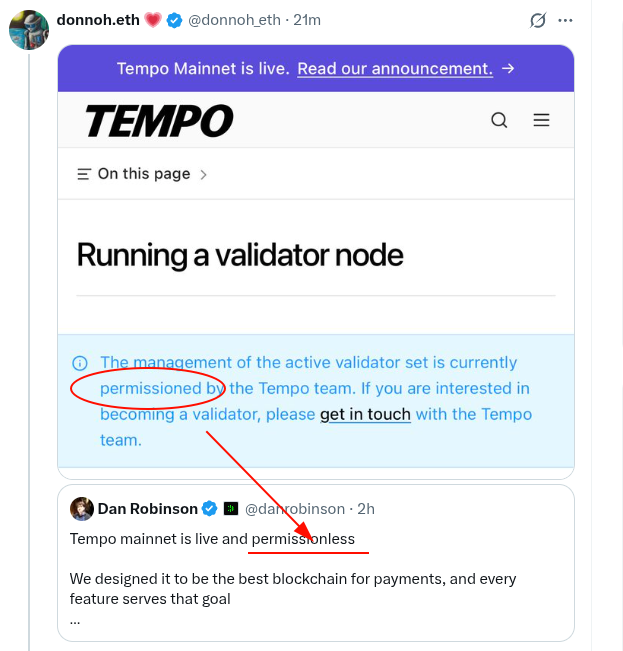
Tempo plans to expand its validator set toward a fully permissionless model. Optional privacy features are on the roadmap. The protocol team says MPP is designed to extend to multiple chains beyond Tempo as adoption grows.
The broader thesis is that AI agents will increasingly act as independent economic participants. If that happens, infrastructure like the Machine Payments Protocol could become the default payment layer for agent-driven commerce. For now, the chain is live and the standard is open. The test is whether enough developers and agents show up to use it.
Our Crypto Talk is committed to unbiased, transparent, and true reporting to the best of our knowledge. This news article aims to provide accurate information in a timely manner. However, we advise the readers to verify facts independently and consult a professional before making any decisions based on the content since our sources could be wrong too. Check our Terms and conditions for more info.