

Loading Ratings...



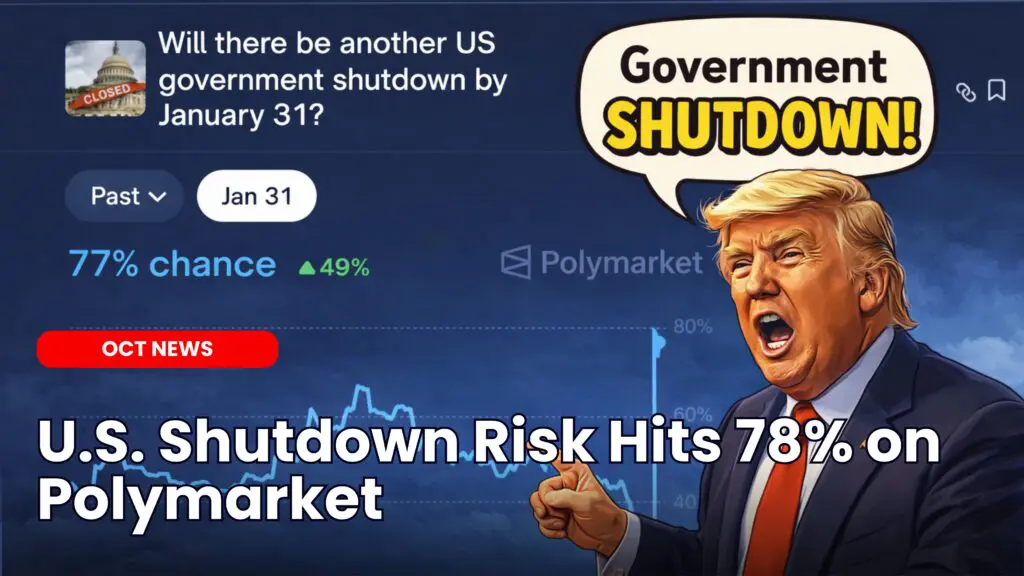
U.S. Shutdown Risk jumps to 78% on Polymarket, raising fears of liquidity drain, liquidations, and a short-term crypto pullback.

Author: Akshat Thakur
Published On: Sun, 25 Jan 2026 19:41:58 GMT
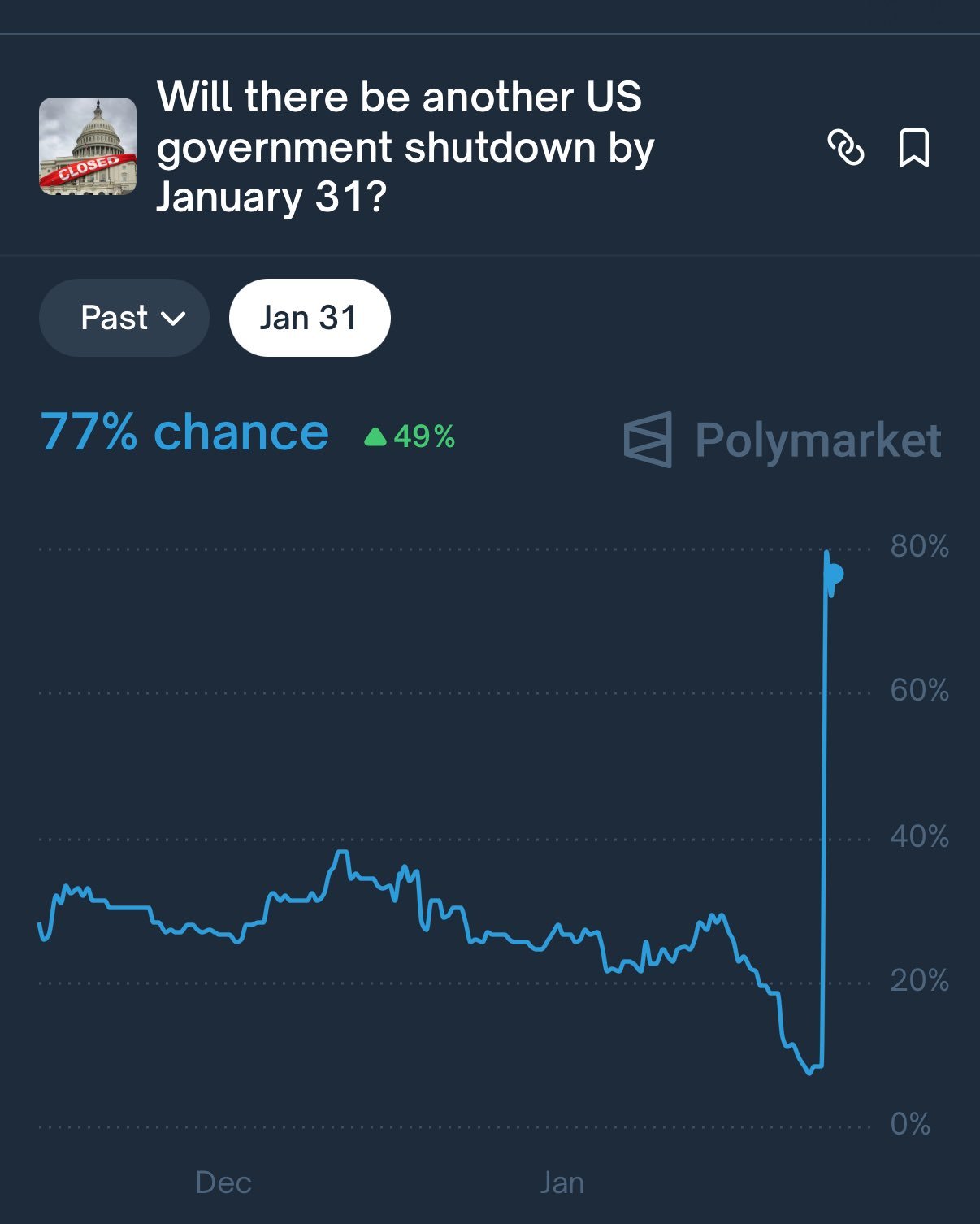
January 25, 2026 — U.S. Shutdown Risk is surging across prediction markets, with Polymarket pricing a 78% probability of a U.S. government shutdown before January 31. The sharp repricing has quickly become a macro narrative inside crypto, as traders warn that U.S. Shutdown Risk could trigger a liquidity squeeze, accelerate derivatives liquidations, and temporarily freeze momentum across high-beta altcoin
High Signal Summary For A Quick Glance
A U.S. government shutdown occurs when Congress fails to pass appropriations bills (or a continuing resolution) to fund federal agencies. When this happens, “non-essential” operations pause, workers are furloughed, and parts of the government operate in a limited capacity. Essential services typically continue, but the economic and market impact comes from uncertainty, delayed data, and risk-off positioning.
The last high-profile shutdown (October 1 to November 12, 2025) lasted 43 days and disrupted key macro reporting cycles, exactly the kind of information vacuum that tends to amplify volatility in risk assets.
The current shutdown risk has intensified because funding negotiations have become intertwined with political pressure points, especially Department of Homeland Security (DHS) budget disputes, broader immigration/security debates, and political fallout from high-profile incidents driving polarized media narratives.
That combination makes a clean continuing resolution more difficult. Markets aren’t pricing this as “routine Washington noise” anymore, Polymarket’s sharp move suggests traders view the risk as immediate and non-trivial, not just a background possibility.
Prediction markets like Polymarket act as real-time sentiment aggregators. Unlike pundit forecasts, they reflect capital-weighted conviction, and rapid swings often indicate:
The most notable feature here is the speed: moving from low probability to ~78% within a day is a major repricing, and that alone can influence broader investor psychology especially in crypto, where sentiment transmission is instant.
Key milestones in Polymarket’s U.S. shutdown odds narrative
Polymarket opens a shutdown-related market with early pricing around 10–15% as traders discount an immediate lapse.
Probability moves into the 26–40% range, then dips as market participants price in hopes of a deal or stopgap.
After a Minneapolis incident intensifies DHS funding debates, shutdown odds jump sharply into the low 70% range.
Shutdown probability climbs further, trading around 77–78% as the standoff narrative hardens.
Deadline arrives; if no continuing resolution or funding bill is signed in time, a lapse could begin.
Crypto is uniquely vulnerable to shutdown dynamics for one reason: liquidity sensitivity.
Even if shutdowns are “temporary,” they typically coincide with:
In practice, crypto tends to react through:
A key fear being amplified across CT is that shutdown turbulence can lead to liquidity tightening mechanics, especially around the U.S. Treasury General Account (TGA).
When government cash management shifts, the Treasury may rebuild balances in ways that drain liquidity from financial markets. In a high-leverage crypto market, even a modest tightening impulse can create outsized downside because crypto is priced on marginal liquidity.
This is why the shutdown narrative is being framed as “liquidity risk,” not simply “political risk.”
Real voices. Real reactions.
@cryptorover A shutdown can definitely mess with sentiment and data flow, but the bigger crypto liquidity risk is what it does to rates and the dollar, if yields/DXY stay steady, the Polymarket spike is mostly just headline vol

Our Crypto Talk is committed to unbiased, transparent, and true reporting to the best of our knowledge. This news article aims to provide accurate information in a timely manner. However, we advise the readers to verify facts independently and consult a professional before making any decisions based on the content since our sources could be wrong too. Check our Terms and conditions for more info.