Loading Search...


Five regional U.S. banks have selected zkSync Prividium blockchain to power the Cari Network, a platform designed to move tokenized deposits.

Author: Sahil Thakur
Steady attention without excessive speculation.
18th March 2026 – Five regional U.S. banks have selected zkSync’s Prividium blockchain to power the Cari Network, a platform designed to move tokenized deposits instantly between institutions while keeping funds inside the regulated banking system.
High Signal Summary For A Quick Glance

SamAlτcoin.eth 🌞
@SAMALTCOIN_ETH

🚨BREAKING: $8T+ in U.S. bank assets now testing tokenized deposits on zkSync via Cari Network — alongside initiatives involving Deutsche Bank Institutions choosing $ETH rails https://t.co/4nKkLFbtTC

01:52 PM·Mar 17, 2026

The ZKnomist
@TheZKnomist
🚨 BREAKING: 5 U.S. BANKS ARE BUILDING A TOKENIZED DEPOSIT NETWORK ON @ZKSYNC PRIVIDIUM. The Cari Network is bringing tokenized deposits onchain within existing banking systems, enabling secure, private, and compliant digital money backed by real bank liabilities. https://t.co/g3WZL2fBr8
Today marks a new chapter for U.S. banking. The Cari Network, developed alongside five regional banks, is building a new platform to bring tokenized deposits onchain. Secure. Private. Within the regulatory perimeter. Powered by ZKsync’s Prividium. https://t.co/TZYafawLV9
11:21 AM·Mar 17, 2026

Elastic Network Community
@joinelastic
BREAKING: Five U.S. banks are preparing to pilot a tokenized deposit network built on @ZKsync technology. Participants include: • Huntington Bancshares • First Horizon • M&T Bank • KeyCorp • Old National Bancorp The initiative is called Cari Network, a new banking https://t.co/h6Zh8FyiSR https://t.co/8z9qFrGyJm
Today marks a new chapter for U.S. banking. The Cari Network, developed alongside five regional banks, is building a new platform to bring tokenized deposits onchain. Secure. Private. Within the regulatory perimeter. Powered by ZKsync’s Prividium. https://t.co/TZYafawLV9
11:16 AM·Mar 17, 2026
The consortium includes Huntington Bancshares, M&T Bank, KeyCorp, First Horizon, and Old National Bancorp. Together, the five lenders hold approximately $780 billion in combined assets, making them collectively one of the largest banking groups to adopt blockchain infrastructure for deposit settlement.
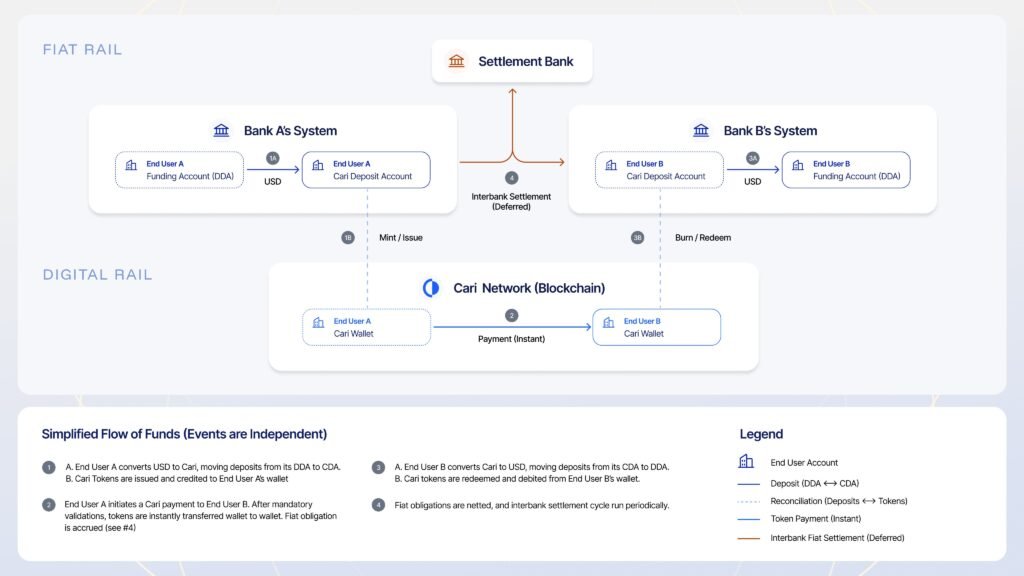
Cari Network tokenized deposits are traditional bank deposits converted into digital tokens that settle between participating banks in real time on blockchain rails. The tokens remain liabilities of the issuing bank, which means they stay on the bank’s balance sheet and qualify for existing FDIC insurance protections up to $250,000 per depositor per institution.
That distinction matters. Stablecoins like USDT and USDC are issued by nonbank companies and do not carry deposit insurance. FDIC Chairman Travis Hill confirmed on March 11 that stablecoins will not receive any form of FDIC coverage under the GENIUS Act framework.
Cari Network tokenized deposits sidestep that limitation entirely. Because regulators classify them as bank deposits regardless of the underlying technology, they retain the same protections and regulatory treatment as traditional deposits.
The Cari Network selected Prividium, a private and permissioned blockchain built by Matter Labs, the development firm behind zkSync. Prividium restricts access to approved participants only. Banks and regulators control who joins the network, creating a closed environment that mirrors traditional interbank settlement systems.
The system uses zero-knowledge proof technology to verify transactions without exposing sensitive data. That approach gives banks the speed of blockchain settlement with the privacy controls their compliance teams require. At the same time, regulators retain the ability to audit activity when needed.
The choice comes at a pivotal moment for zkSync. The public zkSync network saw transaction volumes decline roughly 90% during 2025, and the ZK token currently trades near $0.02 with a market cap around $200 million. The 2026 roadmap now explicitly targets enterprise and government use cases, making the Cari deal a significant validation of that strategic pivot.
Src: zksyncio
Cari Network is led by Gene Ludwig, former U.S. Comptroller of the Currency under President Clinton. Ludwig oversaw national bank regulation from 1993 to 1998 and has spent decades since working on banking policy and financial technology.
Ludwig framed the initiative as a proactive move rather than a defensive one. According to Cointelegraph, he said banks should be leading the next phase of digital money rather than reacting to it. His regulatory background gives the project credibility with banking supervisors who might otherwise view blockchain-based deposit systems with skepticism.
The five founding banks span the U.S. regional banking sector. Huntington Bancshares holds $225 billion in assets, M&T Bank holds $214 billion, KeyCorp manages $184 billion, First Horizon holds $84 billion, and Old National Bancorp holds $72 billion. All five rank among the top 50 U.S. banks by asset size.
The timing of the Cari launch reflects growing urgency. Stablecoin issuers have steadily absorbed functions that banks traditionally controlled, particularly payments and short-term dollar storage.
The GENIUS Act, enacted by Congress in July 2025, created a federal regulatory framework for stablecoins. The law allows insured banks to issue payment stablecoins through subsidiaries. Yet it also opened the door for nonbank issuers to compete directly with banks on regulated terms.
Industry estimates suggest more than $8 trillion in deposits currently held by U.S. regional banks could gradually shift toward tokenized models if institutional adoption accelerates. For regional lenders, that represents both an existential threat and a generational opportunity.
Cari Network tokenized deposits differ from stablecoins in one critical way. The funds never leave the banking system. Deposits stay on bank balance sheets, remain subject to bank regulation, and maintain FDIC insurance eligibility. Stablecoin reserves, by contrast, sit in money market funds or Treasury bills held by nonbank custodians.
The regulatory environment currently favors Cari’s approach. The FDIC has signaled that tokenized bank deposits should receive the same insurance treatment as non-tokenized deposits, regardless of the technology used. That position gives banks a structural edge that stablecoin issuers cannot replicate under current law.
Still, the project faces uncertainty. Regulatory approval for the specific Prividium implementation remains pending, and no live interbank transactions have occurred yet on the network. If regulators later impose additional requirements on blockchain-based deposit systems, the timeline could shift.
The broader question is whether tokenized deposits can match the speed, cost, and accessibility of stablecoins while operating within the constraints of bank regulation. Cari’s pilot will be the first real test of that proposition at scale.
The Cari Network plans to launch a pilot program in Q3 2026 covering the issuance, transfer, and redemption of Cari Network tokenized deposits. A full commercial rollout is targeted for Q4 2026.
If the timeline holds, Cari could become one of the first multi-bank tokenized deposit networks operating on blockchain infrastructure in the United States. The pilot will test whether the system can handle interbank settlements at the speed and scale needed to compete with stablecoin rails.
For the broader crypto industry, the Cari Network signals that traditional finance is building its own blockchain infrastructure with regulatory advantages that stablecoin issuers currently lack. Whether banks can execute fast enough to stem deposit flight remains the open question heading into the second half of 2026.
This article is for informational purposes only and does not constitute financial advice.
Our Crypto Talk is committed to unbiased, transparent, and true reporting to the best of our knowledge. This news article aims to provide accurate information in a timely manner. However, we advise the readers to verify facts independently and consult a professional before making any decisions based on the content since our sources could be wrong too. Check our Terms and conditions for more info.



US Banks Launch Cari Network on zkSync to Rival Stablecoins
Vietnam announces plans to ban trading on Binance and OKX
SEC Declares 18 Crypto Assets As Digital Commodities
OpenSea Delays $SEA Token Launch, Offers Fee Refunds
US Banks Launch Cari Network on zkSync to Rival Stablecoins
Vietnam announces plans to ban trading on Binance and OKX
SEC Declares 18 Crypto Assets As Digital Commodities
OpenSea Delays $SEA Token Launch, Offers Fee Refunds