Loading Search...


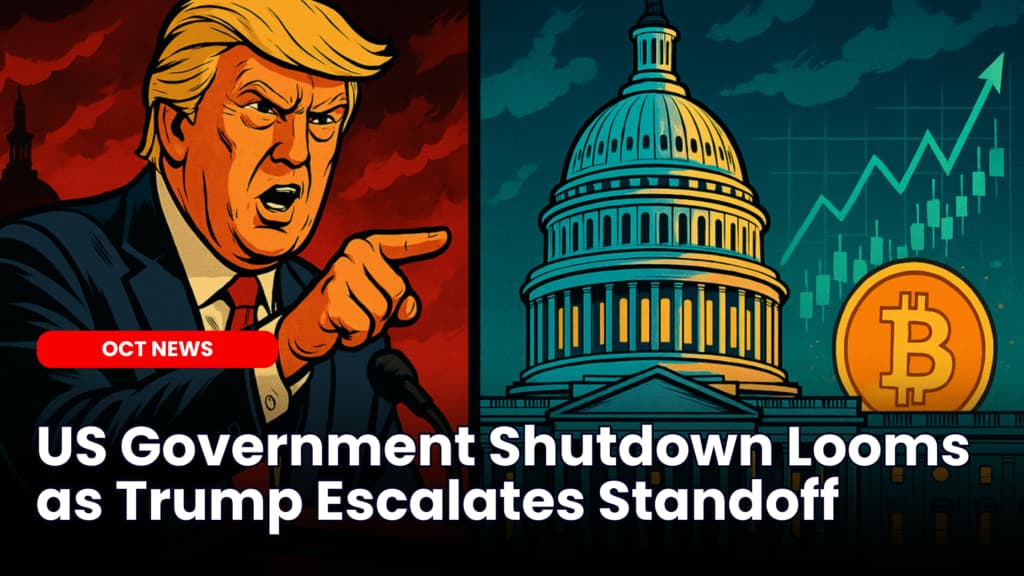
A $1.7T spending clash pushes the US toward a 2025 government shutdown, with Trump escalating tensions and markets including crypto on edge.

Author: Chirag Sharma
September 30, 2025 – As the fiscal year deadline passed, the US edged dangerously close to a government shutdown. The stalemate stems from a $1.7 trillion spending bill, where Republican demands for cuts clash with Democratic priorities such as green energy subsidies. President Donald Trump has intensified the showdown, blasting Democrats on X for “reckless spending” and urging Republicans to hold the line. If no resolution emerges, millions will feel the impact as non-essential government services grind to a halt.
A government shutdown occurs when Congress fails to approve funding legislation by the fiscal deadline, halting discretionary spending. Essential services—national defense, Social Security, and emergency healthcare—remain active. But approximately 2.6 million non-essential federal workers face furloughs without pay until a budget is approved.
The tool, formalized in the 1970s, has become a weapon of leverage during political standoffs. This year’s clash is no exception: Republicans emphasize fiscal restraint, while Democrats defend social and climate spending. Trump’s involvement adds fuel, framing the debate as a fight against “socialists” in Washington.
Immediate consequences include the closure of national parks, suspended FDA inspections, and IRS delays. The cost of lost productivity alone is estimated at $200M daily.
Markets wasted no time reacting. The S&P 500 slid 0.8% in pre-shutdown trading, while the VIX fear index spiked 15% in a week. Defense contractors and travel-related stocks weakened on expectations of contract delays and tourism disruptions. Conversely, bonds rallied as investors sought safety.
Cryptocurrencies mirrored the volatility. Bitcoin held near $62,000 but faces the risk of a 5–10% dip if risk-off sentiment deepens. Altcoins could fare worse due to thinner liquidity, though some investors argue shutdowns highlight crypto’s appeal as a to fiat systems.
Extended shutdowns shave an estimated 0.1–0.2% from GDP each week, compounding lost wages with shaken consumer confidence. Treasury auctions can suffer from reduced foreign appetite, while investor trust in US governance takes a hit.
For crypto, shutdowns delay SEC approvals of ETFs and regulatory frameworks—stalling domestic innovation. Yet in the longer term, resolution periods often bring rebounds, and Trump’s Bitcoin-friendly stance suggests post-shutdown policy resets could favor digital assets.
History underscores the risks but also the resilience of markets. The 2018–19 shutdown under Trump lasted 35 days, costing $11B and triggering a 4% Dow drop. In 2013, a 16-day closure linked to Obamacare caused a 1% S&P slip but temporary bond rallies.

Crypto’s response has been mixed. Bitcoin climbed 14% during the 2013 shutdown as fiat instability spotlighted decentralization. But in 2018, broader market weakness dragged Bitcoin down 20%. Typically, equities recover within a year, averaging 12% S&P gains post-shutdown. The longer-term question is whether investor confidence in US governance can withstand repeated fiscal brinkmanship.
Our Crypto Talk is committed to unbiased, transparent, and true reporting to the best of our knowledge. This news article aims to provide accurate information in a timely manner. However, we advise the readers to verify facts independently and consult a professional before making any decisions based on the content since our sources could be wrong too. Check our Terms and conditions for more info.



Dubai Token2049 Cancelled Amid Middle East Geopolitical Conditions
Across Protocol Plans Potential Move from DAO to U.S. C-corp Structure
Former UK PM Boris Johnson Calls Bitcoin a “Giant Ponzi Scheme”
Quant CEO Announces ISO’s First Global Blockchain Interoperability Standard
Dubai Token2049 Cancelled Amid Middle East Geopolitical Conditions
Across Protocol Plans Potential Move from DAO to U.S. C-corp Structure
Former UK PM Boris Johnson Calls Bitcoin a “Giant Ponzi Scheme”
Quant CEO Announces ISO’s First Global Blockchain Interoperability Standard