Loading Search...


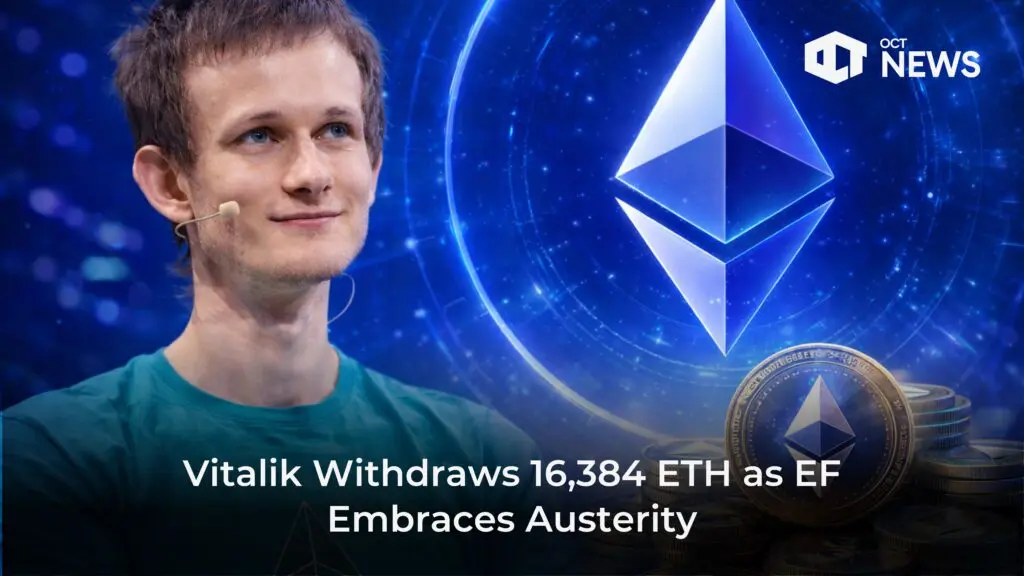
Vitalik Withdraws 16,384 ETH as the Ethereum Foundation adopts mild austerity to fund open-source privacy and security projects.

Author: Akshat Thakur
January 30, 2026 — Vitalik Buterin Withdraws 16,384 ETH in a major personal funding move aimed at accelerating open-source, secure, and verifiable technology development. The withdrawal, worth roughly $45 million, comes as the Ethereum Foundation embraces “mild austerity”, signaling a new phase of disciplined spending while Ethereum pushes forward with its roadmap.
High Signal Summary For A Quick Glance

bdz
@bdznft

@VitalikButerin This is the kind of long-term thinking that separates crypto from traditional tech. Most CEOs optimize for quarters; Vitalik is building for the next century. "Ethereum for people who need it" over "corposlop" — that's the real vision.
In these five years, the Ethereum Foundation is entering a period of mild austerity, in order to be able to simultaneously meet two goals: 1. Deliver on an aggressive roadmap that ensures Ethereum's status as a performant and scalable world computer that does not compromise on
09:19 AM·Jan 30, 2026

DΞSH
@whereislamb0
@VitalikButerin This path is more difficult, slower, and less marketable. But if Ethereum has a long-term mission at all, it's here: to create a verifiable, open infrastructure that works for people, not on top of them.
In these five years, the Ethereum Foundation is entering a period of mild austerity, in order to be able to simultaneously meet two goals: 1. Deliver on an aggressive roadmap that ensures Ethereum's status as a performant and scalable world computer that does not compromise on
08:54 AM·Jan 30, 2026

Uttam
@uttam_singhk
@VitalikButerin Ethereum for people who need it.
In these five years, the Ethereum Foundation is entering a period of mild austerity, in order to be able to simultaneously meet two goals: 1. Deliver on an aggressive roadmap that ensures Ethereum's status as a performant and scalable world computer that does not compromise on
08:32 AM·Jan 30, 2026
Buterin framed the withdrawal as a deliberate effort to accelerate work that supports self-sovereignty and resilience especially as the broader tech landscape becomes more centralized and surveillance-driven. In his post, he positioned the funding as fuel for “full stack” open-source efforts rather than short-term market narratives.
He emphasized that this capital will go toward tooling and infrastructure that can be independently verified, audited, and trusted including systems built for finance, communication, governance, hardware and operating systems, and even biotech and public health-related tools.
The number itself stood out: 16,384 ETH is 2¹⁴, which many in the community interpreted as a symbolic “engineer’s choice,” reinforcing the idea that this was planned and purpose-driven rather than impulsive selling.
The Ethereum Foundation’s austerity language reflects a real shift in tone: prioritizing sustainability, reducing unnecessary burn, and focusing spending on outcomes that strengthen Ethereum’s base-layer mission.
This comes after years of criticism from parts of Crypto Twitter and some ETH holders who argued EF spending lacked transparency or delivered unclear ROI. A tighter approach also helps the Foundation maintain longevity through market cycles, especially if crypto enters another risk-off environment.
Importantly, austerity here doesn’t mean Ethereum development slows down it implies tighter prioritization: fewer “nice-to-have” initiatives, more spending directed toward core primitives, security, scaling paths, and credible public goods.
Key milestones in Ethereum’s evolution and Vitalik’s 2026 cypherpunk pivot
The Ethereum Foundation is formed after Ethereum’s ICO to support development, research, and long-term ecosystem growth.
Ethereum completes its landmark proof-of-stake upgrade, shifting consensus from mining to validator-based security and staking.
Vitalik Buterin signals 2026 as a year for reclaiming Ethereum’s cypherpunk values, emphasizing privacy, resilience, and decentralization.
Buterin announces a renewed focus on austerity and long-term sustainability, alongside a 16,384 ETH withdrawal that draws attention across the ecosystem.
Buterin made it clear the funding will support a broad range of initiatives. It is not limited to “Ethereum things,” but includes infrastructure that strengthens individual autonomy in the digital world.
He framed this around verifiability and user control. That includes secure communication stacks, open-source operating systems, and hardened hardware and software for financial and governance systems. The emphasis wasn’t simply “new apps,” but tools that reduce dependency on opaque intermediaries.
This aligns closely with Ethereum’s narrative shift in late 2025 and early 2026. Its competitive focus has moved away from throughput wars and toward becoming the most trusted settlement layer for high-integrity applications.
Even outside Ethereum, this announcement reinforces a key theme across crypto in 2026. Mission drift is real, and big ecosystems must decide what they stand for.
As more chains compete on speed and incentives, Ethereum’s leadership is leaning harder into credibility: open-source tooling, verified execution, privacy primitives, and long-term resilience. If successful, that could shape not only ETH’s value narrative but also where builders choose to deploy serious applications.
In other words, this isn’t just “Vitalik moved funds.” It’s a directional marker for how Ethereum intends to compete.
Our Crypto Talk is committed to unbiased, transparent, and true reporting to the best of our knowledge. This news article aims to provide accurate information in a timely manner. However, we advise the readers to verify facts independently and consult a professional before making any decisions based on the content since our sources could be wrong too. Check our Terms and conditions for more info.