Loading Search...


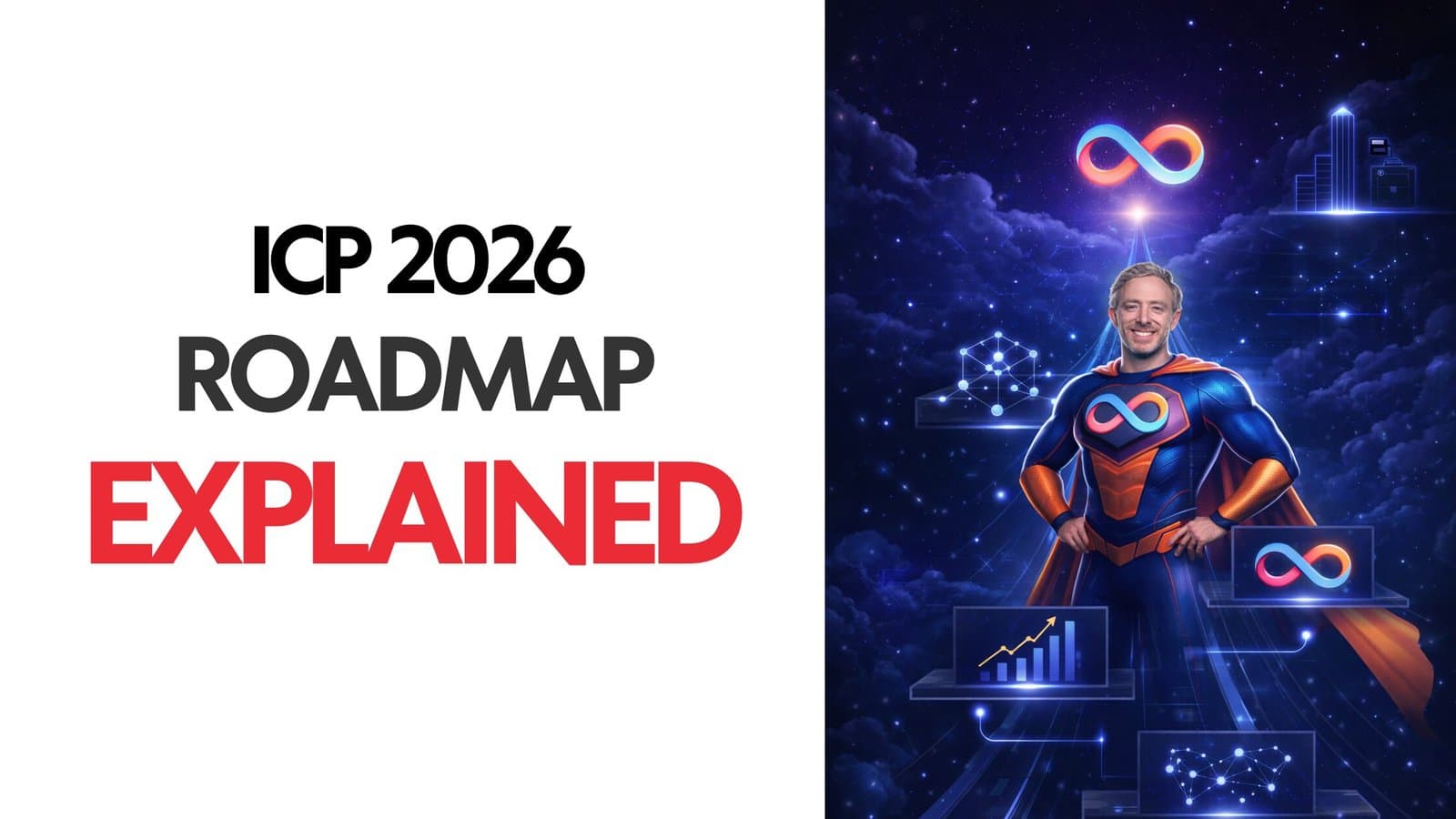
2026 ICP roadmap explained, covering AI integration, Mission70 tokenomics, Chain Fusion interoperability, and what it means for you.

Author: Tanishq Bodh
The Internet Computer Protocol has reached a critical inflection point. After several years focused on proving what was technically possible, ICP is now shifting toward proving what is economically and socially viable. The release of the Mission70 white paper on January 14, 2026, makes that shift explicit. This is no longer a roadmap about experimentation. It is a roadmap about adoption, sustainability, and real-world relevance.
The 2026 ICP roadmap explained is best understood as a transition from infrastructure-first thinking to usage-first execution. Instead of asking whether decentralized compute can rival centralized cloud providers, ICP is now asking how quickly developers, enterprises, and users can adopt it without friction. Artificial intelligence, tokenomics reform, interoperability, and developer accessibility sit at the center of this plan.
Importantly, this roadmap does not abandon ICP’s long-term vision of a decentralized World Computer. Rather, it sharpens it. By reducing inflation, simplifying developer tooling, and embedding AI directly on-chain, ICP is positioning itself as a serious alternative to traditional cloud infrastructure. For builders, investors, and users, 2026 is less about promises and more about outcomes.
This article breaks down what is changing, why it matters, and how the 2026 ICP roadmap explained reshapes the protocol’s trajectory over the next decade.
The Internet Computer Protocol operates differently from most blockchains. Instead of optimizing for token transfers, ICP functions as a decentralized cloud capable of hosting applications, data, and artificial intelligence entirely on-chain.
Launched in 2021 by the DFINITY Foundation, ICP introduced Chain-Key cryptography, which allows independent subnets to scale horizontally while remaining interoperable. These subnets can process thousands of transactions per second with low latency, enabling full-stack applications to run without relying on centralized servers.

IC: Greater Zurich Area
Another defining feature is the reverse gas model. Applications pay for computation, not users. As a result, end users interact with dApps much like traditional web services, without managing wallets or gas fees. This design choice underpins ICP’s broader adoption strategy.
By 2025, the network had already demonstrated on-chain AI execution, native integrations with Bitcoin and Ethereum without bridges, and verifiable credentials used by global institutions. The 2026 ICP roadmap explained builds directly on these foundations, shifting focus from proof to scale.
Earlier ICP roadmaps prioritized deep technical breakthroughs. While necessary, that approach introduced complexity and slowed non-technical adoption. The 2026 roadmap corrects this imbalance.
Instead of showcasing what is possible, the roadmap concentrates on what is usable. AI moves from experimental demos to revenue-generating infrastructure. Interoperability expands from isolated integrations to unified liquidity. Tokenomics transitions from inflation-heavy bootstrapping to long-term sustainability.

IC : Mission70 (ICP)
This evolution reflects feedback from developers, enterprises, and token holders. The roadmap now optimizes for clarity, predictability, and economic alignment. As a result, the 2026 ICP roadmap explained represents a maturity milestone rather than another innovation cycle.

IC : Mission70 (ICP)
Artificial intelligence sits at the center of ICP’s 2026 vision. Rather than treating AI as an add-on, ICP integrates it as a native network function.
AI Worker Monetization, planned for mid-2026, allows developers to train and deploy models directly on-chain and earn revenue per inference. This removes reliance on centralized APIs and eliminates data leakage risks.
Self-writing applications represent another major leap. These systems allow AI models to generate, deploy, and maintain software autonomously. Combined with Open Caffeine, a natural-language development interface, ICP significantly reduces the barrier to entry for application creation.
In practical terms, developers can describe an application in plain language and deploy it on-chain without writing traditional code. This shift transforms ICP from a developer-only platform into an accessible compute layer for businesses and individuals.
Within the 2026 ICP roadmap explained, decentralized AI is no longer aspirational. It becomes a revenue-generating, production-ready system.
Cross-chain interoperability has historically relied on bridges, which introduced systemic risk. ICP’s Chain Fusion model removes this dependency.
In 2026, ICP expands native integrations to Dogecoin, BNB Chain, and XRPL. Assets move directly between chains using Chain-Key cryptography, without wrapped tokens or external validators.
This design allows decentralized exchanges on ICP to access liquidity from Bitcoin and Ethereum while maintaining on-chain security. Early 2026 demonstrations already show seamless swaps across networks.
For users, this means fewer hacks, lower friction, and faster settlement. For developers, it simplifies cross-chain design. The 2026 ICP roadmap explained positions Chain Fusion as a foundational advantage rather than a feature.
Scalability remains a central concern for any decentralized compute platform. ICP addresses this through the Fission protocol, scheduled for rollout in early 2026.
Fission introduces load balancing, auto-scaling, and support for up to one million canisters per subnet. These upgrades allow applications to scale dynamically, similar to traditional cloud services.
Wallet applications, or Wapps, further enhance user control. Users can install personal applications directly on-chain, retaining ownership of data and logic. Combined with the reverse gas model, this enables Web3 experiences that feel indistinguishable from Web2.
From a practical perspective, these improvements make ICP viable for enterprise workloads. Within the 2026 ICP roadmap explained, compute upgrades transform ICP into a competitive cloud alternative.
Tokenomics reform represents one of the most consequential elements of the 2026 roadmap. Mission70 proposes a 70 percent reduction in ICP inflation.
This change directly addresses long-standing concerns around dilution. Lower emissions reduce sell pressure while increasing the importance of utility-driven demand.
Additional governance updates include lower minimum dissolve delays and long-term staking recognition through NNS badges. These incentives reward alignment and participation rather than short-term speculation.

IC : Mission70 (ICP)
By tying token value more closely to network usage, the 2026 ICP roadmap explained reframes ICP as an infrastructure asset rather than a high-inflation utility token.
Privacy shifts from optional to default in 2026. VetKeys enable encrypted messaging and secure data access, while on-chain KYC tools support compliance without sacrificing decentralization.
The Chain Name System simplifies identity and naming, making applications easier to navigate and trust. These tools bridge the gap between enterprise requirements and blockchain-native privacy.
For regulated industries, this matters. The 2026 ICP roadmap explained positions ICP as a platform capable of supporting compliant, privacy-first applications at scale.
For developers, the roadmap lowers friction. No-code tools, AI-driven deployment, and expanded language support accelerate time to market.
For enterprises, ICP offers sovereign cloud infrastructure without vendor lock-in. Integration with standards like ISO 20022 enables tokenized payments and enterprise-grade workflows.

For investors, reduced inflation and increasing utility improve long-term value capture. As AI workloads increase, cycle burns tie network growth directly to token economics.
The 2026 ICP roadmap explained signals a shift from speculative narratives to measurable adoption.
Despite progress, risks remain. Rapid adoption could stress infrastructure, although Fission aims to mitigate this. Regulatory uncertainty around AI and DeFi persists globally.
Competition from high-throughput chains intensifies. However, ICP’s on-chain AI and Chain Fusion remain difficult to replicate.
Market volatility also affects perception. Still, Mission70 reduces long-term dilution risk, strengthening ICP’s economic foundation.
The 2026 ICP roadmap explained marks a turning point. ICP evolves from a technically impressive experiment into a usable, economically aligned platform.
By prioritizing AI, interoperability, and sustainability, ICP positions itself as a decentralized compute layer for the next generation of applications. The roadmap does not promise overnight dominance. Instead, it delivers structural improvements that compound over time.
As blockchain and AI converge, ICP’s approach offers a compelling alternative to centralized infrastructure. Whether it becomes the World Computer depends on execution, adoption, and continued alignment. However, 2026 makes one thing clear. ICP is no longer building for the future alone. It is building for users now.