Loading Search...


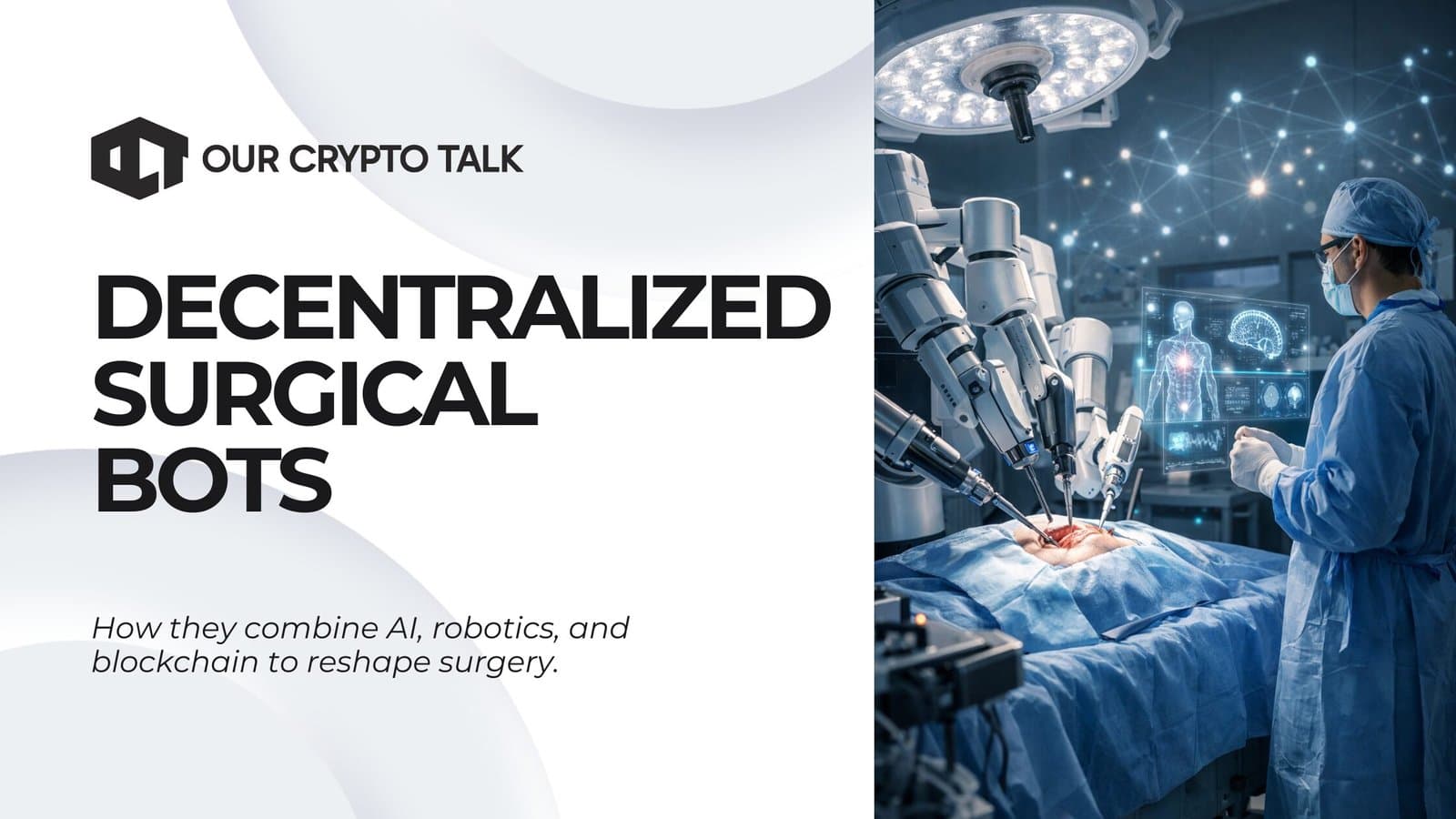
Decentralized surgical bots combine AI, robotics, and blockchain to reshape surgery with greater precision, transparency, and global access.

Author: Chirag Sharma
Healthcare robotics already plays a role in modern operating rooms. Surgeons use robotic assistance to improve precision, reduce invasiveness, and shorten recovery times. Yet most of these systems still depend on centralized software, closed data environments, and proprietary control.
Decentralized surgical bots introduce a different architecture.
Instead of relying on a single company or server, these systems combine robotics, artificial intelligence, and blockchain to operate across distributed networks. Surgical actions, AI decisions, and system updates no longer live inside siloed databases. They become verifiable, shareable, and auditable.
This shift matters because healthcare struggles with three structural problems:
Traditional robotic platforms such as the da Vinci Surgical System still operate inside closed ecosystems. Hospitals trust one vendor for software updates, data integrity, and system reliability. Decentralized surgical bots remove this dependency.
Web3 principles strongly influence this evolution. Blockchain enables patient-controlled data ownership. Smart contracts automate consent and compliance. Decentralized AI training improves accuracy by learning from global datasets rather than isolated hospitals.
For underserved regions, the implications are even larger:
Tokenized incentive models further accelerate adoption. Contributors who provide data, compute power, or validation receive rewards. This mirrors decentralized science models and helps sustain long-term innovation.
Decentralized surgical bots do not replace surgeons. They expand human capability while improving trust at the system level.

Blockchain does more than store data. In decentralized surgical bots, it acts as the coordination layer that aligns machines, humans, and intelligence without central oversight.
Every surgical procedure generates a trail of decisions and actions. Planning inputs, robotic movements, sensor readings, and post-operative assessments all produce data. Blockchain anchors cryptographic proofs of this data, creating a permanent and verifiable record.
This structure changes accountability. Hospitals can review outcomes without altering history. AI developers can improve models based on real-world performance. Regulators gain clearer visibility into how systems behave over time.
Consent also becomes more robust. Instead of relying on paperwork and internal databases, smart contracts record patient approvals transparently. These approvals remain tamper-resistant and easy to audit, reducing both friction and compliance risk.
Precision-heavy procedures benefit as well. In areas like spine surgery, augmented reality navigation demands accuracy and integrity. Decentralized storage combined with on-chain verification ensures that navigation data stays secure and accessible. Networks such as Ethereum already support these architectures.
AI training may be the most important shift. Centralized datasets often introduce bias and limit learning. Decentralized surgical bots rely on federated learning, where hospitals contribute anonymized data while keeping control locally. The AI improves collectively, without centralizing sensitive information.
This approach unlocks several advantages at once:
Supply chain verification adds another layer of safety. Blockchain-based certificates allow surgical bots to confirm the authenticity of instruments and components before use. In an industry plagued by counterfeit devices, this matters more than it seems.
Performance remains a constraint. Surgery allows little room for latency. High-throughput chains like Solana and layer-2 solutions address these limits, though infrastructure continues to evolve.
Overall, blockchain turns surgical robotics from isolated tools into coordinated systems.

BioNexus approaches decentralized surgical bots from the research and experimentation side rather than direct operating-room deployment. The project focuses on autonomous robotic laboratories where experiments run through smart contracts instead of centralized research institutions. This matters because surgical robotics depends heavily on validated datasets, simulations, and repeatable outcomes.
Rather than treating research as a black box, BioNexus makes experimentation transparent and verifiable. Surgical simulations, robotic task training, and medical research outputs remain immutable and auditable on-chain. Over time, this creates a trusted foundation for training decentralized surgical bots without relying on closed academic or corporate databases.
Key aspects of BioNexus include:
This model lowers barriers to participation while improving trust in how surgical AI systems are trained and evaluated.
Robomed takes a more practical, clinical approach. Instead of focusing purely on robotics, it builds a blockchain-secured healthcare layer that combines AI diagnostics, wearable data, and telemedicine. This layer becomes especially relevant when decentralized surgical bots depend on accurate, verified inputs before any procedure begins.
In traditional systems, diagnostic data often sits across disconnected providers. Robomed addresses this fragmentation by anchoring diagnostic and patient data on-chain. Surgical bots operating within such a framework can validate inputs before acting, reducing the risk of errors caused by incomplete or outdated information.
Robomed’s contribution shows up in areas such as:
While Robomed does not manufacture surgical robots directly, it strengthens the decision layer that decentralized surgical bots rely on.
Most discussions around surgical robotics focus on hardware and algorithms, but compute infrastructure quietly determines whether these systems scale. Surgical AI requires heavy simulation, real-time inference, and continuous retraining. Centralized cloud providers create cost, dependency, and availability risks.
Aethir addresses this problem by offering decentralized GPU infrastructure designed for physical AI workloads. For decentralized surgical bots, this means training and simulation can continue without reliance on a single cloud provider.
Aethir’s relevance becomes clear when you look at:
Infrastructure like this does not grab headlines, but it plays a critical role in making decentralized surgical bots viable beyond pilots.
Beyond named projects, a broader wave of decentralized health and DeSci initiatives is filling in missing pieces of the ecosystem. Some focus on decentralized treatment planning using AI consensus models. Others explore tokenized ownership of medical data and surgical outcomes.
These projects often operate upstream or downstream from surgery itself, but their impact remains significant. They shape how data gets shared, how incentives align, and how governance evolves in medical systems that rely on automation.
Common themes across these initiatives include:
While not all of these projects deploy robots directly, they build the economic and governance layers that decentralized surgical bots will depend on long term.
Over the next decade, decentralized surgical bots are likely to move from early adoption to foundational infrastructure in advanced healthcare systems.
Training will change first. Immersive simulations connected to real surgical data will standardize education globally. Surgeons will learn from shared outcomes rather than isolated cases.
Economic models will evolve alongside technology. Tokenized systems will fund ongoing research and reward contributors based on measurable performance rather than speculation.
Healthcare delivery itself may shift. Predictive monitoring could reduce the need for surgery by identifying risks earlier. When intervention becomes necessary, decentralized surgical bots will operate within transparent, verifiable frameworks.
Regulatory clarity will improve gradually. Governments already explore blockchain standards for healthcare data. Ethical AI governance will likely integrate directly into protocol design.
Decentralized surgical bots represent more than automation. They reflect a structural shift toward healthcare systems built on transparency, collaboration, and patient-centric control.