Loading Search...


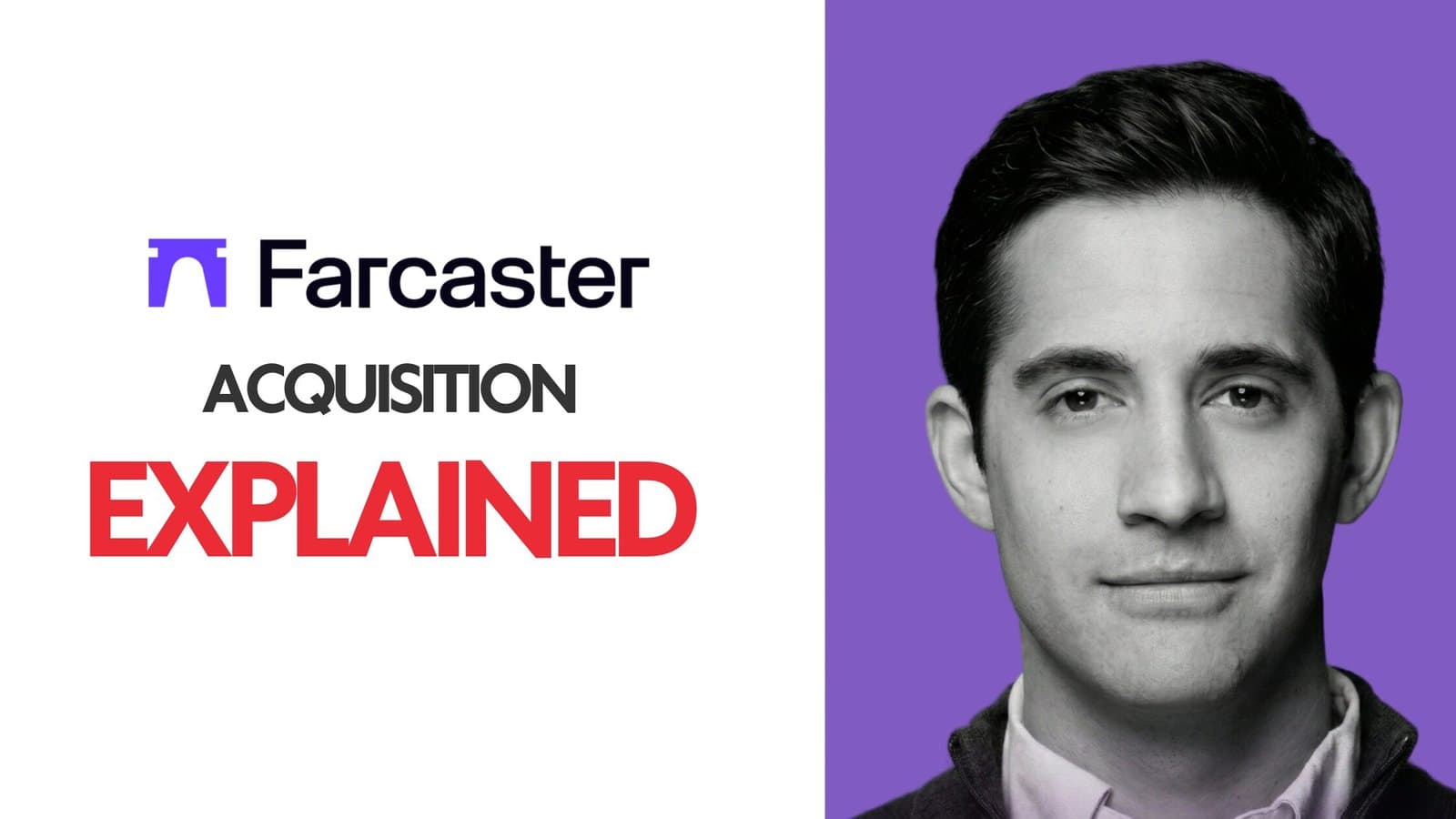
Farcaster saga explained, covering its rise as a Web3 social protocol, internal failures, and the controversial Neynar acquisition.

Author: Tanishq Bodh
For a brief moment, Farcaster represented one of Web3’s most convincing answers to Big Tech, controlled social media. It promised user-owned identities, censorship resistance, and composable social applications built directly on blockchain rails. To many in crypto, it looked like the long-awaited alternative to X, one that removed platform risk and returned ownership to users.
By early 2026, that vision collided with reality.
Farcaster, once valued at $1 billion and backed by nearly $180 million in venture funding, was acquired by Neynar, an infrastructure startup that had raised roughly $14 million. The acquisition triggered backlash across crypto Twitter. Critics framed it as a slow-motion rug pull. Supporters argued it was a necessary survival move in a brutal market.
This explained article breaks down the full Farcaster saga. We trace its origins, growth, internal fractures, and controversial acquisition. More importantly, we examine what Farcaster reveals about decentralized social media, venture-backed Web3 products, and the limits of protocol idealism.
Farcaster was founded in 2020 by Dan Romero and Varun Srinivasan, both alumni of Coinbase. Their motivation was simple but powerful. Centralized social platforms expose users to platform risk. Accounts, audiences, and livelihoods can disappear overnight due to policy changes or bans.

Farcaster set out to solve this by separating social identity from any single app.
At the protocol level, Farcaster allowed users to own cryptographic keys tied to their identity. Posts, called casts, were written onchain. Any developer could build a client on top of the protocol without permission. In theory, this meant no single company controlled the social graph.
The flagship client, Warpcast, made this vision usable. It looked familiar enough to onboard crypto-native users while introducing onchain features like verifiable identities and paid storage to reduce spam.
Early funding reinforced confidence. In 2022, Merkle Manufactory, Farcaster’s parent company, raised $30 million led by Andreessen Horowitz, with participation from Coinbase Ventures and others. Farcaster quickly became the poster child for decentralized social.
Still, from the start, tension existed. Warpcast remained the dominant interface. Moderation and infrastructure were not fully decentralized. Critics warned that Farcaster was more protocol in theory than in practice.
The real acceleration came in 2023 and 2024.
As crypto markets recovered, Farcaster attracted developers, artists, and traders looking for a cleaner social environment. Daily active users climbed into the tens of thousands. Engagement felt high quality, especially compared to spam-heavy crypto Twitter.
In May 2024, Farcaster raised a $150 million Series A at a $1 billion valuation. Paradigm, a16z, and Haun Ventures joined the round. Total funding reached roughly $180 million.

Product momentum followed. Frames, later rebranded as Mini Apps, allowed users to perform onchain actions directly inside social posts. Users could mint NFTs, trade tokens, vote, or play games without leaving the feed. This feature became Farcaster’s defining innovation.
Revenue began to appear. By mid-2024, Farcaster had generated around $2 million from storage fees and related activity. During peak moments, daily active users ranged between 50,000 and 80,000.
At this stage, Farcaster was widely described as crypto’s best shot at decentralized social.
Even during its peak, Farcaster showed signs of strain.
Frames became a vector for scams and low-effort engagement. Spam increased despite onchain verification. Power user programs and badges sparked accusations of favoritism. Channel confiscations contradicted the narrative of permissionless communities.
More importantly, growth plateaued. Farcaster remained a niche crypto product. Monthly active users never escaped the low tens of thousands. Outside of Web3 circles, adoption was negligible.

The decentralization story also weakened. Warpcast remained the default client. Moderation decisions were centralized. Governance was informal and founder-driven. For many users, Farcaster felt increasingly like a Web2 app with Web3 branding.
By 2025, the problems became impossible to ignore.
User activity dropped sharply. Daily active users fell roughly 40 percent year over year. Revenue collapsed by more than 80 percent. Q4 2025 revenue came in at under $2 million, with some months barely clearing five figures.
Spam worsened. Community trust eroded. Feedback was often dismissed. In December 2025, Romero and Srinivasan announced a strategic pivot away from decentralized social toward wallets and trading tools.
The message landed badly.
Founders publicly stated that decentralized social “doesn’t work.” For early believers, this felt like abandonment of the core thesis. Confidence in leadership evaporated.
An attempt to stabilize revenue followed. Farcaster acquired Clanker, a social trading protocol generating significant fee volume. The move failed to reverse declining engagement. The social layer remained broken.
By the end of 2025, Farcaster faced an existential question. It had capital, but no momentum and no clear product-market fit.
On January 21, 2026, Farcaster announced its acquisition by Neynar, a developer-focused infrastructure company.
Neynar had raised approximately $14 million and was best known for APIs and backend tooling supporting Farcaster apps. The founders stepped back from daily operations, framing the deal as a long-planned transition.
Financial details were limited. Reports suggested the acquisition occurred near Farcaster’s prior valuation. In an unusual move, Merkle Manufactory committed to returning the full $180 million to investors.
Supporters viewed the acquisition as an ecosystem handover that preserved the protocol. Critics saw it as a soft landing for founders after strategic failure.
The optics were brutal. A billion-dollar social protocol changing hands to a company with a fraction of the funding reinforced accusations of mismanagement and overvaluation.
Several unresolved issues fueled the backlash.
First, there was no native token. For years, speculation around a Farcaster token circulated. It never materialized. Early users received no ownership, governance, or upside. In crypto, expectations matter, and silence bred resentment.
Second, founder optics mattered. Romero faced criticism over personal wealth, secondary share sales, and lifestyle choices during Farcaster’s decline. While he denied misuse of investor funds, trust had already eroded.
Third, decentralization failed the stress test. Central moderation, channel seizures, and VC-driven control contradicted the original narrative. Farcaster became a case study in how decentralization promises can collapse under operational pressure.
The Farcaster saga offers hard lessons.
Decentralized social is structurally difficult. Network effects favor incumbents. Spam resistance is expensive. Monetization without exploitation remains unsolved.
Venture funding accelerates growth but magnifies failure. A billion-dollar valuation without mass adoption invites scrutiny. When growth stalls, narratives unravel quickly.
Finally, protocol idealism must align with product reality. Without sustainable engagement, decentralization becomes branding rather than substance.
Farcaster did not fail because the idea of decentralized social is wrong. It failed because execution, incentives, and governance never fully aligned.
Its rise showed what is possible when crypto-native design meets social media. Its fall exposed how fragile that vision remains without scale, trust, and clear ownership structures.
Under Neynar, Farcaster may survive as infrastructure rather than a cultural movement. Whether decentralized social can succeed elsewhere remains an open question.
What is clear is this. Web3 no longer rewards vision alone. It demands durable products, honest governance, and alignment between builders and users.