Loading Search...


Understand the CLARITY Act: what it proposes, which cryptos it affects, and what it could mean for your portfolio on Coinbase or exchanges.

Author: Kritika Gupta
If you hold crypto on an exchange like Coinbase, you may be wondering whether new U.S. laws could affect your ability to trade certain tokens. Could some altcoins get delisted? Will Bitcoin and Ethereum face new rules? And what happens to assets like XRP or emerging DeFi tokens if regulators change how they classify cryptocurrencies? These questions have become more urgent as the CLARITY Act moves through Congress and begins to shape the future of crypto regulation in the United States.
For years, investors have navigated a market where enforcement actions often created sudden uncertainty around listings, compliance requirements, and legal risks. As a result, many retail participants struggled to understand whether regulatory developments could impact their portfolios overnight. Now lawmakers are attempting to introduce a structured framework that defines how digital assets should be regulated and which federal agency will oversee different parts of the crypto ecosystem.
However, a significant content gap still exists. Most current coverage comes from legal firms, institutional research notes, or breaking news reports that assume readers already understand regulatory terminology. These sources often focus on technical analysis or legislative process details rather than explaining what the proposal means for everyday investors. As a result, beginners who encounter the topic through crypto social media or trending search queries still struggle to find straightforward answers to questions such as whether the bill could affect their exchange accounts, token holdings, or trading access.

The Digital Asset Market Clarity Act, commonly known as the CLARITY Act, is a proposed U.S. law that aims to create clear rules for how different cryptocurrencies are regulated. Its central purpose is to define which digital assets fall under the authority of the Securities and Exchange Commission and which come under the jurisdiction of the Commodity Futures Trading Commission. In simple terms, the bill seeks to establish a structured legal framework so that regulators, exchanges, developers, and investors can understand how crypto assets should be classified and supervised.
At present, the U.S. crypto market operates under a patchwork of interpretations and enforcement actions that leaves exchanges and investors uncertain whether a token qualifies as a security or a commodity. The CLARITY Act attempts to resolve this issue by introducing definitions that focus on how a crypto network functions and how decentralized it has become. Tokens that primarily raise capital from investors and rely on centralized development teams could face securities-style oversight. In contrast, assets that operate on decentralized blockchain networks and derive value from user participation may receive commodity-style treatment.
The proposal also accounts for how crypto ecosystems evolve.Many projects begin with structured fundraising phases and later transition toward broader community governance and independent validation. The bill recognizes this lifecycle and suggests that regulatory treatment should adapt as networks mature. Therefore, projects could follow clearer compliance pathways instead of navigating uncertain legal interpretations.
Why this matters is straightforward. Clear classification rules can reduce regulatory confusion, support more predictable exchange listings, and improve investor confidence. Ultimately, the CLARITY Act aims to replace reactive enforcement with transparent guidelines that help the U.S. crypto market operate within a defined and stable regulatory environment.
Many investors hear about the GENIUS Act and the CLARITY Act in the same conversation and assume they serve the same purpose. In reality, the two pieces of legislation target different regulatory challenges within the digital asset ecosystem. Understanding this distinction helps readers see how U.S. crypto policy is gradually forming a more complete framework rather than relying on isolated rules.
The GENIUS Act, which became law in 2025, focuses specifically on stablecoins. Lawmakers designed it to regulate how dollar-pegged digital tokens are issued, backed, and redeemed. The act introduces requirements around reserve transparency, redemption rights, and oversight from banking regulators. As a result, stablecoin issuers must maintain clear financial safeguards to protect users who rely on these tokens for payments, trading liquidity, and cross-border transfers.
By contrast, the CLARITY Act addresses the broader structure of the crypto market. Instead of concentrating on one asset category, it proposes rules to determine whether a cryptocurrency should be treated as a security or a digital commodity. This classification affects how exchanges list tokens, what disclosures projects must provide, and which federal agency supervises trading activity. In simple terms, the GENIUS Act regulates stable digital money, while the CLARITY Act aims to define how the rest of the crypto economy operates.
Relative positioning between GENIUS Act and CLARITY Act
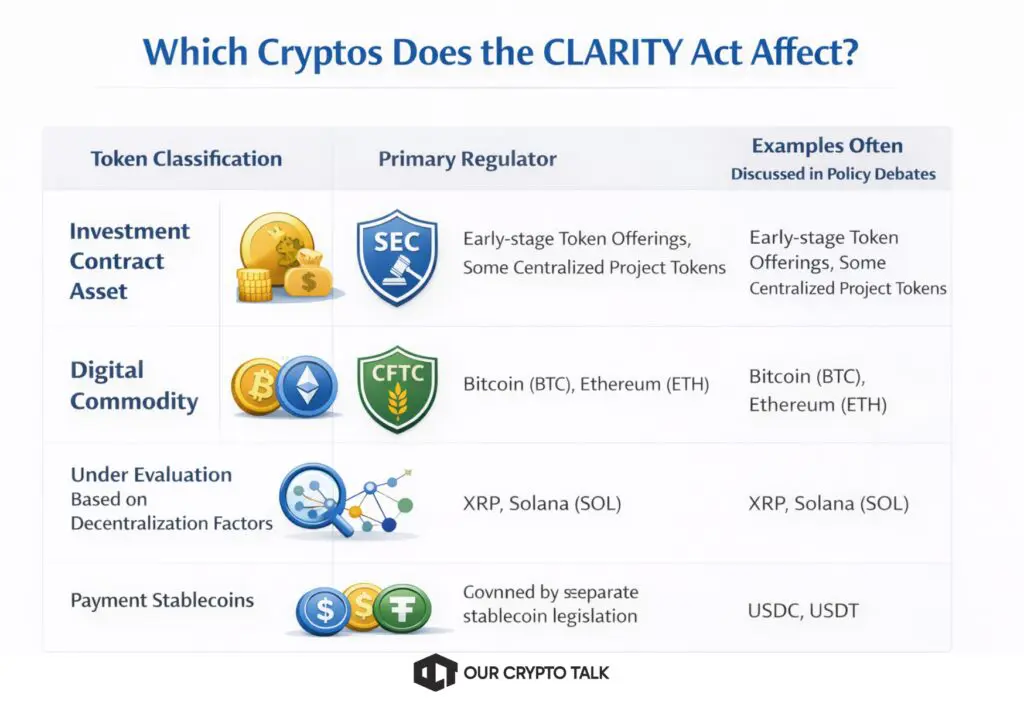
The CLARITY Act does not name specific cryptocurrencies as securities or commodities. Instead, it introduces a structured framework that determines regulatory oversight based on how a token is issued, how its network operates, and whether meaningful decentralization exists. This approach aims to create consistent standards across the market rather than relying on unpredictable enforcement decisions. Regulators would examine factors such as governance control, token distribution, and the functional use of the blockchain when deciding how to classify a digital asset.
Under the proposal, tokens that are primarily sold to raise capital and depend on the managerial efforts of a centralized team could fall under the authority of the Securities and Exchange Commission during their early stages. The bill refers to these tokens as investment contract assets. Issuers in this category may need to provide structured disclosures that explain governance models, token economics, development roadmaps, and potential technological risks. This requirement aims to improve transparency for investors who participate in early token distributions.
In contrast, the CLARITY Act introduces the concept of digital commodities, which would fall under the jurisdiction of the Commodity Futures Trading Commission. These assets typically operate on decentralized blockchain networks where value derives from user participation, transaction validation, and application activity rather than centralized promises. Bitcoin and Ethereum are often discussed in policy conversations as examples of assets that may fit within this category because their networks function through distributed consensus and independent validators.
Some cryptocurrencies, such as XRP or Solana, may fall into an intermediate category where regulators evaluate decentralization factors before assigning oversight. The bill also recognizes that payment stablecoins follow a different regulatory path, since separate legislation already addresses reserve backing and redemption standards.
Overall, the framework suggests that classification may evolve as networks mature. If a project demonstrates broader ownership distribution and independent governance over time, its token could transition from securities-style oversight toward commodity treatment in secondary trading markets.
The SEC and the CFTC regulate different types of financial assets, and the CLARITY Act aims to clearly divide their roles in crypto oversight. The SEC focuses on tokens that function like securities, especially those sold to raise capital where investors rely on a central team’s efforts. In contrast, the CFTC oversees digital commodities, which are typically decentralized cryptocurrencies whose value comes from network usage and market demand. By defining this jurisdictional split, the bill seeks to reduce regulatory uncertainty, support clearer exchange listing decisions, and create more predictable rules for investors and developers in the U.S. crypto market.
SEC vs CFTC jurisdiction under the proposed CLARITY Act

Regulatory clarity could reduce sudden market disruptions linked to enforcement actions. In recent years, exchanges sometimes removed tokens quickly after receiving regulatory scrutiny. Investors who held those assets faced liquidity challenges and price volatility.
A standardized classification framework may help exchanges evaluate listing eligibility more confidently. This means, retail investors could experience fewer unexpected interruptions.
The proposal also emphasizes investor education through structured disclosures. Exchanges and token issuers may need to provide accessible explanations of governance mechanisms, economic incentives, and technological risks.
Such transparency could encourage more informed decision-making. Instead of relying solely on online speculation or short-term market trends, investors might gain clearer insights into the fundamentals of the assets they hold.
Lawmakers also discuss safe harbor concepts for certain decentralized protocols. Platforms that do not custody user funds or act as traditional intermediaries may avoid broker-dealer classification.
This approach could allow decentralized trading and lending applications to continue evolving while still operating under anti-fraud standards. Retail users who engage with these tools might benefit from expanded access to financial experimentation.
Clear regulatory frameworks often attract institutional capital. Pension funds, asset managers, and banks typically require predictable compliance environments before allocating resources.
If the CLARITY Act reduces ambiguity, large financial players may increase exposure to digital assets. Greater institutional participation could improve liquidity and market depth. However, investors should remember that increased participation does not eliminate price cycles or speculative dynamics.
Retail users might also notice practical adjustments on trading platforms. These could include stricter identity verification processes, updated risk labeling for tokens, and enhanced custody protections.While such measures may increase friction for some users, they aim to align crypto markets more closely with traditional investor safeguards.
The CLARITY Act has already crossed an important milestone in the legislative process. The U.S. House of Representatives passed the bill in July 2025 with bipartisan backing, which signaled growing recognition among lawmakers that the digital asset market needs clearer regulatory rules. This vote did not make the proposal law. However, it established political momentum and moved the conversation from policy theory to real legislative action. As a result, market participants began to pay closer attention to how the bill could shape the future of crypto trading, token listings, and investor protections.
The next phase involves Senate review, which often proves to be the most decisive stage for complex financial legislation. Committees responsible for banking oversight and commodity market regulation will examine the bill’s provisions in detail. Lawmakers may introduce amendments related to stablecoin treatment, disclosure standards, or supervisory authority between federal agencies. During this process, stakeholders from the crypto industry, traditional financial institutions, and regulatory bodies are likely to present their perspectives. These discussions can influence both the final structure of the framework and the timeline for a vote.
If the Senate passes a version that differs from the House proposal, both chambers would need to reconcile their differences through a conference process before sending the final bill to the President. Once signed into law, the regulatory work would still continue. Agencies such as the Securities and Exchange Commission and the Commodity Futures Trading Commission would need to draft detailed implementation rules. Fortune reported in early 2026 that a Senate vote could occur around mid-2026.
The CLARITY Act reflects a broader evolution in how governments approach digital assets. Early crypto markets thrived in loosely defined legal environments that allowed rapid experimentation. However, as adoption increased, policymakers recognized the need for clearer rules that balance innovation with investor protection.
If enacted, the proposal could mark a significant transition from enforcement-driven policy toward structured oversight. Defined classifications may reduce uncertainty for developers and exchanges while providing investors with improved transparency.Still, regulation represents only one factor shaping crypto markets. Technology upgrades, macroeconomic conditions, and global competition will continue to influence adoption and valuation.
For everyday investors, preparation remains essential. Understanding how classification frameworks evolve can help market participants adapt to future compliance requirements and conditions.
The CLARITY Act signals that digital assets are moving from experimental status toward integration within formal financial systems. That transition may reshape market dynamics for years to come, creating both opportunities and challenges for those who participate in the crypto economy.