Loading Search...


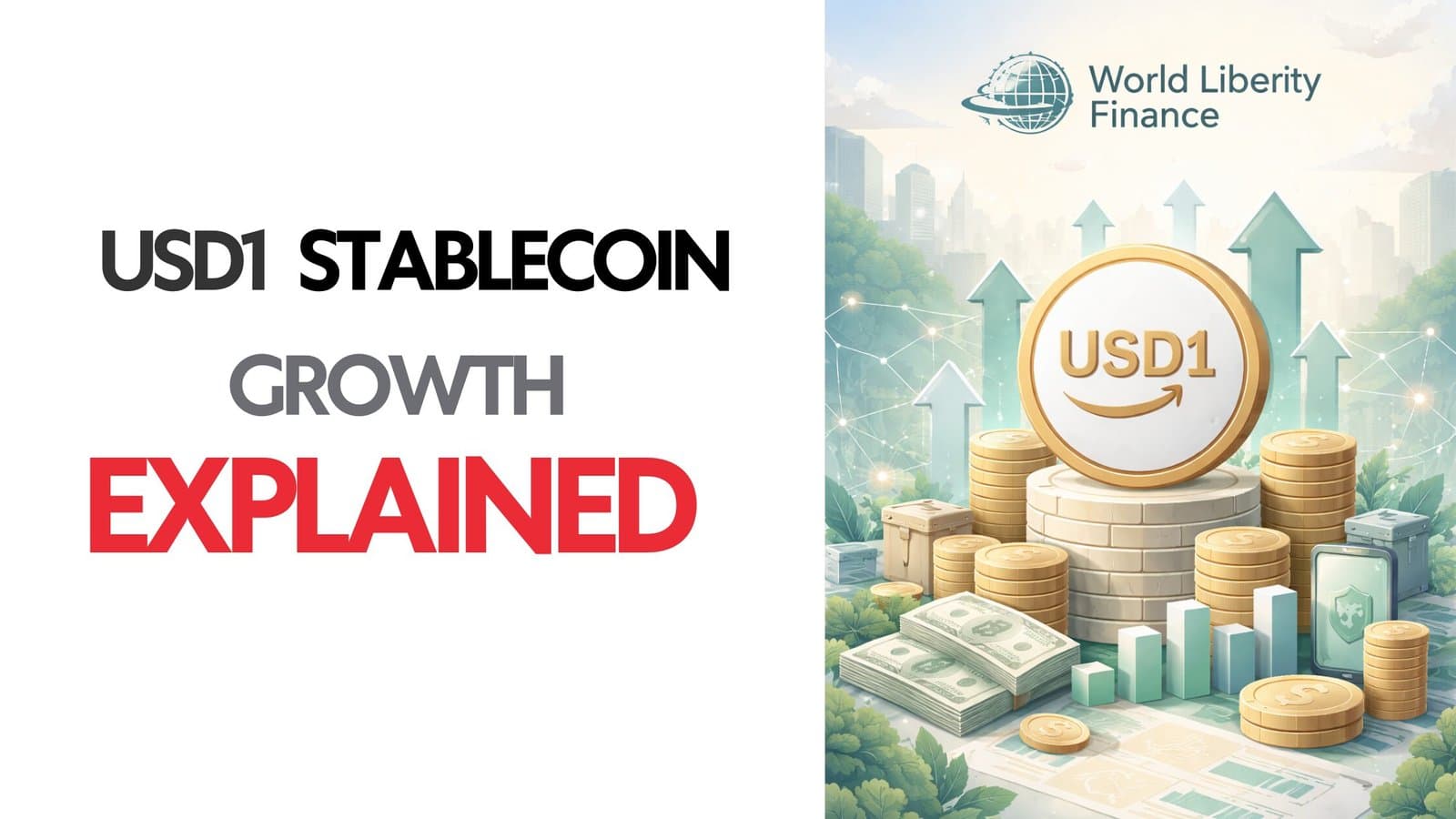
USD1 stablecoin growth explained as WLFI’s digital dollar hits $5B market cap, and gains adoption via incentives, DeFi, and institutions.

Author: Kritika Gupta
In the fast-moving world of digital finance, stablecoins have become a core layer of crypto infrastructure. They help users avoid the extreme volatility of assets like Bitcoin and altcoins, while still enabling fast, on-chain transactions. USD1 stablecoin growth has become one of the most closely watched trends in this segment, as USD1, issued by World Liberty Financial (WLFI), has expanded at an unusually rapid pace in a short period of time.
Since its launch in March 2025, USD1 has expanded at an unusually rapid pace. By late January 2026, it reportedly crossed $5 billion in market capitalization, placing it ahead of several newer competitors and pushing into the top tier of stablecoins. This growth has not been driven by organic DeFi usage alone. Instead, it reflects a combination of strong distribution channels, exchange support, institutional relationships, and heavy incentive programs. At the same time, USD1’s political association has made it one of the most debated stablecoins in the market.

USD1 is a fiat-backed stablecoin issued by World Liberty Financial, a crypto venture that has been widely described as politically connected to the Trump family. Structurally, it aims to operate like other reserve-backed stablecoins: one USD1 token is intended to equal one U.S. dollar, supported by reserves.
The project positions USD1 as a stable digital dollar designed for payments, DeFi, and institutional settlement. Rather than using algorithmic stabilization, USD1 follows the “fully reserved” approach. That means the circulating supply is designed to be backed by cash equivalents and short-term U.S. Treasuries, plus dollar deposits. This model is meant to reduce the risk of a depeg by ensuring redemptions can be fulfilled under normal conditions.
WLFI has also leaned heavily into branding USD1 as a U.S.-aligned stablecoin. That narrative has made it more visible than most new stablecoin launches. As a result, USD1 stablecoin growth has been amplified by attention beyond typical crypto circles, including political media coverage and TradFi conversations.

USD1 operates through a standard issuance and redemption framework used by most fiat-backed stablecoins. When a user or institution deposits dollars with the issuer or an approved partner, WLFI mints an equivalent amount of USD1. When holders redeem, WLFI burns USD1 and releases the corresponding fiat value.
This mechanism keeps supply aligned with reserves as long as redemption channels remain functioning. In addition, reserve verification plays a major role in credibility. According to the update, WLFI uses attestations and outside verification through firms such as Crowe LLP, following AICPA-style verification standards. These attestations are important because past stablecoin failures often came down to reserve opacity and redemption uncertainty.
USD1 also expanded across multiple networks, including Ethereum, BNB Chain, Solana, and Tron. This matters because stablecoin adoption is heavily influenced by transaction costs. For example, Solana and Tron enable low-fee transfers, so they are strong distribution hubs for payments and large-scale settlement.
Incentive structures also play a central role. The update highlights yield-style programs such as Binance offering earn incentives, including high APY promotions. These programs can drive rapid supply expansion because users mint or buy the stablecoin mainly to capture yield, rather than for transactional utility.
USD1 was developed through late 2024 as WLFI formed and positioned itself as a high-profile crypto venture. It formally launched in March 2025, with messaging focused on Treasuries-backed stability and a U.S.-centric financial narrative.
Soon after launch, USD1 expanded quickly. The update claims it reached approximately $2 billion market capitalization within a month, which suggests aggressive distribution rather than slow organic adoption. Institutional flows were also highlighted as a catalyst, including large transactions tied to Binance-linked activity.
By mid 2025, USD1 achieved wider reach through listings and multi-chain deployments. Once the stablecoin became usable across major ecosystems, it became easier for DeFi protocols and payments platforms to integrate it. In fact, the multi-chain rollout became one of the most important fuel sources behind USD1 stablecoin growth.
Later in 2025, USD1 reportedly passed major milestones such as $3B in TVL and continued to grow through DeFi lending integrations. The update emphasizes that expansion accelerated further after incentives increased and partnerships deepened.
By January 2026, USD1 reportedly surpassed $5 billion market cap, overtaking competitors like PayPal’s PYUSD. As a result, USD1 became one of the largest stablecoins in the market within less than a year.
Key milestones related to this development
World Liberty Financial forms and positions itself as a high-profile crypto venture, laying the foundation for USD1’s launch.
USD1 launches with messaging centered on Treasuries-backed stability and a U.S.-centric digital dollar narrative.
USD1 reportedly climbs to around $2B market cap within a month, pointing to aggressive distribution rather than slow organic adoption.
USD1 broadens adoption through listings and deployments across major ecosystems, making integration easier for DeFi and payment platforms.
USD1 reportedly surpasses $3B in TVL as DeFi lending integrations deepen and expansion accelerates through incentives and partnerships.
For crypto users, USD1’s growth matters because it increases stablecoin choice, particularly for people who want alternatives to USDT and USDC. If liquidity continues rising, users benefit through tighter spreads, deeper DeFi pools, and faster transfers across chains. In addition, incentive programs create short-term yield opportunities, especially through exchange earn products and DeFi lending markets.
However, incentives also introduce a risk dynamic. If demand is largely yield-driven, adoption can reverse quickly once rewards decline. Therefore, users should treat high APYs as promotional, not permanent. Even strong market cap growth does not automatically mean stable real-world utility.
For developers, USD1 adds a new stable unit that can be integrated into lending protocols, payment systems, payroll rails, and real-world asset tokenization products. Multi-chain availability makes it easier to deploy applications across ecosystems. As adoption expands, USD1 stablecoin growth could increase USD1’s usefulness as a base unit for pricing and settlement across DeFi apps.
At the same time, developers must consider liquidity fragmentation. Stablecoin ecosystems become messy when supply exists across many chains without deep bridging liquidity. That can limit composability unless there is robust cross-chain infrastructure and stable liquidity support.

USD1’s key technical requirement is peg stability. Reserve-backed designs generally hold pegs well, but stress events can still expose weaknesses, especially if redemption channels are slow or if liquidity dries up during shocks. Therefore, operational execution matters as much as reserves.
Cross-chain expansion also creates security and reliability challenges. If USD1 depends on bridges, it inherits bridge risk. If it is separately deployed on multiple chains, liquidity can fragment. Either way, stable and secure interoperability becomes critical for long-term usage.
Economic sustainability is another open question. If USD1’s growth is primarily incentive-driven, adoption may slow once APYs normalize. This is common in crypto where liquidity follows yield. Therefore, real demand signals should include payment flows, merchant usage, and steady DeFi borrow demand rather than short-term staking programs.
Governance and compliance also remain key unknowns. As WLFI seeks expanded regulatory status through a national trust bank charter, oversight could increase. That may strengthen institutional confidence. However, it may also restrict some DeFi integrations depending on future policy decisions.
Stablecoins increasingly function like global digital dollars. When one grows quickly, it impacts remittances, corporate settlement, and financial inclusion efforts. USD1 aims to position itself as a next-generation dollar token with transparency, regulation-friendly design, and deep institutional distribution.
If USD1 continues expanding, it could influence stablecoin regulation by shaping expectations around reserve disclosure and licensing. It could also accelerate adoption of programmable money systems that integrate directly with fintech apps, payment cards, and payroll rails.
More broadly, USD1 reflects a shift where stablecoins are no longer purely crypto-native instruments. Instead, they increasingly merge with traditional finance infrastructure, political narratives, and institutional settlement demand. That makes them a major strategic layer of the future financial system.
World Liberty Financial’s USD1 stablecoin has grown from a new launch in March 2025 into one of the market’s largest stablecoins by late January 2026, reportedly surpassing $5 billion in market capitalization. This expansion reflects more than just crypto market momentum. It has been powered by institutional-scale distribution, multi-chain rollout, deep exchange integration, and aggressive incentive programs that attracted rapid liquidity.
Going forward, USD1’s next phase depends on whether it can convert incentive-driven inflows into lasting utility. If WLFI secures stronger regulatory legitimacy and builds sustainable real-world demand across payments, lending, and settlement, USD1 could become a long-term pillar in stablecoins. However, competition remains intense, and scrutiny around transparency and political ties will stay high.



USD1 reportedly crosses $5B market cap and overtakes competitors like PayPal’s PYUSD, becoming a top stablecoin within a year.