Loading Search...


AI agents crypto payments could reshape digital commerce as autonomous software begins transacting at scale using blockchain wallets.

Author: Chirag Sharma
On March 9, 2026, Changpeng Zhao, founder of Binance, made a bold prediction on X about how AI agents will make one million times more payments than humans, and they will use crypto. Hours later, Brian Armstrong, CEO of Coinbase, reinforced the same idea.
Just a day later, another signal arrived. Meta announced the acquisition of Moltbook, a fast-growing social network designed specifically for AI agents to interact with each other.
These developments are not random headlines. They reveal a deeper shift: the rise of AI agents crypto payments as a new economic layer. Autonomous AI agents are software capable of reasoning, executing tasks, and interacting with systems and are rapidly moving from experimental tools to active economic participants. And when these agents need to exchange value, traditional banking rails simply cannot keep up.
The transformation began in earnest during 2025. Until recently, most AI systems were reactive tools. They responded to prompts but did not act independently. That model has now evolved into agentic AI, where autonomous software systems plan, execute, and learn from tasks without constant human input.
Today’s AI agents can:

Rather than single bots operating alone, organizations increasingly deploy multi-agent systems, where multiple specialized AI agents collaborate to complete complex tasks.
Industry adoption is accelerating rapidly:
The economic implications are enormous.
AI agents do not sleep. They operate continuously and scale almost infinitely. A single organization might deploy thousands of agents to manage infrastructure, optimize supply chains, or automate financial operations.
Each action performed by an agent potentially requires a payment.
This is where AI agents crypto payments become crucial.
AI agents face a fundamental limitation when interacting with traditional financial infrastructure. Banks are built around human identity verification. Opening a bank account requires personal identification, regulatory compliance, and legal accountability. AI agents have none of these.
They have:
As a result, they cannot open bank accounts or access traditional payment systems. Crypto changes that entirely.
A crypto wallet can be created in seconds by generating a private key. No approval process, no identity checks, and no centralized permission are required. For autonomous AI systems, this is the only practical financial infrastructure available.
This explains why companies are already developing payment tools designed specifically for AI agents.
Coinbase recently introduced agent-compatible crypto wallets capable of interacting directly with AI applications. These wallets enable agents to perform transactions automatically using stablecoins and smart contracts.
Meanwhile, developers are experimenting with protocols such as x402, which embed payment requests directly into web interactions. When an AI agent accesses an API or service, it can automatically pay using stablecoins before receiving data. Traditional payment networks cannot replicate this model efficiently.

Several structural advantages make blockchain-based payments uniquely suited for autonomous AI systems.
Crypto wallets require only cryptographic keys, not human identity. This means AI agents can generate wallets instantly and transact independently without waiting for financial approval. Emerging standards such as on-chain AI identity frameworks allow agents to maintain persistent identities on blockchain networks while protecting privacy.
AI agents often operate at microeconomic levels.
For example, an agent might:
Traditional payment systems charge fixed transaction fees that make such payments impossible.
Crypto networks especially high-throughput chains and Layer-2 solutions can process microtransactions with minimal cost.
This enables entirely new economic models.
AI agents operate at machine speed. A human may approve a few transactions per day. An AI system might need to execute hundreds or thousands of transactions per minute. Blockchain payments allow programmable automation through smart contracts. Agents can send funds automatically when certain conditions are met, without requiring human oversight.
AI systems frequently operate across multiple jurisdictions. A supply chain optimization agent in Singapore might purchase data from Europe while interacting with infrastructure hosted in the United States. Crypto payments remove the friction associated with international banking:
Transactions settle globally within minutes.
The combination of autonomous AI and programmable money will unlock entirely new economic systems. Below are several practical scenarios where AI agents crypto payments could transform digital commerce.
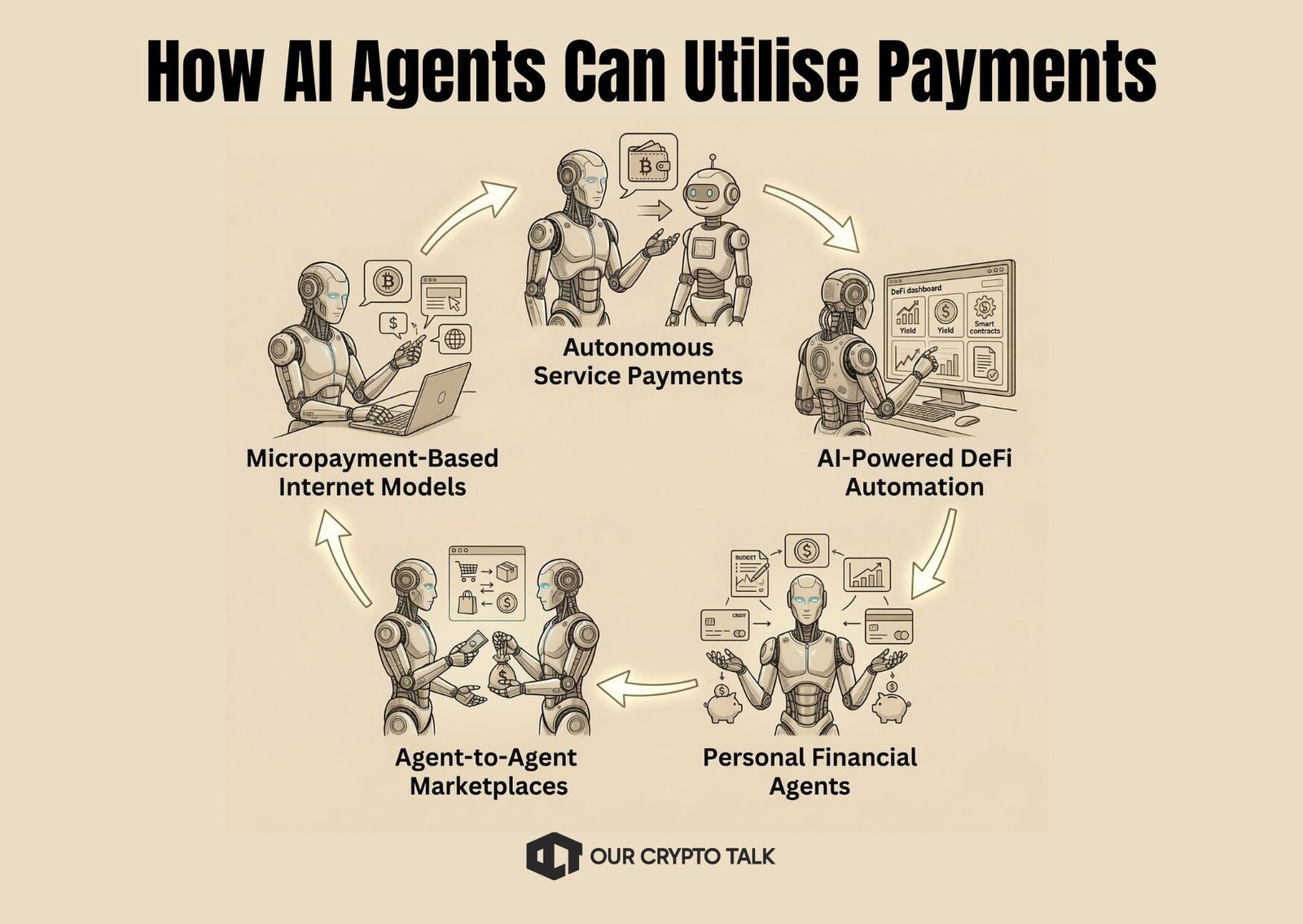
Imagine an AI research agent running machine learning experiments.
To complete its work, it needs:
Instead of waiting for human approval, the agent can automatically compare prices, select the best provider, and pay using stablecoins. Each service interaction becomes a microtransaction on blockchain rails.
In decentralized finance, agents can monitor markets continuously.
An AI agent might:
Payments occur automatically through smart contracts, enabling autonomous financial operations.
Multiple specialized agents could collaborate:
Each interaction involves programmable payments.
Consumers may soon rely on personal AI assistants to manage everyday financial decisions.
A personal agent could:
To the user, the process feels seamless. Behind the scenes, thousands of automated microtransactions occur on blockchain networks.
Platforms like Moltbook demonstrate how AI agents can interact socially. The next step is economic interaction.
Agents will be able to hire other agents for tasks.
For example:
These collaborations will require instant programmable payments.
Crypto provides the infrastructure.
Traditional online monetization relies heavily on advertising.
AI agents could introduce a new model based on micropayments.
Instead of viewing ads, an AI browsing assistant might automatically pay small amounts to publishers for high-quality content.
This could enable:
Every content interaction becomes a microtransaction.
Several key technological developments are enabling this new ecosystem.
Stablecoins remain the most practical payment medium for AI systems because they maintain predictable value. Agents can transact using dollar-denominated tokens without worrying about price volatility.
Scalable blockchain networks reduce transaction costs dramatically, making high-frequency micropayments viable.
Agent-compatible wallets allow AI systems to manage funds securely while executing automated transactions.
Smart contracts enable complex payment logic, allowing agents to execute conditional transactions. For example, an agent could release payment only when a task is completed successfully.
Despite the promise of AI agents crypto payments, several challenges remain.
Autonomous agents controlling funds create new attack surfaces.
A compromised AI system could execute malicious transactions rapidly.
Developers are exploring safeguards such as:
Governments are still determining how to regulate AI-driven financial activity.
Questions remain regarding:
Regulatory clarity will evolve over time.
If billions of AI agents begin transacting frequently, blockchain networks must handle enormous transaction volumes.
Layer-2 scaling solutions and specialized blockchain architectures will be essential.
The concept of an agent economy is gaining momentum. In this model, autonomous AI systems perform economic tasks independently, interacting with each other and with human-operated systems. Consider the scale.
There are currently around 8 billion humans on Earth. Predictions suggest tens of billions of AI agents could exist within the next decade.
If each agent performs even a handful of transactions daily, the total payment volume could dwarf today’s global financial activity.
Crypto infrastructure is uniquely positioned to support this environment.
It offers:
This is why leaders across the crypto industry are investing heavily in the intersection of AI and blockchain. The next wave of crypto adoption may not come from humans downloading wallets. It may come from AI systems that automatically create them.
All the opinions in this article are that of the author and in no way are financial advice. Our Crypto Talk and the author always suggest you do your own research in crypto and to never take anything as financial advice that you read on the internet. Check our Terms and conditions for more info.