Loading Search...


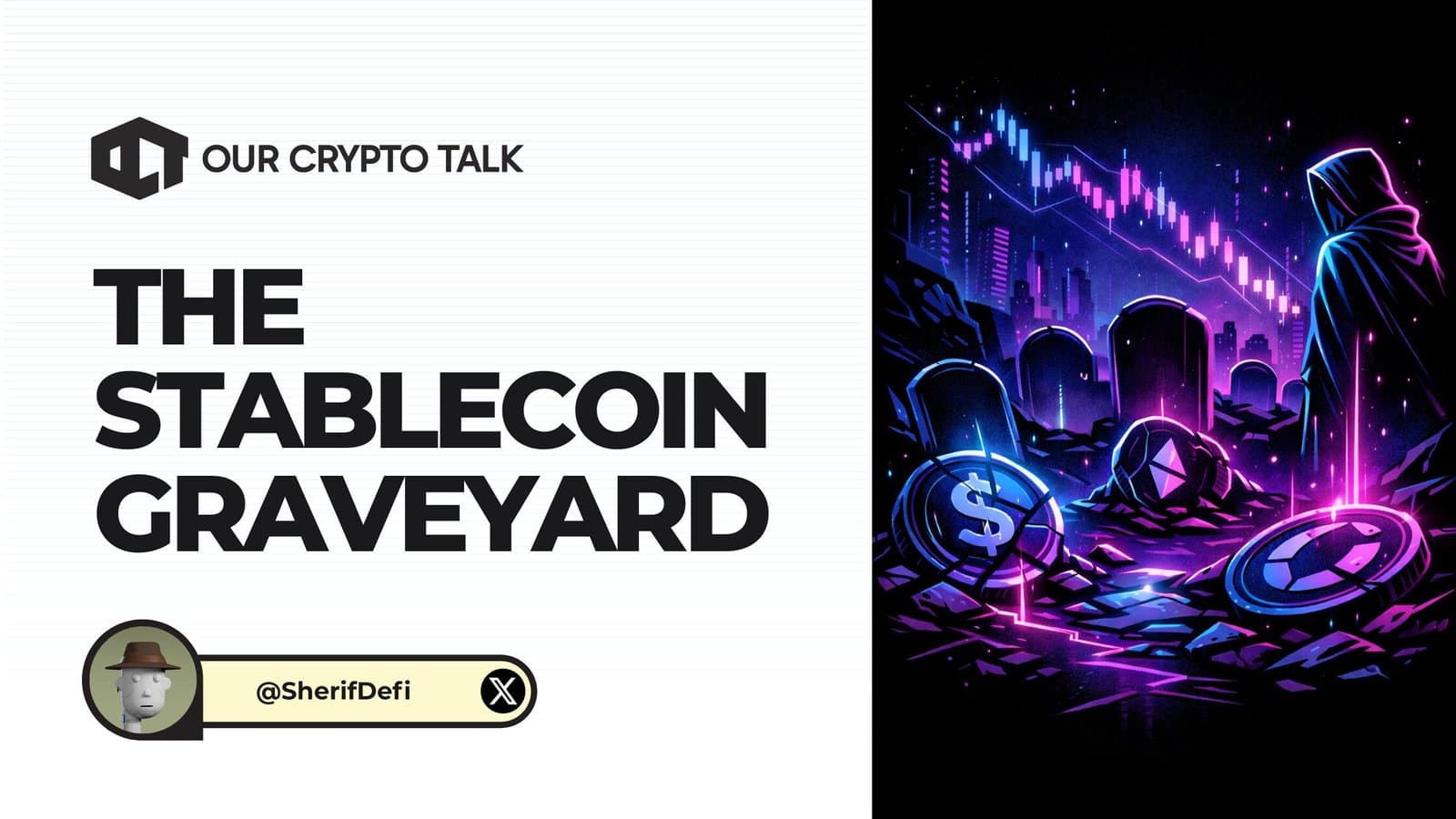
The stablecoin graveyard shows why most stablecoins fade as liquidity, trust, and adoption consolidate around a few survivors.
There has never been a moment in crypto where the stablecoin graveyard has grown as quickly as it is today, with more stablecoins being created at the same time.
But do we really need them?
New ones appear constantly, each with a different structure, different backing, different angle.
Almost all of them are launched with confidence, usually tied to the same underlying belief- that the right stablecoin can finally unlock adoption.
That belief isn’t wrong.
Stablecoins sit at the center of everything crypto wants to become.
They’re what people actually use when they trade, send money, settle positions, or park value without volatility.
If crypto ever becomes invisible infrastructure instead of a niche ecosystem, stablecoins will be the first thing users touch.
That’s what the stablecoin graveyard really is.
Not a collection of disasters, but a growing pile of assets that technically work and economically don’t matter.
The explosion in stablecoin launches isn’t driven by hype alone. It is accelerating the stablecoin graveyard.
It’s driven by maturity.
Issuing a stablecoin used to be genuinely hard
Today, most of that complexity has been abstracted away.
Tooling exists. Legal frameworks exist. Infrastructure exists. The cost of launching a stablecoin has dropped sharply.
Whenever the cost of experimentation falls, experimentation increases. We’ve seen this pattern with tokens, DeFi protocols, NFTs, and rollups. Stablecoins are simply the latest surface area where creation has become cheap.
What many teams underestimate is that stablecoins don’t reward experimentation the same way other crypto categories do.
They reward endurance.
Stablecoins aren’t products users explore.
They’re infrastructure users default to. People don’t compare stablecoins based on features or design.
They choose what already works, what already has liquidity, what already settles everywhere without friction.
Trust, in this category, compounds slowly and punishes shortcuts brutally.

When people think about stablecoin failure, they imagine dramatic events. Depegs, spirals, sudden collapses. Those do happen, but they’re not the dominant outcome.
Most stablecoins fail quietly.
They launch with incentives, attract some activity, and integrate into a few places.
Then incentives fade, liquidity thins, integrations stop expanding, and usage slows.
Nothing explicitly breaks.
The stablecoin still exists, but nothing depends on it anymore.
From an economic perspective, that’s a full failure. Money that doesn’t move stops being money. Velocity is unforgiving.
From the outside, many stablecoins look meaningfully different.
Different collateral, different mechanics, different tradeoffs.
From the user’s perspective, those differences collapse almost immediately.
What matters in practice is depth, redemption certainty, and acceptance.
Once a small number of stablecoins dominate those surfaces, habit takes over.
New stablecoins stop competing with ideas and start competing with inertia.
And inertia is one of the hardest forces to fight in finance.
Stablecoins behave more like monetary infrastructure than applications. And infrastructure consolidates.
There aren’t dozens of global settlement currencies. There aren’t dozens of universal payment rails.
Fragmentation exists during exploration. It disappears during scale.
Once a stablecoin becomes embedded across exchanges, wallets, DeFi protocols, and payment systems, it gains gravity.
Every additional use reinforces the same few standards. At that point, launching a new stablecoin isn’t about having a better design. It’s about displacing an ecosystem.
That’s why the graveyard keeps growing.
This isn’t a failure of innovation. It’s selection pressure.
Many stablecoin experiments need to exist briefly so the market can learn what doesn’t hold up.
The stablecoins that survive aren’t the loudest or the most ambitious.
They’re the ones that behave predictably through boring months, volatile markets, and regulatory scrutiny.
Money rewards consistency more than creativity.
When a stablecoin truly succeeds, it stops being discussed.
People don’t analyze it or debate it
They simply assume it’s there.
More stablecoins will launch. Most will fade. A few will quietly become standards.
That’s not pessimism. That’s how money has always worked.
The graveyard will keep growing, and the ones that escape it won’t do so by promising to fix adoption, but by surviving long enough to become invisible.





Howdy howdy ✬ Writing about Crypto & Defi 🧵✬ Advisor for @OKX ✬ The Cleanest Calls 🧹 #NFA
https://t.co/tItAH3C1ib
Genome Protocol Rug Pull: Explained
Top 6 ZachXBT Revelations That Shocked The World
AI Agent Payments Explained: Circle Nanopayments and the x402 Protocol
Top 7 Projects in the World Liberty Financial (WLFI) Portfolio
Genome Protocol Rug Pull: Explained
Top 6 ZachXBT Revelations That Shocked The World
AI Agent Payments Explained: Circle Nanopayments and the x402 Protocol
Top 7 Projects in the World Liberty Financial (WLFI) Portfolio