Loading Search...


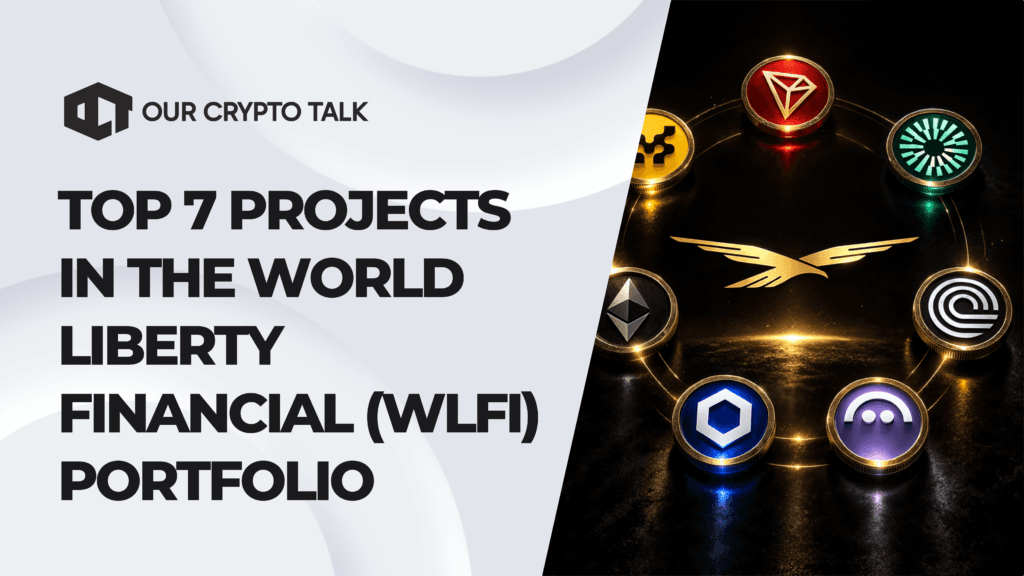
Top 7 Projects in WLFI portfolio powering USD1, lending, RWAs, scalability, and multi-chain DeFi infrastructure.

Author: Akshat Thakur
World Liberty Financial (WLFI) stands as one of the most politically visible and strategically ambitious entrants into the decentralized finance (DeFi) landscape. Launched in September 2024, WLFI was co-founded by members of the Trump family, with Donald Trump positioned as “co-founder emeritus,” alongside Donald Trump Jr., Eric Trump, and Barron Trump. From the outset, the platform was built around a clear and politically charged vision: to “keep the dollar digital” by leveraging blockchain infrastructure to reinforce the global role of the U.S. dollar while expanding access to decentralized lending, borrowing, and stablecoin services. The Top 7 Projects in WLFI portfolio highlight the core infrastructure behind World Liberty Financial, one of the most politically visible and strategically ambitious entrants into the DeFi landscape.
WLFI positioned itself as a structural bridge between traditional finance (TradFi) and decentralized finance. Rather than embracing pure crypto-native experimentation, the platform emphasized stability, transparency, and institutional-grade infrastructure. Its ecosystem revolves around two core pillars: the WLFI governance token and the USD1 stablecoin. USD1 is pegged to the U.S. dollar and backed by reserves such as U.S. Treasuries and cash equivalents, designed to provide a reliable medium for lending markets and cross-chain transactions.
The project continued evolving into 2026. In January 2026, WLFI Markets officially went live, introducing transparent liquidity markets. A temporary USD1 depegging event in early 2026 prompted immediate structural upgrades, including the implementation of real-time proof of reserves. By March 2026, WLFI expanded further into real-world asset (RWA) tokenization through a partnership with BlackRock-backed Securitize. This partnership enabled tokenization of loan revenue interests tied to Trump-branded properties, including the upcoming Trump International Hotel & Resort in the Maldives.
A defining element of World Liberty Financial is its direct association with the Trump family. Unlike most DeFi platforms, WLFI is not politically neutral infrastructure. It was co-founded by members of the Trump family, with Donald Trump serving as “co-founder emeritus,” and launched during a broader pro-crypto political narrative in the 2024 U.S. presidential election.
During the campaign, Trump publicly committed to making the United States the “crypto capital of the world.” Following his return to the presidency in 2025, WLFI’s political visibility intensified significantly. The project became intertwined with broader national economic rhetoric around digital assets and dollar dominance.
Supporters argue that WLFI represents a strategic attempt to strengthen the U.S. dollar’s global influence in a digitizing financial system. Critics, however, have raised concerns regarding potential conflicts of interest, particularly around stablecoin regulation, tokenized securities, and regulatory oversight from agencies such as the SEC.
This political dimension makes WLFI structurally different from most DeFi protocols. Regulatory attention has remained elevated, and market perception is heavily influenced by the intersection of politics and finance. Whether viewed as strategic innovation or controversial overlap, the Trump connection remains central to understanding WLFI’s trajectory.
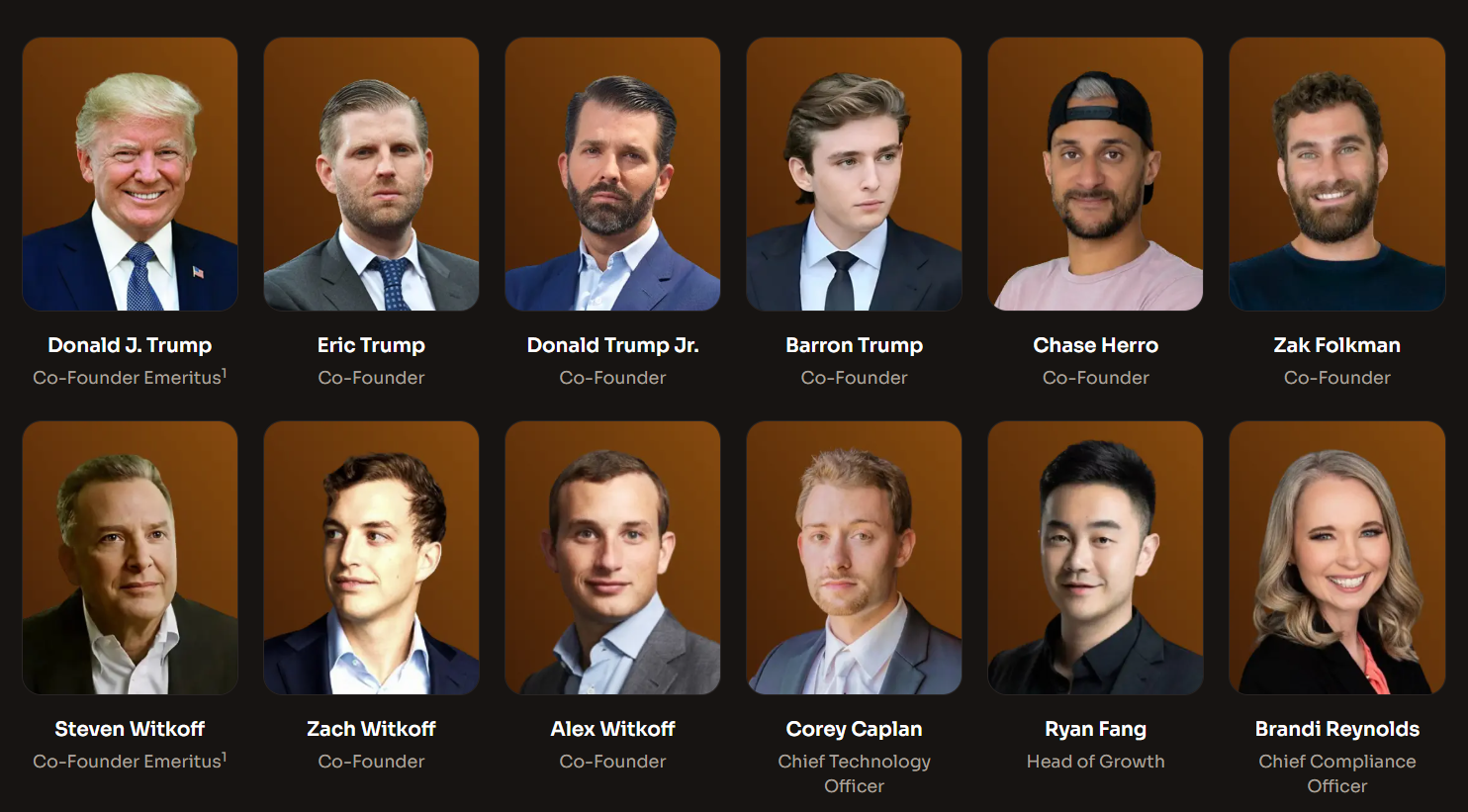
Src: WLFI
The WLFI portfolio is not a passive collection of crypto holdings. It is a structured treasury strategy designed to support:
As of March 2026, the treasury includes approximately 16 tokens spanning Layer-1 blockchains, Layer-2 networks, decentralized oracles, lending protocols, and RWA-focused platforms. Although total portfolio value declined by roughly 16 percent due to broader market conditions, diversification reduces concentration risk.
Initial allocations in 2024 focused on blue-chip assets to establish credibility. In 2025, WLFI expanded liquidity with $21.5 million in wrapped assets and stablecoins. By 2026, governance enhancements were introduced, including a proposed tiered node system requiring 180-day lockups to enable voting rights and reward long-term holders with treasury-derived yields.
The following seven projects represent the most strategically significant components of the World Liberty Financial portfolio.
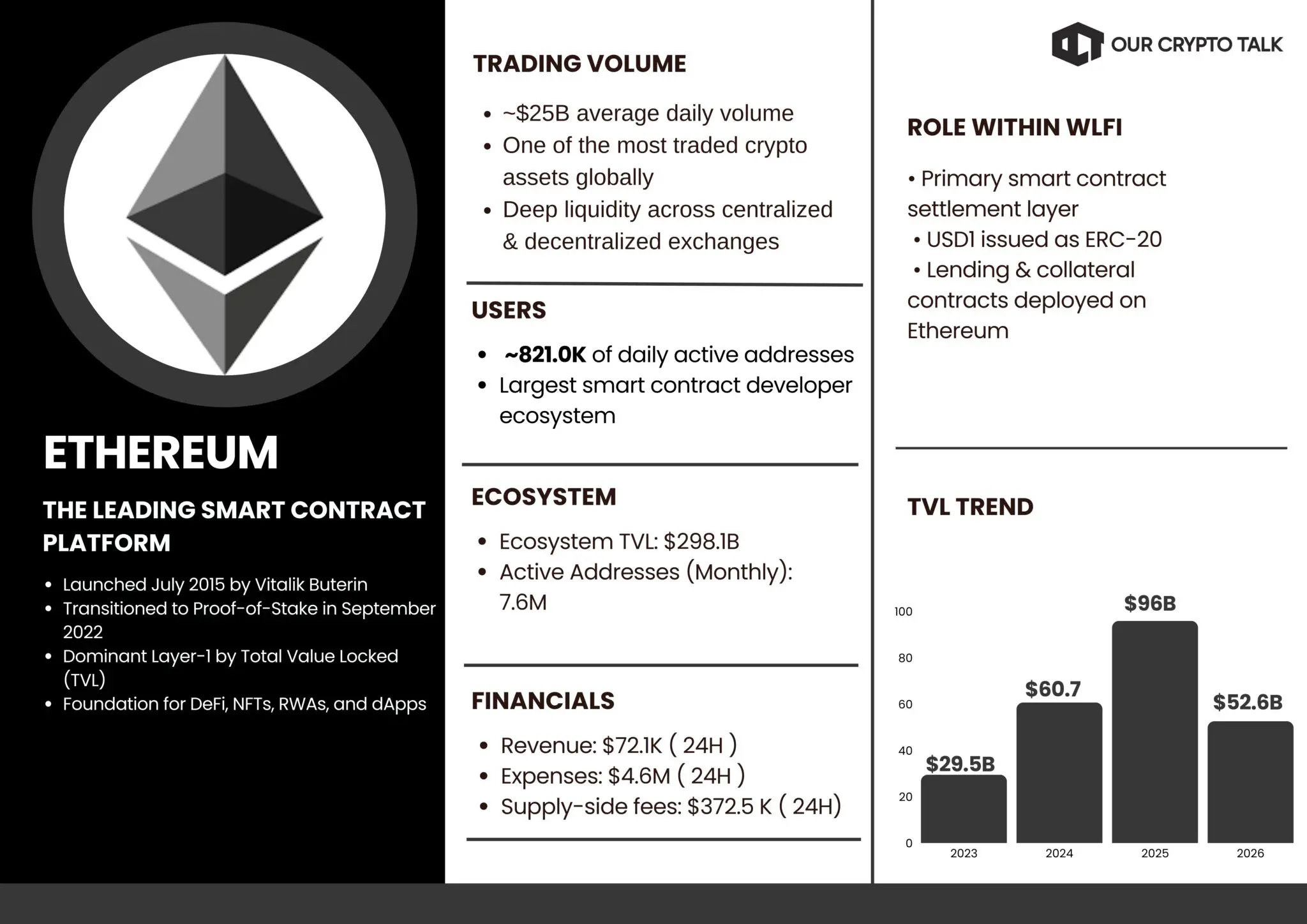
Ethereum, conceived by Vitalik Buterin and launched in July 2015, fundamentally transformed blockchain technology by introducing programmable smart contracts. Unlike Bitcoin, which primarily functions as a digital currency, Ethereum enabled developers to deploy self-executing code on-chain, allowing decentralized applications (dApps), DeFi protocols, NFTs, and tokenized financial instruments to operate without centralized intermediaries. At the center of Ethereum’s architecture is the Ethereum Virtual Machine (EVM), which standardizes smart contract execution across all nodes and ensures deterministic outcomes regardless of geographic location.
Initially operating under a Proof-of-Work consensus mechanism, Ethereum faced clear scalability limitations. The network processed a limited number of transactions per second, and during high-demand cycles such as the DeFi and NFT expansions, transaction fees increased significantly. This constrained usability for smaller transactions and retail users. In September 2022, Ethereum transitioned to Proof-of-Stake through “The Merge,” replacing miners with validators who stake ETH to secure the network. This shift reduced energy consumption by more than 99 percent and introduced staking rewards as a structural component of network security.
Subsequent upgrades improved liquidity and efficiency. The Shanghai upgrade in April 2023 enabled withdrawals of staked ETH, increasing capital flexibility. In March 2024, the Dencun upgrade introduced proto-danksharding (EIP-4844), reducing Layer-2 rollup costs by introducing blob-based temporary data storage. Rather than scaling entirely at the base layer, Ethereum’s long-term roadmap relies on Layer-2 networks that batch transactions and settle them on Ethereum, preserving security while improving throughput. Enhancements such as ERC-4337 account abstraction improved wallet flexibility and transaction handling, while zero-knowledge integrations strengthened scalability and verification efficiency.
Ethereum forms the operational backbone of WLFI’s DeFi architecture. Ethereum remains the dominant smart contract platform by total value locked, hosting a majority share of DeFi liquidity. Its established developer ecosystem, liquidity depth, and institutional familiarity make it the default settlement layer for decentralized finance. As the largest smart contract network by total value locked, it anchors the stability of the Top 7 Projects in WLFI portfolio.
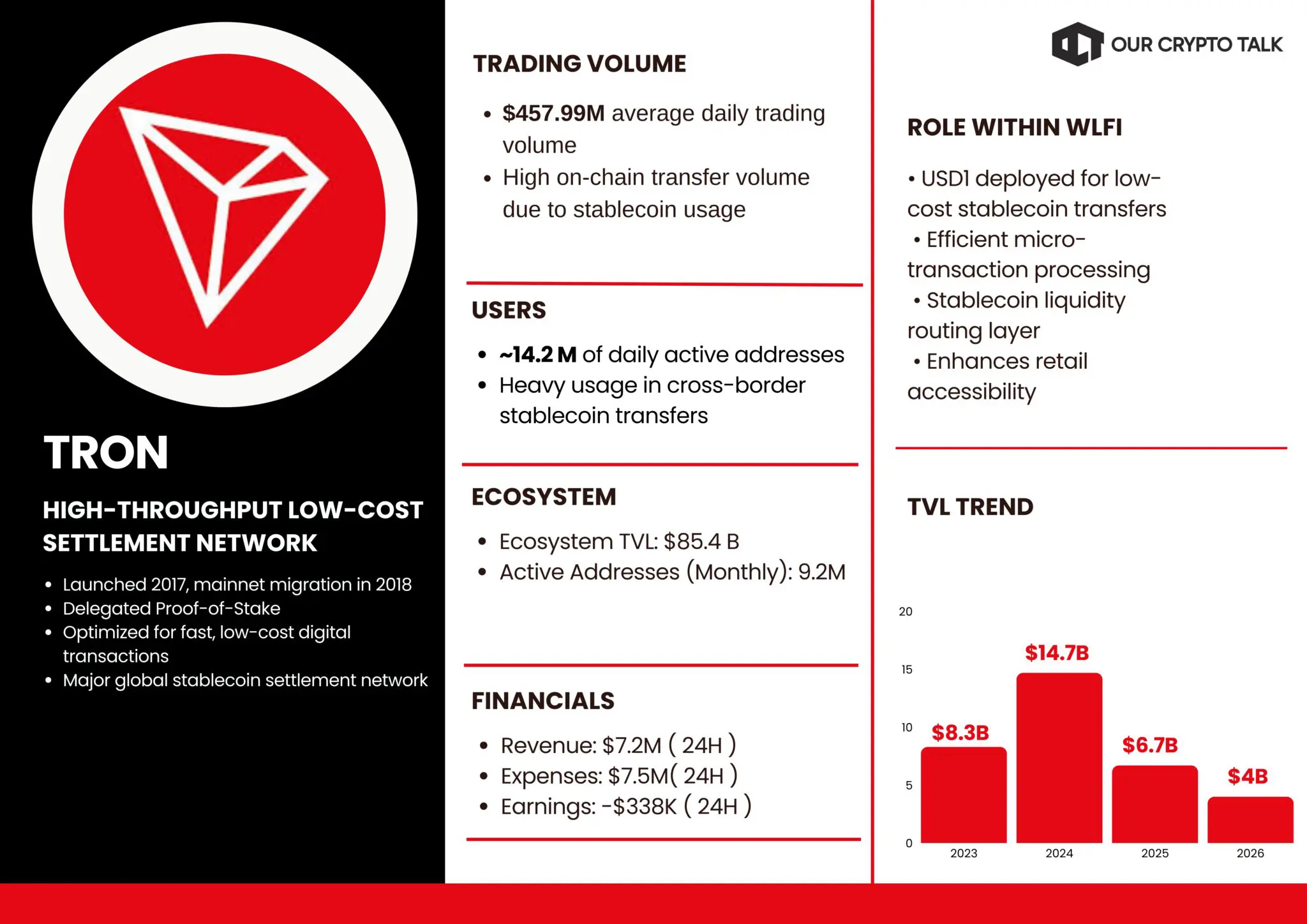
TRON was launched in 2017 with the objective of creating a high-throughput blockchain optimized for low-cost digital transactions. Initially issued as an ERC-20 token, TRON migrated to its own mainnet in 2018. The network operates under a Delegated Proof-of-Stake consensus model, where token holders vote for 27 Super Representatives responsible for block production. This structure enables faster block times and lower transaction costs compared to many base-layer networks.
TRON’s architecture includes a smart contract layer, storage layer, and application layer. The TRON Virtual Machine (TVM) maintains compatibility with Ethereum’s EVM, allowing Solidity-based contracts to be ported across networks with minimal adjustments. A key differentiator is TRON’s resource model: users can stake TRX to obtain bandwidth and energy, reducing or eliminating transaction fees for many operations.
Over time, TRON became a major hub for stablecoin activity. Its low transaction costs and fast settlement made it widely used for high-volume transfers, particularly in cross-border environments. The integration of BitTorrent expanded TRON’s ecosystem into decentralized file sharing, while BitTorrent Chain (BTTC) introduced cross-chain connectivity.
TRON strengthens WLFI’s cost-efficiency and multi-chain transaction strategy. TRON’s DeFi ecosystem includes lending protocols and automated market makers, though its primary strength remains cost-efficient stablecoin settlement and transaction throughput. Within the broader structure of the Top 7 Projects in WLFI portfolio, it plays a practical role in global stablecoin movement.
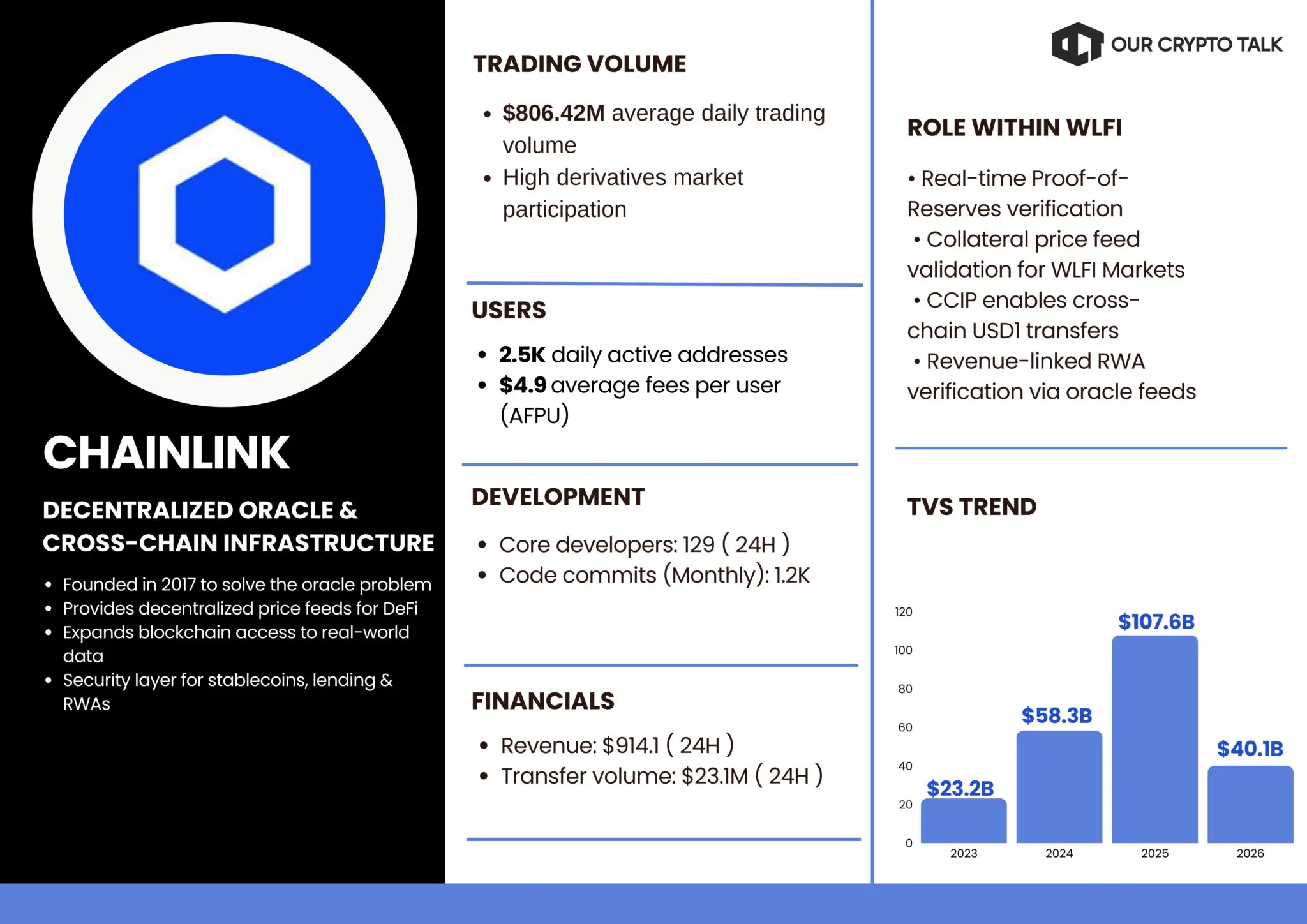
Chainlink was founded in 2017 to address a structural limitation in blockchain systems known as the oracle problem. Smart contracts cannot natively access external data such as asset prices, interest rates, or real-world events. Chainlink developed a decentralized oracle network that aggregates off-chain data from multiple sources and delivers it to blockchains in a tamper-resistant manner.
Rather than relying on a single data provider, Chainlink nodes retrieve and verify information from independent sources, reducing manipulation risk. This infrastructure became widely adopted across DeFi, particularly for price feeds used in lending, derivatives, and stablecoin protocols. Chainlink later expanded into additional services including Verifiable Random Function (VRF) for provable randomness and automation services for smart contract execution.
In 2023, Chainlink introduced Cross-Chain Interoperability Protocol (CCIP), enabling secure messaging and token transfers across different blockchains. Another critical service is Proof-of-Reserves (PoR), which allows on-chain verification of asset backing, particularly relevant for stablecoins and tokenized financial instruments.
Chainlink provides the data integrity layer required for WLFI’s stablecoin and lending operations. Chainlink’s infrastructure has become deeply embedded in DeFi, serving as a core security layer for collateral pricing and cross-chain coordination. This verification layer is essential to maintaining trust across the Top 7 Projects in WLFI portfolio, particularly after the USD1 depeg event.
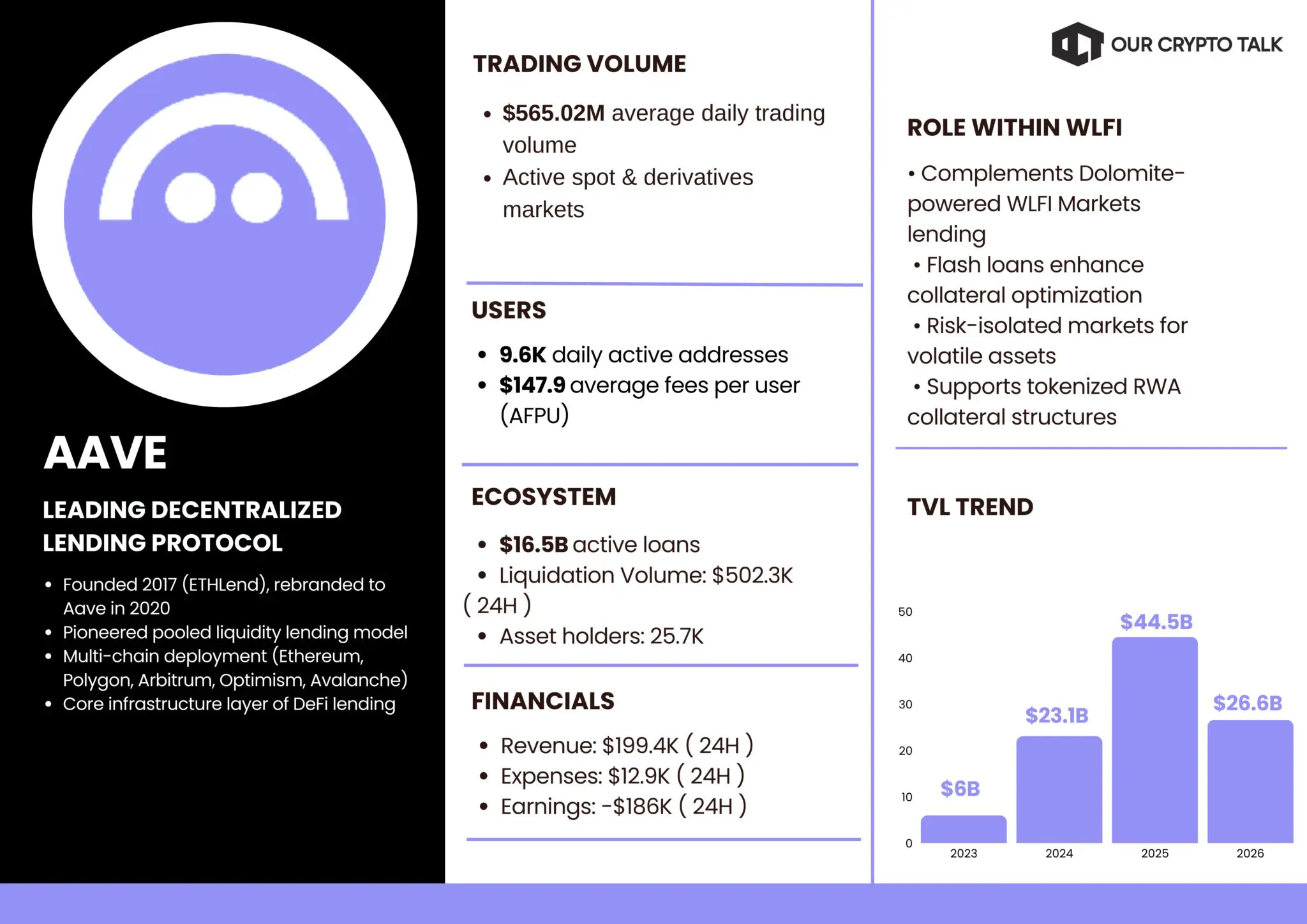
Aave began in 2017 as ETHLend, a peer-to-peer lending protocol founded by Stani Kulechov. The original model directly matched lenders and borrowers, but liquidity fragmentation limited efficiency. In 2020, the project rebranded to Aave and transitioned to a pooled liquidity model, allowing users to deposit assets into shared liquidity pools from which borrowers could draw. This structural shift made capital more efficient and scalable, positioning Aave as one of the core infrastructure layers of decentralized finance.
Aave operates primarily on Ethereum, with deployments across multiple networks including Polygon, Avalanche, Optimism, and Arbitrum. The protocol allows users to supply assets and earn variable or stable interest rates, while borrowers provide overcollateralized positions to access liquidity. The overcollateralization requirement reduces default risk and protects lenders. Positions are monitored using a Health Factor metric, and if collateral value falls below required thresholds, liquidations are triggered automatically by smart contracts.
One of Aave’s most notable innovations is the flash loan. Flash loans allow users to borrow assets without collateral, provided the loan is repaid within the same transaction. This feature enabled arbitrage, refinancing, and collateral swapping strategies without upfront capital. While flash loans introduced new efficiencies, they also highlighted the importance of secure oracle pricing across DeFi.
Aave V3 introduced further risk controls, including isolation mode for volatile assets and cross-chain functionality through portals. These features improved capital allocation and allowed liquidity movement between supported chains. Governance is managed through the AAVE token, which enables token holders to propose and vote on protocol changes through the Aave Improvement Proposal framework. The Safety Module allows AAVE staking to act as a backstop in the event of shortfall events.
Aave provides WLFI with a mature and security-tested lending infrastructure layer. Aave also launched GHO, a decentralized overcollateralized stablecoin minted against supplied assets. GHO integrates directly into Aave’s liquidity ecosystem and reinforces its lending architecture. Its integration strengthens the capital efficiency of the Top 7 Projects in WLFI portfolio.
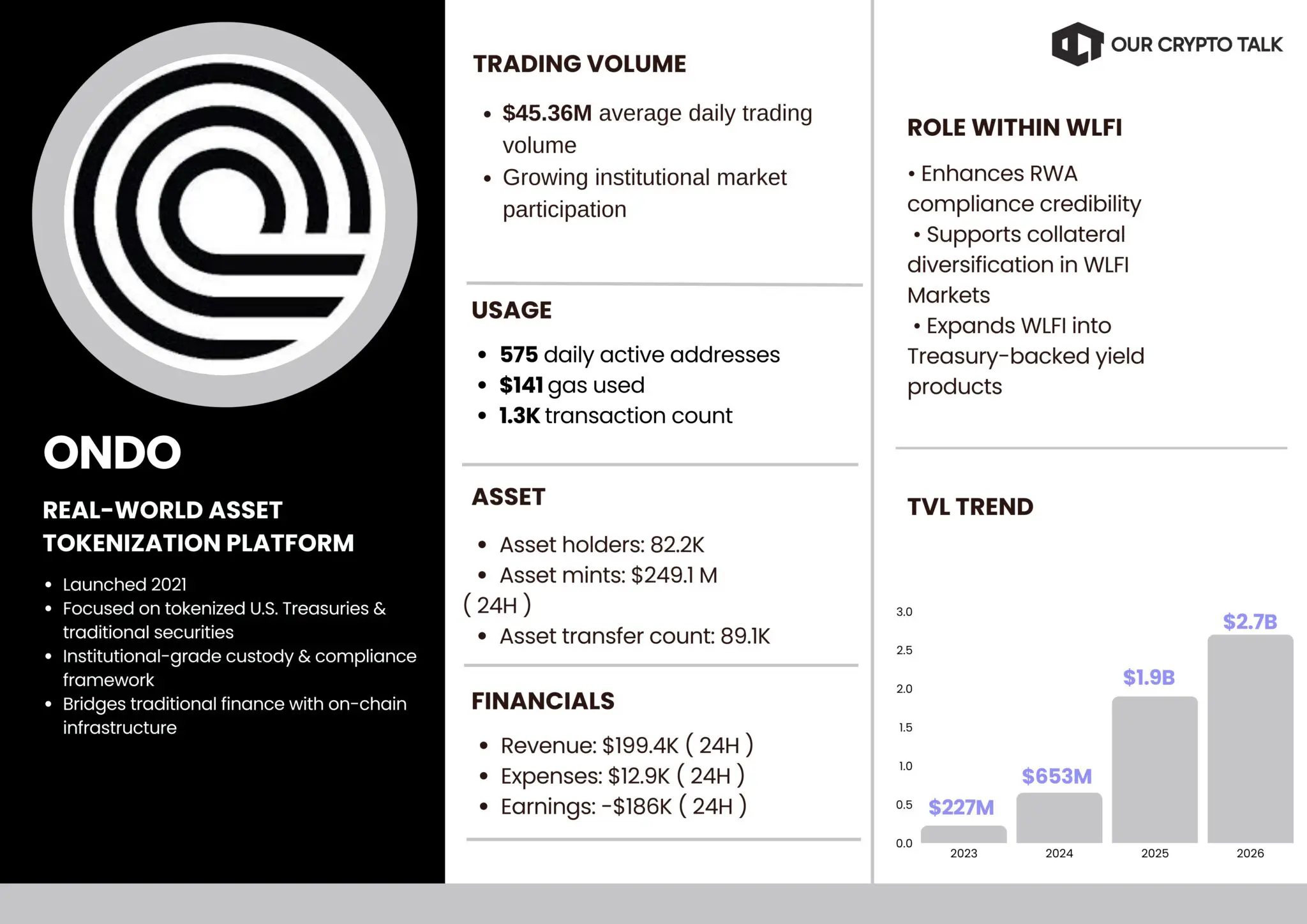
Ondo Finance was launched in 2021 with the objective of bringing institutional-grade financial products on-chain through real-world asset tokenization. Rather than building a traditional DeFi lending protocol, Ondo focuses on structuring tokenized exposure to U.S. Treasuries and other traditional financial instruments. This approach addresses a structural gap in DeFi: access to stable, yield-bearing assets backed by real-world securities.
Ondo’s model involves issuing tokenized products backed 1:1 by underlying financial instruments held with qualified custodians. Assets such as short-term U.S. Treasuries are packaged into tokenized structures that distribute yield on-chain. Transparency is supported through third-party custodianship, independent accounting, and audited reserve disclosures. This compliance-oriented approach distinguishes Ondo from purely crypto-native yield strategies.
Key products include OUSG, which represents tokenized exposure to short-term U.S. Treasuries for accredited investors, and USDY, a yield-bearing dollar-denominated token backed by Treasury holdings. Yield distributions are derived from underlying government securities rather than algorithmic mechanisms. Ondo also expanded into tokenized equities and ETFs through its broader tokenization platform, enabling blockchain-based exposure to traditional financial instruments.
Ondo Chain was introduced to support institutional-grade RWA issuance and high-throughput token distribution. Rather than replacing existing DeFi networks, Ondo’s infrastructure integrates across multiple blockchains to distribute tokenized assets efficiently.
Ondo strengthens WLFI’s ability to integrate traditional financial yields into its decentralized infrastructure. Ondo’s strength lies in its compliance alignment and its focus on transforming traditionally illiquid financial instruments into on-chain assets that can be used within DeFi ecosystems as collateral or yield-bearing positions. Ondo expands the Top 7 Projects in WLFI portfolio into real-world asset tokenization, providing exposure to Treasury-backed yield products and structured financial instruments.
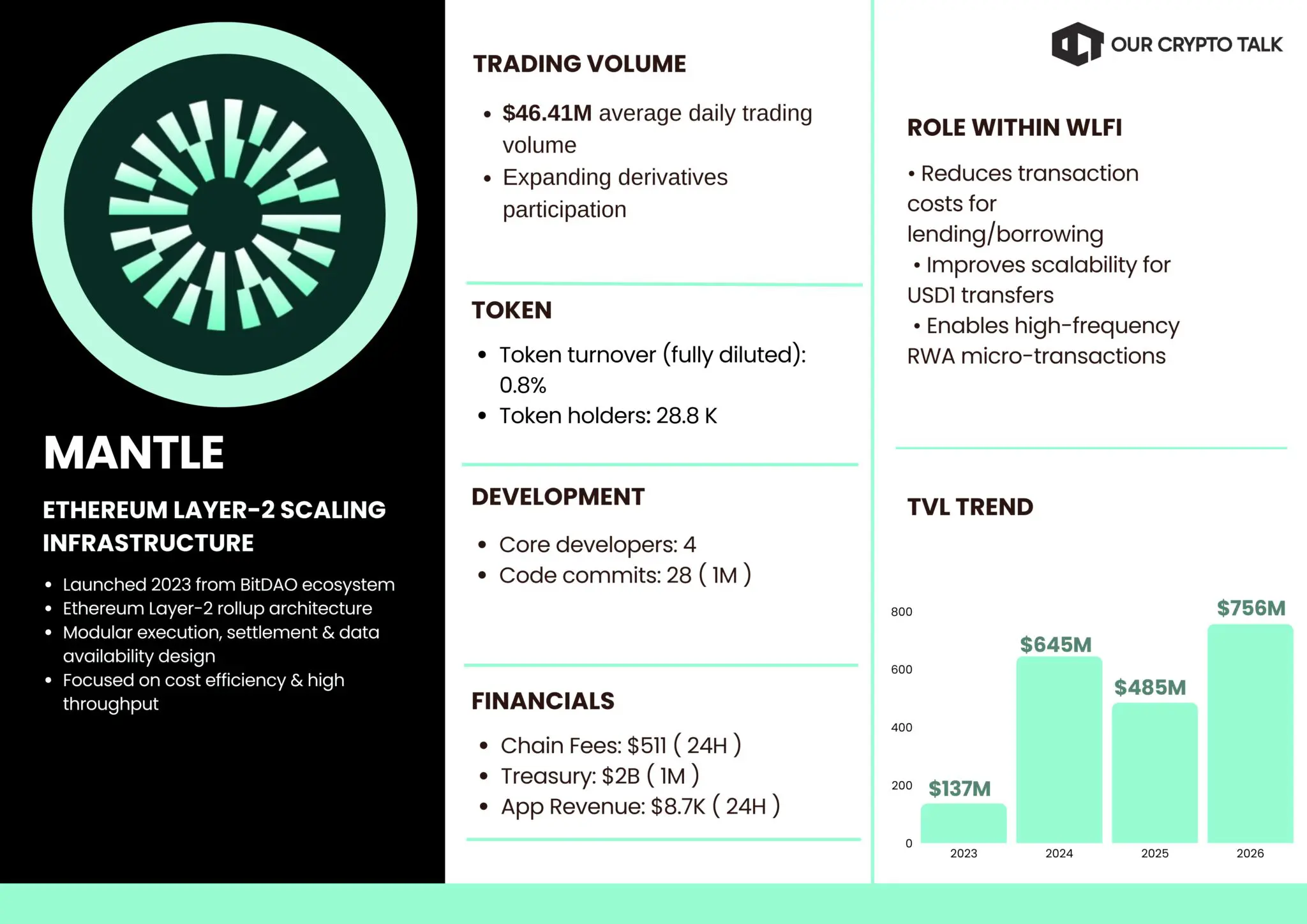
Mantle Network launched in 2023 as an Ethereum Layer-2 scaling solution designed to improve transaction efficiency while maintaining compatibility with Ethereum’s security model. Originating from the BitDAO ecosystem, Mantle was structured with a significant treasury and governance-driven development model. Its objective is not to replace Ethereum, but to reduce transaction costs and increase throughput by processing transactions off-chain before settling them on Ethereum.
Mantle initially adopted optimistic rollup architecture but later incorporated zero-knowledge validity proofs to improve finality speed and verification efficiency. Its modular design separates execution, data availability, and settlement layers. One of Mantle’s notable technical integrations is EigenDA for data availability, which reduces data posting costs compared to traditional Layer-2 structures. This improves cost efficiency for high-frequency DeFi applications and token transfers.
Mantle also introduced the mETH Protocol, a liquid staking mechanism that allows users to stake ETH while maintaining liquidity through derivative tokens. This supports capital efficiency, as staked assets can still be deployed in DeFi strategies. Integration with restaking frameworks further enhances yield optimization without requiring direct custody transfer.
Another component of Mantle’s ecosystem is BTC integration through wrapped Bitcoin structures, enabling Bitcoin holders to participate in Ethereum-based DeFi environments. This cross-asset approach broadens liquidity sources and supports multi-asset collateral strategies. Governance within Mantle is managed by MNT token holders, who vote on treasury allocations, ecosystem funding, and protocol upgrades. The large ecosystem treasury has been used to incentivize builders and liquidity providers.
Mantle strengthens WLFI’s scalability while preserving Ethereum-based settlement guarantees. Mantle’s positioning focuses on providing scalable infrastructure for DeFi, gaming, and tokenized asset platforms while maintaining Ethereum compatibility. As adoption grows, this Layer-2 infrastructure supports the operational sustainability of the Top 7 Projects in WLFI portfolio.
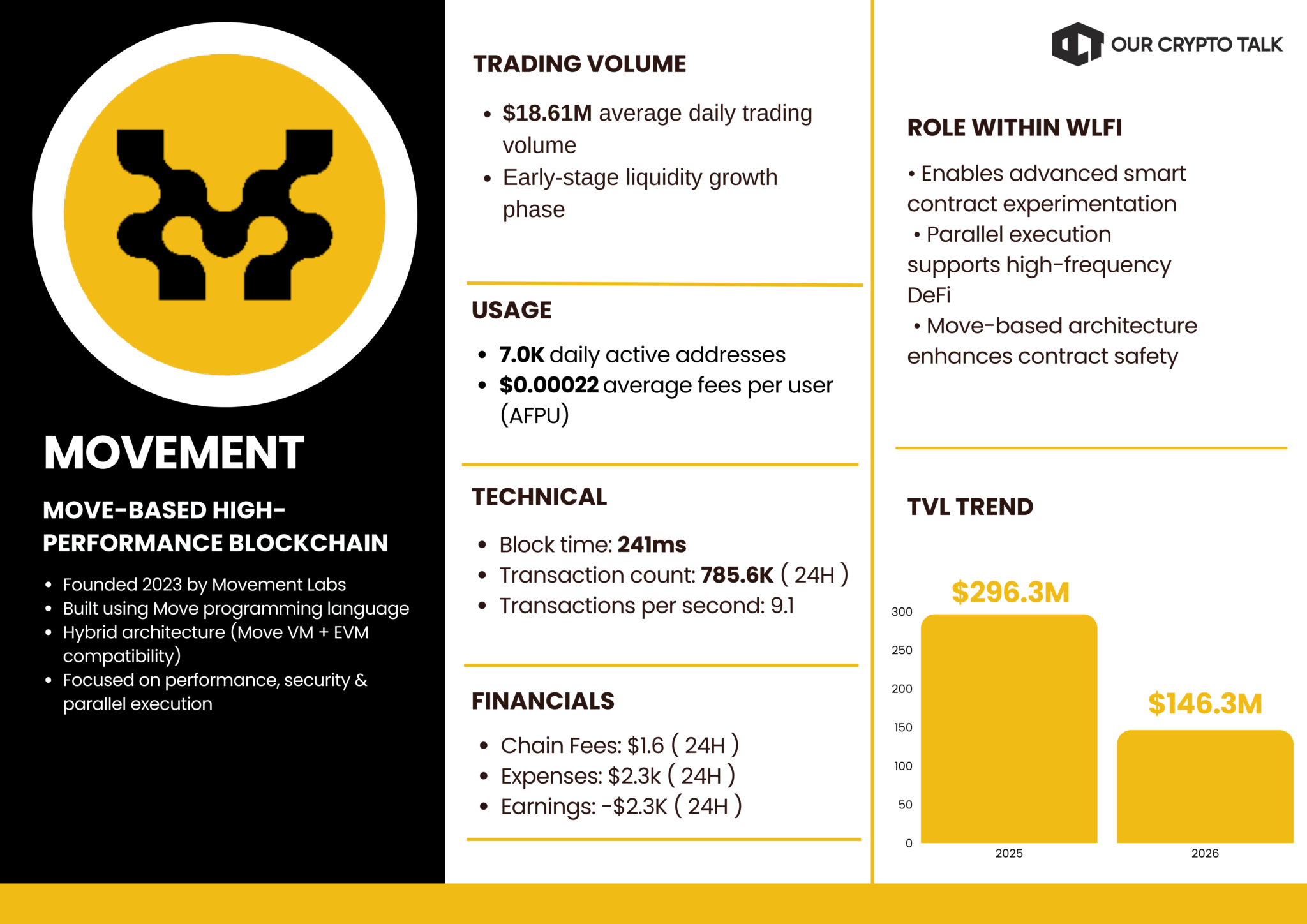
Movement Labs was founded in 2023 with the objective of building high-performance blockchain infrastructure using the Move programming language. Originally developed for Meta’s Diem project, Move was designed to address common smart contract vulnerabilities by introducing resource-oriented programming. Unlike traditional EVM-based systems, Move treats digital assets as first-class resources that cannot be duplicated or unintentionally destroyed, improving safety guarantees.
Movement initially launched as an Ethereum Layer-2 solution but later transitioned toward standalone Layer-1 infrastructure to expand execution capabilities. The network integrates Aptos Move and Sui Move concepts while maintaining compatibility with Ethereum through an embedded EVM interpreter. This hybrid design allows developers to bridge liquidity between EVM-based applications and Move-based smart contracts.
One of Movement’s key technical advantages is parallelized execution. Instead of processing transactions sequentially, Movement can execute independent transactions simultaneously. This increases throughput efficiency and reduces congestion under high demand. The architecture is modular, allowing developers to build customizable chains and deploy applications across interconnected environments.
The MOVE token supports transaction fees, staking, governance participation, and validator incentives. A significant portion of the supply is allocated to community incentives and ecosystem growth. Movement emphasizes secure execution environments and aims to attract developers building advanced DeFi and gaming applications that require higher throughput and improved contract safety.
Movement represents WLFI’s allocation toward performance-focused and security-oriented blockchain innovation. Despite growth, Movement has faced challenges, including market volatility and governance scrutiny related to token distribution events. However, its technical foundation remains centered on Move-based smart contract safety and performance efficiency. It represents WLFI’s forward-looking allocation within the Top 7 Projects in WLFI portfolio, focused on speed and contract safety.
The seven projects in the World Liberty Financial portfolio, Ethereum, TRON, Chainlink, AAVE, ONDO, Mantle, and Movement, reflect a structured infrastructure strategy rather than a speculative allocation. Each asset supports a specific layer of WLFI’s ecosystem and reinforces its objective of building a dollar-centered DeFi platform that integrates stablecoin issuance, lending, and real-world asset tokenization.
Ethereum serves as the primary settlement and smart contract layer, anchoring USD1 issuance and governance mechanisms. TRON enhances cost efficiency and global stablecoin transfers, supporting high-volume transactions across markets. Chainlink provides the data integrity layer through price feeds and proof-of-reserves systems, strengthening peg transparency and lending risk management.
AAVE contributes established decentralized lending infrastructure, enabling overcollateralized borrowing, liquidity depth, and tested liquidation mechanics. ONDO expands WLFI into tokenized real-world assets, aligning with revenue-linked initiatives such as the Maldives resort model. Mantle improves scalability through Layer-2 efficiency while maintaining Ethereum compatibility. Movement introduces exposure to high-performance smart contract architecture beyond traditional EVM systems.
Together, these integrations create a layered structure covering base infrastructure, verification, liquidity provision, and tokenized asset exposure. Diversification across networks reduces dependency on a single blockchain while supporting USD1 stability and multi-chain functionality.
Operational complexity, regulatory scrutiny, and market volatility remain structural challenges. WLFI’s long-term trajectory will depend on transparent reserve management, disciplined governance, and stable technical integration.
The portfolio demonstrates a deliberate attempt to combine decentralized infrastructure with institutional-grade financial exposure under a dollar-centric framework. Execution and risk management will ultimately determine its sustainability.
All the opinions in this article are that of the author and in no way are financial advice. Our Crypto Talk and the author always suggest you do your own research in crypto and to never take anything as financial advice that you read on the internet. Check our Terms and conditions for more info.



AI Agent Payments Explained: Circle Nanopayments and the x402 Protocol
Top 7 Projects in the World Liberty Financial (WLFI) Portfolio
Where Crypto Actually Makes Money in 2026?
What If Satoshi Nakamoto Was Here in 2026?
AI Agent Payments Explained: Circle Nanopayments and the x402 Protocol
Top 7 Projects in the World Liberty Financial (WLFI) Portfolio
Where Crypto Actually Makes Money in 2026?
What If Satoshi Nakamoto Was Here in 2026?