Loading Search...


Taraxa Review: A scalable Layer-1 blockchain using Block DAG architecture, immediate finality, and optimized execution to reduce friction.

Author: Akshat Thakur
This Taraxa Review explores a purpose-built Layer-1 blockchain designed to reduce real-world business friction by making operational data verifiable, scalable, and immediately final. Taraxa approaches blockchain scalability from a fundamentally different angle, focusing not just on throughput, but on the integrity, provenance, and usability of unstructured and informal data that dominates modern economic activity.
Rather than optimizing solely for DeFi or token transfers, Taraxa is engineered as a fast, scalable public ledger for anchoring off-chain data, tracking informal transactions, and enabling verifiable audit trails across organizations. By combining a Block DAG architecture, asynchronous finality, and an optimized execution layer, Taraxa aims to deliver Web2-level performance without compromising decentralization or security.
At its core, Taraxa positions itself as infrastructure for a data-driven economy, where trust, traceability, and speed are essential. This review examines how Taraxa’s consensus design, execution model, and economic system work together to support high-throughput applications that traditional blockchains struggle to handle.
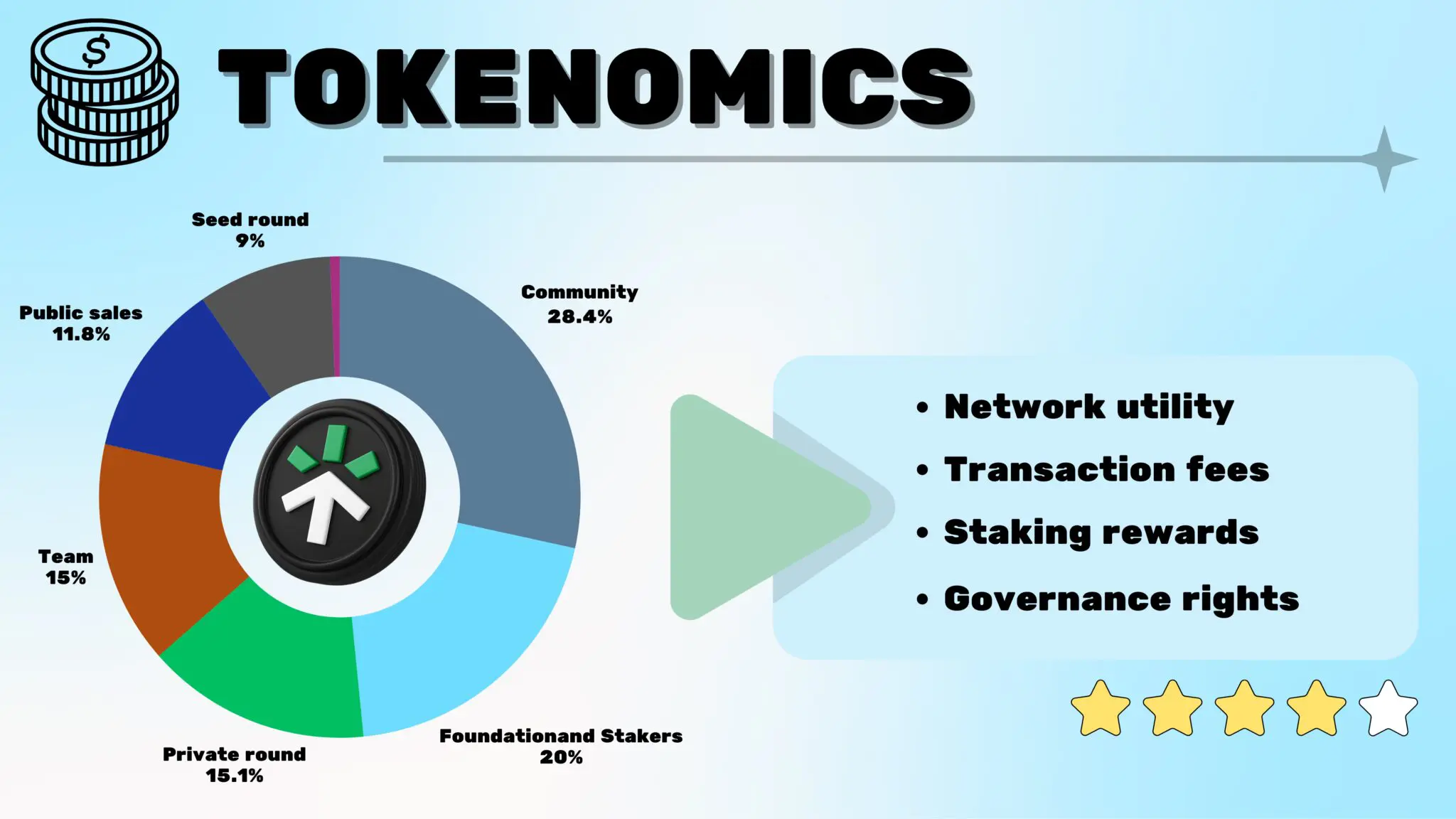
The Taraxa token is the native utility asset of the network. It is used for transaction fees, staking, validator participation, and governance. The total initial supply is 10 billion tokens, all minted at genesis.
Inflation occurs through block rewards distributed to staked validators, with a target staking rate of approximately 67% and a maximum annualized yield of 20%. Tokens are distributed across seed and private investors, public sale participants, the team, foundation, and community ecosystem funds.
Taraxa is developed by a technically focused team with deep expertise in distributed systems, cryptography, and consensus research. The project is supported by the Taraxa Foundation, which oversees long-term ecosystem growth and governance.

Compared to Ethereum, Taraxa removes single-chain bottlenecks through a Block DAG while retaining smart contract capability. Relative to other DAG-based systems, Taraxa distinguishes itself with deterministic ordering and true finality rather than probabilistic convergence.
| Project | Core Focus | Privacy Model | Execution Architecture | Programmability | Token Utility | Notes |
|---|---|---|---|---|---|---|
|
|
This Taraxa Review highlights a blockchain designed not just for transactions, but for trust in a data-heavy global economy. By combining an inclusive Block DAG, immediate finality, and an optimized execution layer, Taraxa breaks many of the scalability limitations that constrain traditional blockchains.
Rather than chasing generalized smart contract dominance, Taraxa targets a specific and under-served problem: making informal and unstructured data verifiable at scale. Its architecture reflects this focus, prioritizing deterministic ordering, auditability, and execution efficiency over speculative design choices.
If Taraxa succeeds in driving adoption around data anchoring and real-world operational use cases, it could occupy a unique and defensible position within the Layer-1 landscape one defined less by hype and more by measurable economic utility.
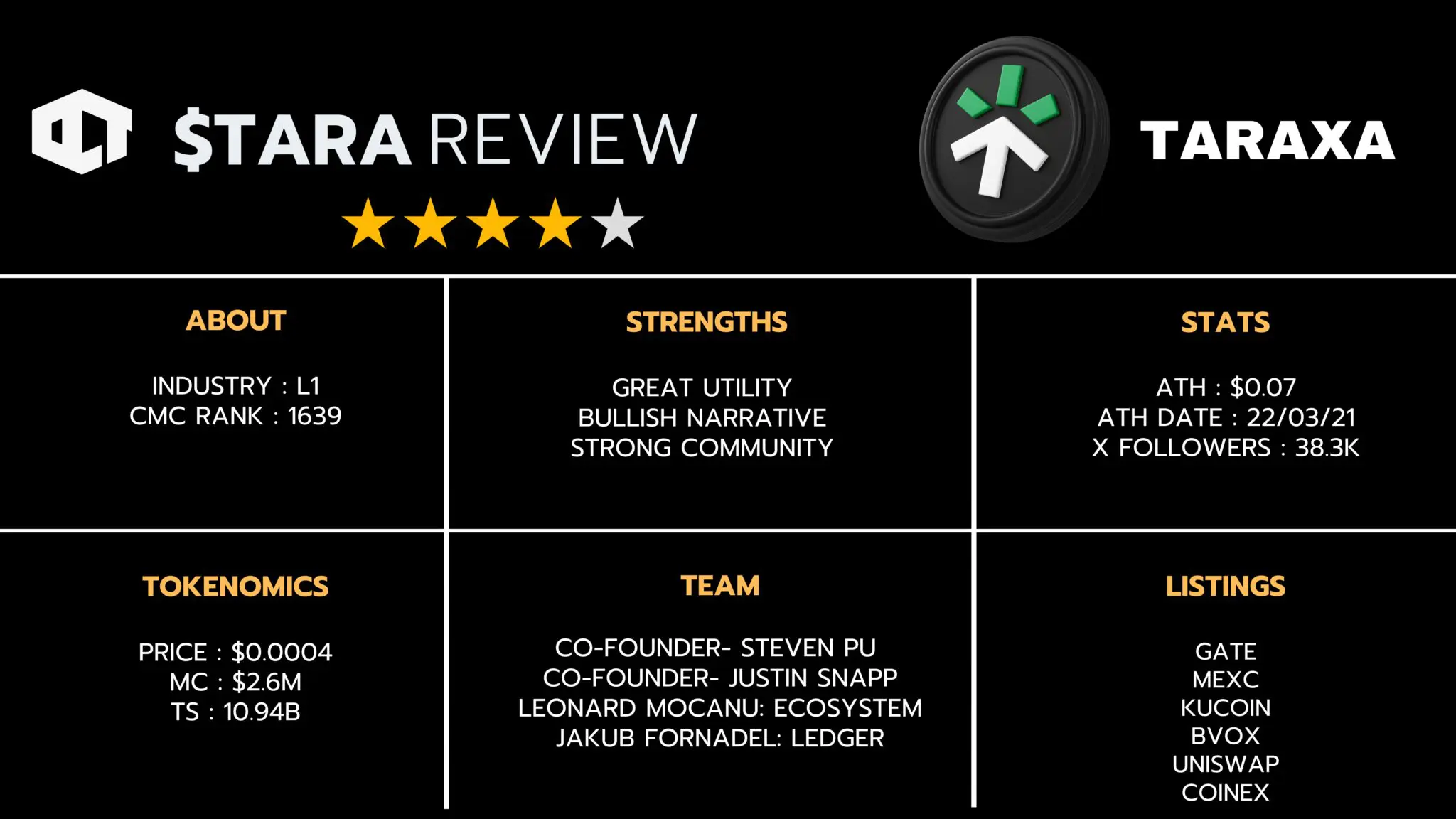



| Scalable EVM Layer-1 for DeFi, Social AI, and data auditing. |
| Public by default. |
| BlockDAG with t-Graph Proof-of-Stake and asynchronous PBFT finality. |
| Full EVM compatibility using Solidity. |
| Transaction fees, staking rewards, and governance. |
| Over 5,000 TPS with under 3.7s finality; mainnet launched in 2023; Cacti upgrade scheduled for Jan 2026; TVL growth of 1169%. |
 Kaspa
Kaspa
| High-throughput BlockDAG optimized for fast transactions. | Public by default. | BlockDAG using GHOSTDAG with Proof-of-Work. | Emerging smart contracts using Rust. | Transaction fees and mining rewards. | Fastest Proof-of-Work chain by throughput; roughly 10k TPS claimed; no native EVM; strong community support. |
 Hedera
| Enterprise distributed ledger for decentralized applications and payments. | Public network with optional private deployments. | Hashgraph consensus with asynchronous Byzantine Fault Tolerance. | Full EVM compatibility. | Fees, staking, and governance via HBAR. | Sustains 10k+ TPS with low fees; governed by an enterprise council; active in supply chain and NFT use cases. |
 IOTA
IOTA
| Feeless network for IoT data exchange and value transfers. | Public network with data-sharding-based privacy. | Tangle DAG with mana-based spam protection. | Smart contracts using Assembly. | Feeless transactions with mana-based prioritization. | Designed for machine-to-machine economies; Coordicide roadmap toward full decentralization; strong real-world data integrations. |
 VeChain
| Blockchain for supply chain tracking and business data integrity. | Public network with enterprise privacy tooling. | Proof-of-Authority consensus. | Full EVM compatibility. | Dual-token model: VET for value transfer and VTHO for gas. | Strong enterprise adoption including Walmart; NFC and RFID tracking. |
 Solana
| High-throughput blockchain for scalable decentralized applications. | Public by default. | Proof-of-History combined with Proof-of-Stake. | Rust-based smart contracts; non-EVM. | Transaction fees and staking rewards. | Theoretical throughput above 65k TPS; highly efficient execution; ongoing centralization concerns. |