Loading Search...


Hyperliquid Review: A high‑performance Layer 1 blockchain with fully onchain order books, HyperBFT consensus, and infrastructure for DeFI.

Author: Akshat Thakur
Most decentralized exchanges still cannot compete with centralized trading platforms. Execution is slower, liquidity is fragmented across chains, and many so called decentralized systems quietly rely on offchain infrastructure to function. The gap between DeFi and real market infrastructure allows centralized exchanges to continue dominating global trading volume. Professional traders care about execution quality, liquidity depth, and reliability. If a decentralized platform cannot deliver those things consistently, self custody becomes less important than performance. This Hyperliquid Review starts with a simple question. Why do most decentralized exchanges still feel slower and less efficient than centralized platforms?
Over the past few years the industry has tried several approaches to solve this problem. Automated market makers improved accessibility but often struggle with large trades and capital efficiency. Hybrid exchanges improved performance but sacrificed transparency by moving critical infrastructure offchain.
Hyperliquid takes a different path. Instead of building another decentralized application on top of an existing blockchain, the team designed an entirely new Layer 1 built specifically for financial markets. The idea is simple but ambitious. If trading infrastructure is the core problem, then developers must optimize the underlying blockchain for trading. Order books, margin systems, and liquidations should not be external services. They should exist directly within the protocol itself.
In this Hyperliquid Review we examine how the network attempts to rebuild financial market infrastructure onchain, why its architecture is different from most DeFi protocols, and whether this approach can realistically compete with centralized exchanges that currently dominate the market.
Decentralized finance promised open and transparent markets. In practice, many trading platforms struggle with the same structural limitations. Performance remains one of the biggest issues. Many blockchains simply were not designed for high frequency trading workloads. Slow block times and network congestion can make active trading strategies impossible.
Liquidity fragmentation is another problem. Assets and traders are spread across different chains, protocols, and liquidity pools. That fragmentation reduces efficiency and increases slippage for users. Many systems also rely on hybrid models that move critical infrastructure offchain. Order matching engines, liquidation systems, and pricing mechanisms sometimes operate outside the blockchain itself. While this improves performance, it weakens transparency.
These issues create a persistent tradeoff between decentralization and performance. Hyperliquid was designed around the idea that the underlying infrastructure must change if decentralized markets want to compete with centralized exchanges.
These challenges explain why Hyperliquid chose to build a new blockchain instead of launching another decentralized exchange on an existing network, a core point examined throughout this Hyperliquid review.
Hyperliquid takes a different architectural approach compared to most DeFi protocols. Instead of layering financial applications on top of a general purpose blockchain, the project built a new chain optimized for financial activity from the start. The protocol introduces a custom consensus mechanism called HyperBFT, inspired by the HotStuff family of consensus algorithms. The system is designed to deliver fast block finality and low latency across the network.
A central component of the design is that trading infrastructure lives directly onchain. Hyperliquid operates fully onchain perpetual futures and spot order books where orders, trades, cancellations, and liquidations are all executed transparently on the blockchain. The network is capable of processing roughly two hundred thousand orders per second. This level of throughput allows the platform to support trading activity that historically only existed on centralized exchanges.
Developers can also build applications that interact with this trading infrastructure through the protocol’s smart contract environment. Instead of building isolated liquidity pools, applications can access the same shared market infrastructure.
The design attempts to combine performance and transparency rather than forcing a tradeoff between the two, which is one of the key ideas explored in this Hyperliquid review.
The Hyperliquid blockchain is structured around two major components. These components are HyperCore and HyperEVM.
HyperCore powers the core trading infrastructure of the network. It includes perpetual futures markets, spot order books, clearing systems, and margin management. Every trading action is processed directly within the blockchain state.
This architecture allows the system to maintain deterministic ordering of trades while preserving full transparency. All trading activity can be verified directly from the public ledger.
HyperEVM provides a general purpose smart contract environment that is compatible with the Ethereum Virtual Machine. Developers can deploy decentralized applications using familiar tooling while still accessing HyperCore liquidity.
Because both systems share the same consensus layer, applications can interact directly with order book liquidity without relying on bridges or fragmented liquidity pools.
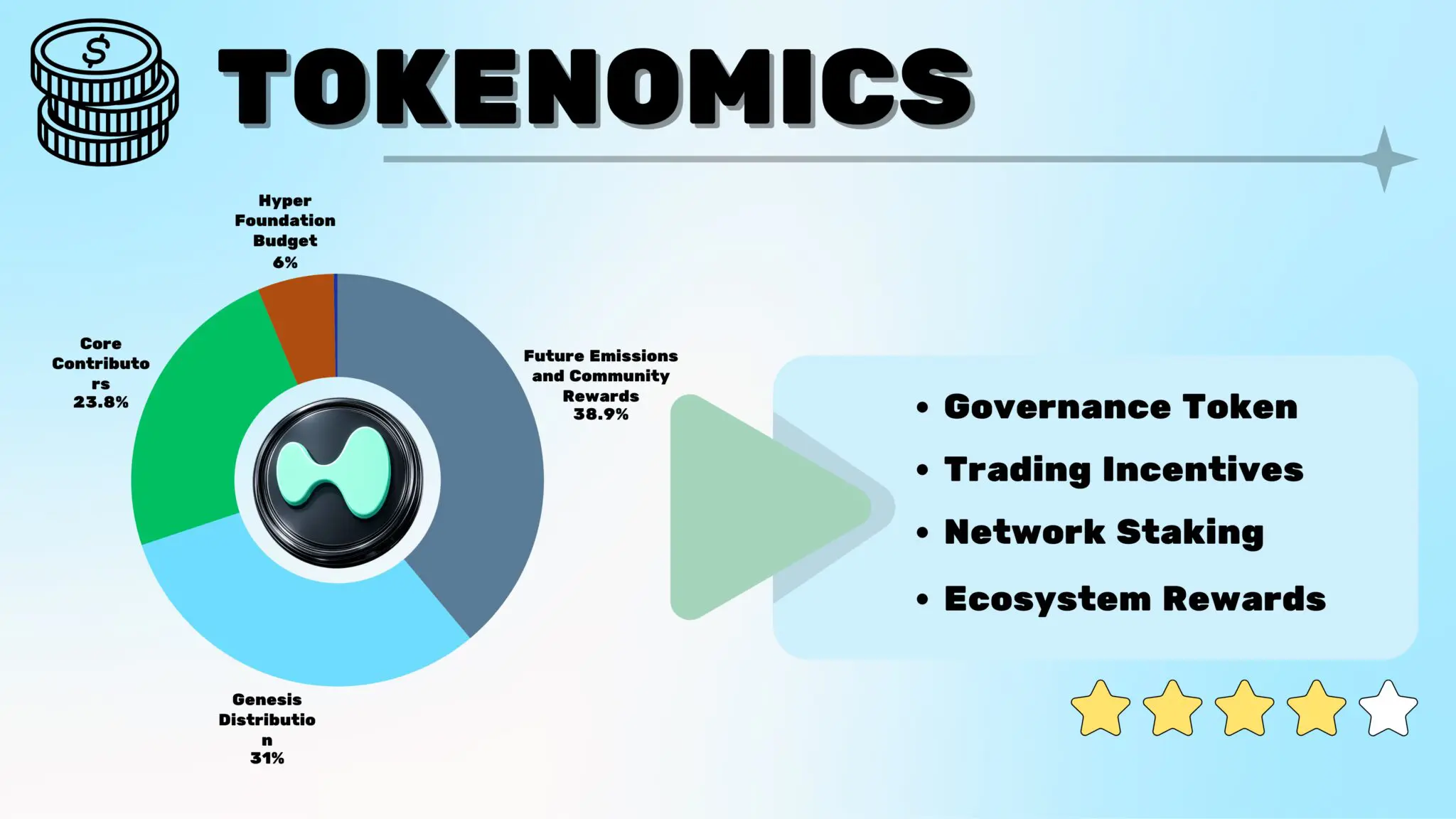
The HYPE token sits at the center of the Hyperliquid ecosystem. It acts as both the governance asset and the economic coordination mechanism that aligns traders, liquidity providers, and network participants with the long-term growth of the protocol.
Unlike many DeFi projects that launch on existing chains, Hyperliquid operates on its own custom Layer-1 blockchain, purpose-built for high-speed on-chain perpetual futures trading. Within this environment, HYPE plays multiple roles: governance participation, staking for network security, trading incentives, and ecosystem rewards.
In simple terms, HYPE is designed to capture the value generated by the Hyperliquid trading ecosystem while giving the community a direct say in how the protocol evolves.
The difference between the issued supply and the maximum supply comes from protocol adjustments and token burns carried out over time.
The distribution of HYPE reflects a balance between early community ownership, long-term development incentives, and future ecosystem growth.
Overall, Hyperliquid’s tokenomics structure emphasizes early community ownership while preserving a large pool of incentives for long-term ecosystem growth.
This balance between circulating supply, locked allocations, and future emissions is designed to support sustained protocol expansion rather than short-term token distribution spikes.
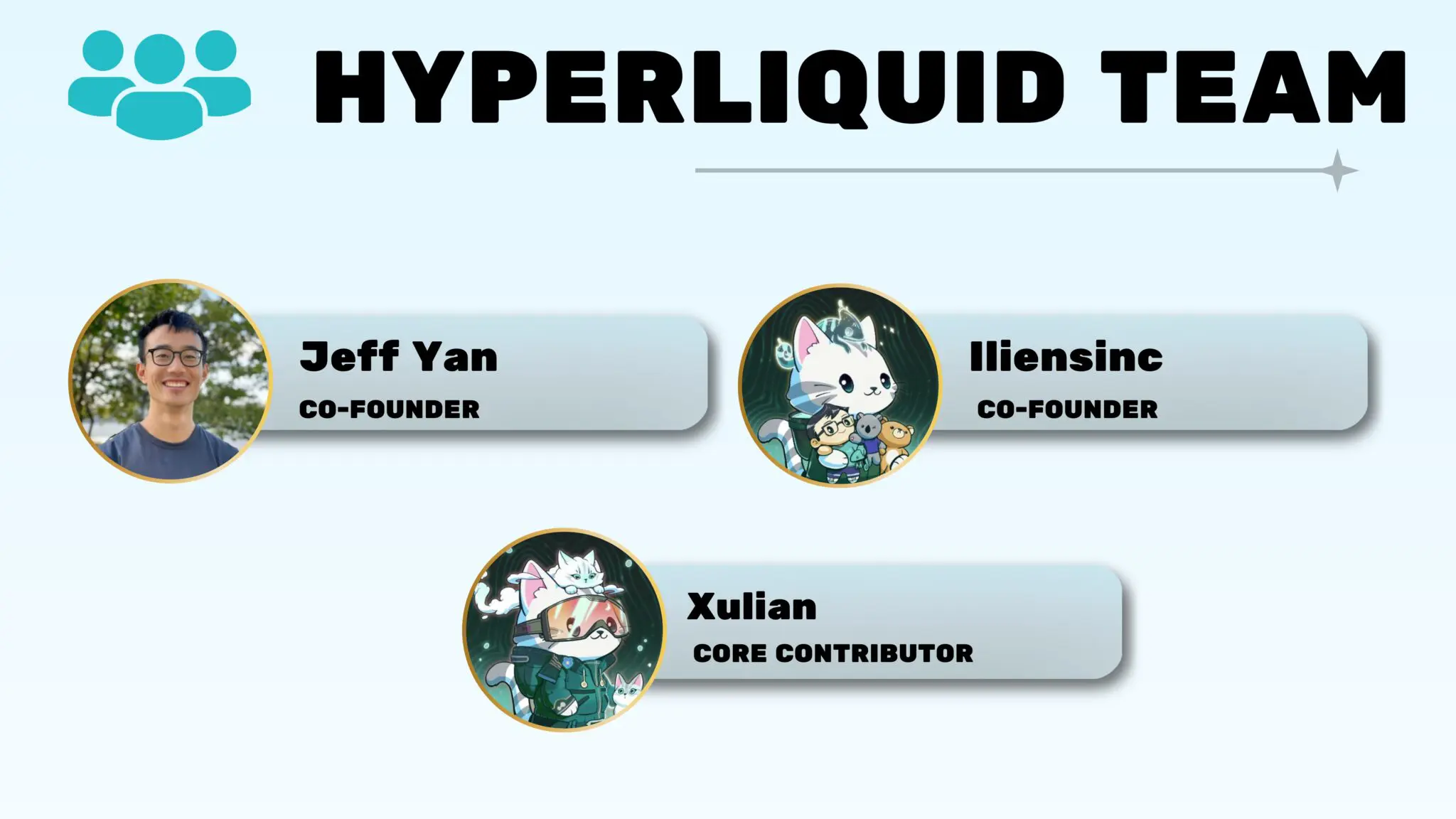
Core development of the protocol is led by Hyperliquid Labs. The founding team includes engineers and quantitative researchers with backgrounds from Harvard, MIT, and Caltech.
Before building the protocol, members of the team worked in proprietary crypto trading and market making. Their experience exposed weaknesses in existing DeFi infrastructure such as poor market design, unreliable performance, and complicated user interfaces.
The project is notable for being self funded. The team did not raise venture capital and has continued development without external funding. This structure allows the project to pursue long term infrastructure development without pressure from investors.
Hyperliquid stands out because it treats decentralized trading as an infrastructure problem rather than a user interface problem. Most decentralized exchanges focus on building better trading interfaces or liquidity incentives. Hyperliquid instead rebuilt the entire technical stack around the needs of trading systems.
This approach creates several advantages. A dedicated Layer 1 can optimize execution, consensus, and networking for financial workloads. Developers can also build new applications on top of a shared liquidity layer instead of creating fragmented markets.
At the same time, the model comes with tradeoffs. Building a new financial infrastructure requires sustained adoption from traders, liquidity providers, and developers. Without a strong ecosystem, even technically impressive infrastructure can struggle to reach critical mass.
| Project | Core Focus | Execution Architecture | Programmability | Token Utility | Notes |
|---|---|---|---|---|---|
|
|
Hyperliquid represents a different direction for decentralized finance. Instead of building applications on top of slow and fragmented infrastructure, the project attempts to rebuild the core market engine itself.
The architecture combines high performance trading infrastructure with a programmable smart contract environment. If this design works at scale, it could allow decentralized markets to compete directly with centralized exchanges in terms of execution speed and liquidity.
The real test will be adoption. Infrastructure only matters if traders and developers choose to build on it. Over the past 2 weeks ( 26 Feb- 12 March ), RWA trading on Hyperliquid has repeatedly broken records, surpassing $1.3B in open interest and $1.4B in weekend volume, which suggests that the market is interested in the model.
Whether the protocol ultimately becomes the backbone of onchain finance remains uncertain. What is clear is that it represents one of the most serious attempts to build exchange grade trading infrastructure directly on a blockchain.



| High-performance perpetual DEX on sovereign Layer-1 |
| Custom high-throughput Layer-1 with off-chain matching engine |
| Custom (Rust-based) |
| Governance, fee buybacks |
| Market leader in perp volume; ~$28M treasury for regulatory initiatives; HIP-3/4 feature expansions; no VC allocation; launched 2023 |
|
| Decentralized perpetual trading | Cosmos-based V4 appchain (previously Ethereum L2) | Full (CosmWasm) | Governance, staking (DYDX) | Orderbook model with high leverage support; migrated to sovereign appchain architecture |
|
| Perpetual trading using GLP liquidity pool model | Smart contracts on Arbitrum and Avalanche | Full (EVM) | Governance, protocol fee share (GMX) | Zero-slippage trading via multi-asset liquidity pool; V2 introduces synthetic markets |
|
| Perpetual DEX offering crypto and stock perpetuals | Custom Layer-1 architecture similar to Hyperliquid | Custom | Governance (ASTER) | Backed by CZ; rapid open-interest growth; differentiated via tokenized stock perp exposure |
|
| Options and perpetual derivatives trading | Ethereum Layer-2 built on OP Stack | Full (EVM) | Governance, staking (AEVO) | Formed via Ribbon Finance merger; optimized for high-speed derivatives trading; pre-launch farming incentives |
|
| Latency-optimized perpetual DEX | Custom high-speed Layer-1 | Custom | Governance | Competes primarily on execution speed and low-latency matching; emerging ecosystem |
|
| Hybrid orderbook perpetual DEX | Arbitrum deployment with appchain expansion | Full (EVM) | Governance, fee utility (VRTX) | Cross-chain liquidity synchronization; low fees; integration pathways toward Cosmos ecosystem |