Loading Search...


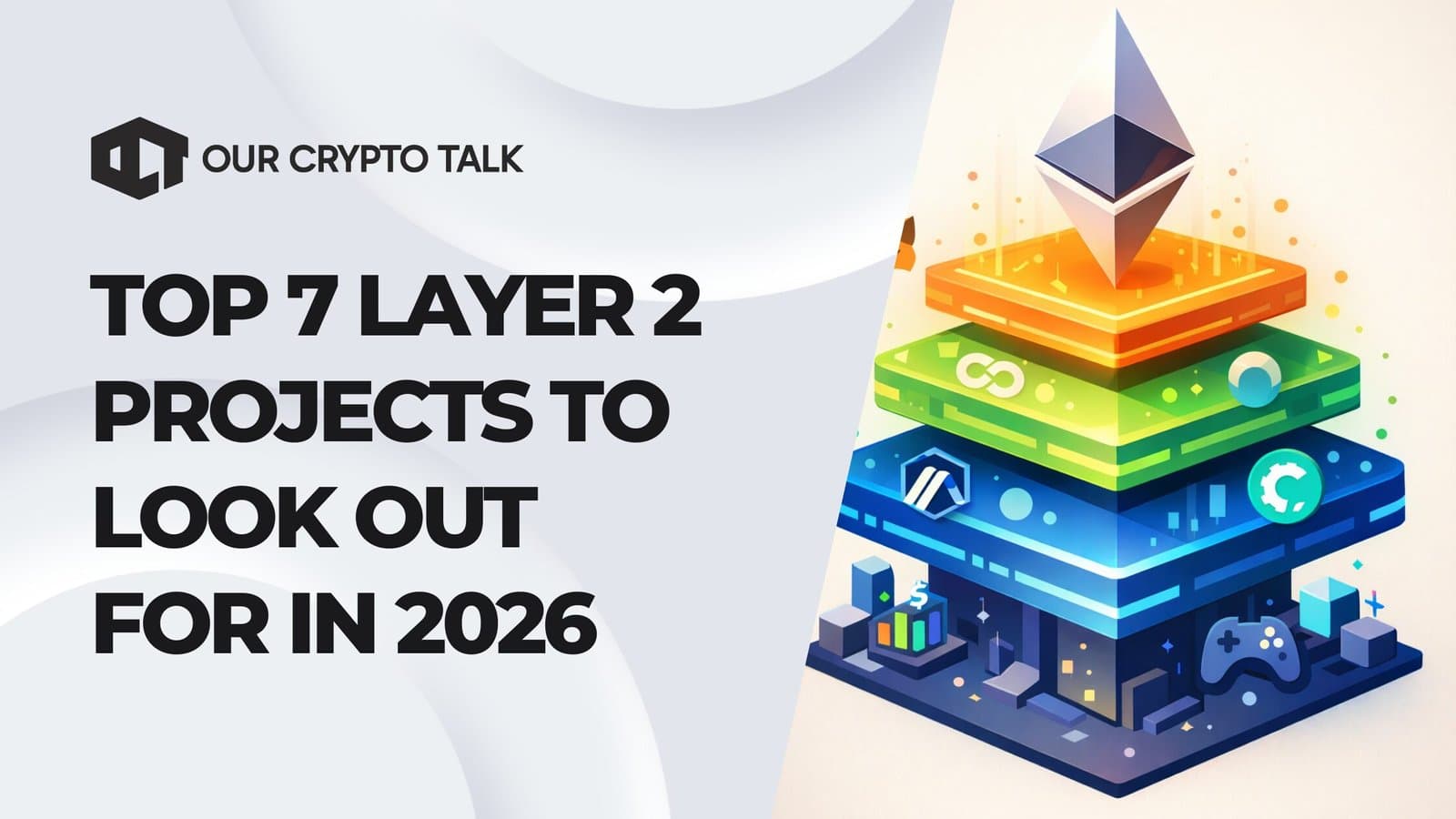
Explore the top Layer 2 projects of 2026 driving Ethereum scaling, and powering the next wave of blockchain adoption and innovation.

Author: Kritika Gupta
Blockchain scaling remains one of the most critical challenges and opportunities in the cryptocurrency ecosystem. As adoption expands and more users, developers, and institutions enter decentralized networks, the demand for faster, cheaper, and more efficient transaction processing continues to increase. Layer 2 projects are emerging as the primary solution, enabling blockchains like Ethereum to scale without compromising security or decentralization.
Layer 2 networks process transactions off the main chain and then batch and settle compressed data or proofs back to Ethereum. As a result, they significantly improve performance. Transactions confirm faster, fees drop to fractions of a cent, and throughput increases enough to support millions of users. In fact, Layer 2 activity now exceeds many Layer 1 networks in daily usage, secured value, and ecosystem expansion. These networks support decentralized finance, gaming, social applications, payments, and tokenized real-world assets.
Moreover, the Layer 2 ecosystem has matured rapidly. Early experimental platforms have evolved into robust, production-grade infrastructure. Developer tools have improved, interoperability continues to advance, and economic models have become more sustainable. At the same time, consolidation has intensified. Only a small group of networks now captures most liquidity, users, and developer attention. This trend will likely continue as institutional adoption accelerates and real-world use cases expand.
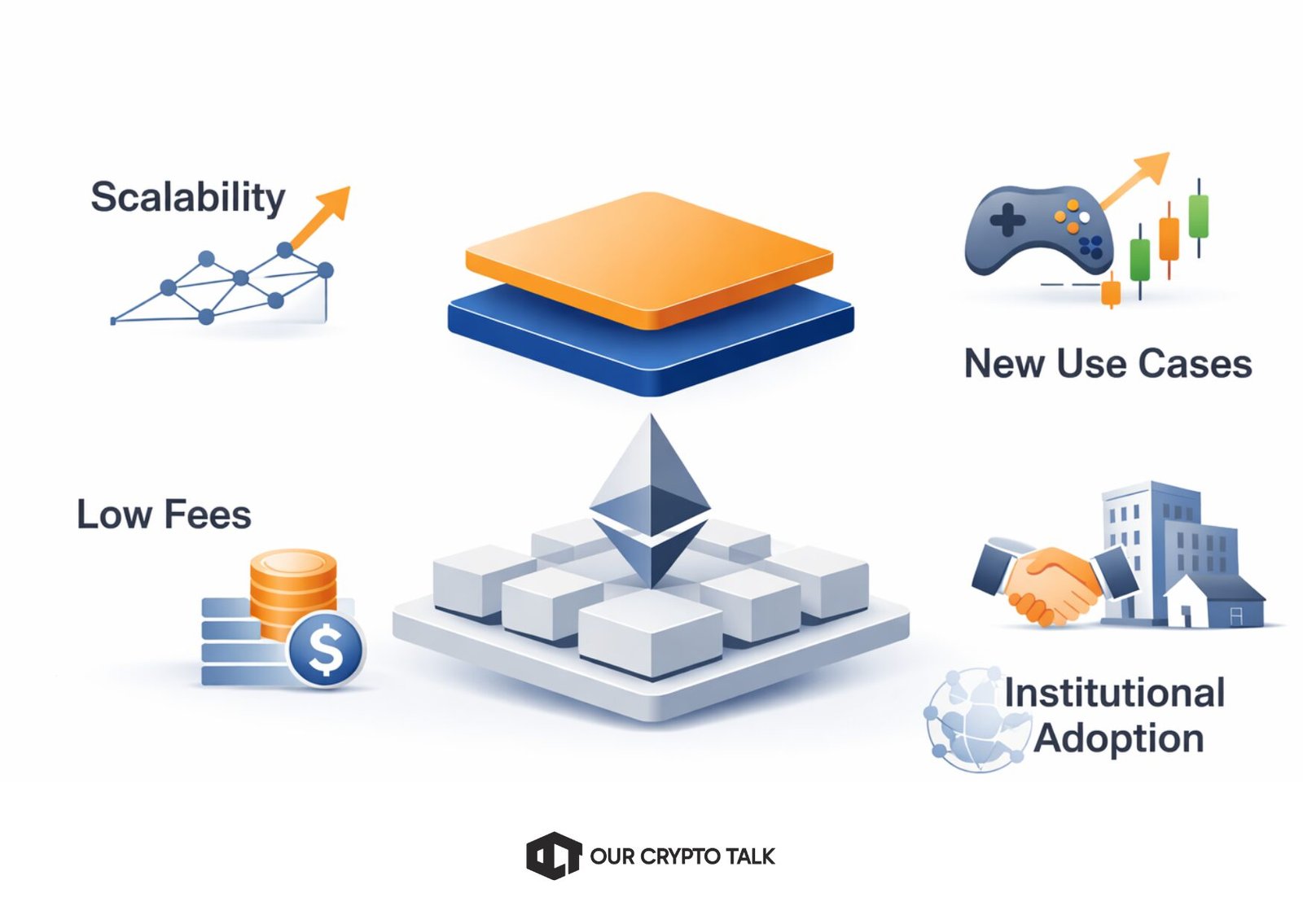
1) Solving the Blockchain Trilemma: The blockchain trilemma continues to define how networks evolve. Security, decentralization, and scalability cannot all be maximized simultaneously on a single base layer. Ethereum prioritizes security and decentralization, but this design limits throughput and increases transaction costs during periods of high demand.
Layer 2 projects solve this constraint directly by moving transaction execution off the main chain while preserving Ethereum’s security guarantees. As adoption accelerates, Layer 2 networks have become essential infrastructure capable of supporting scalable blockchain applications and institutional-grade transaction volume without compromising decentralization.
2) Enabling New Categories of Scalable Blockchain Applications : Lower transaction costs and faster execution speeds have unlocked entirely new use cases. High-frequency trading, large-scale blockchain gaming, micropayments, and real-time stablecoin transfers now operate efficiently at scale.
Additionally, tokenized real-world assets require reliable and scalable infrastructure to support institutional transaction volumes. Layer 2 networks provide the performance, cost efficiency, and scalability required to enable these emerging financial and technological applications.
3) Accelerating Institutional Adoption and Financial Integration : Institutional adoption has accelerated significantly as financial institutions, payment providers, and infrastructure platforms increasingly require scalable blockchain solutions. These organizations demand predictable transaction costs, high throughput, and reliable settlement mechanisms.
Layer 2 networks provide these capabilities while maintaining blockchain transparency, auditability, and security. As a result, many institutions now deploy financial services, settlement systems, and tokenized asset infrastructure directly on Layer 2 networks.
4) Establishing the Foundation for Blockchain’s Long-Term Growth: Layer 2 networks have become the primary execution infrastructure of the blockchain ecosystem. They now support the majority of real economic activity, decentralized application development, and user interactions.
Their ability to combine scalability, cost efficiency, and security makes them essential to blockchain’s long-term success. As adoption continues to expand, Layer 2 networks will play a critical role in enabling global financial infrastructure, decentralized applications, and institutional blockchain integration.
Relative positioning of major Layer-2 ecosystems heading into 2026
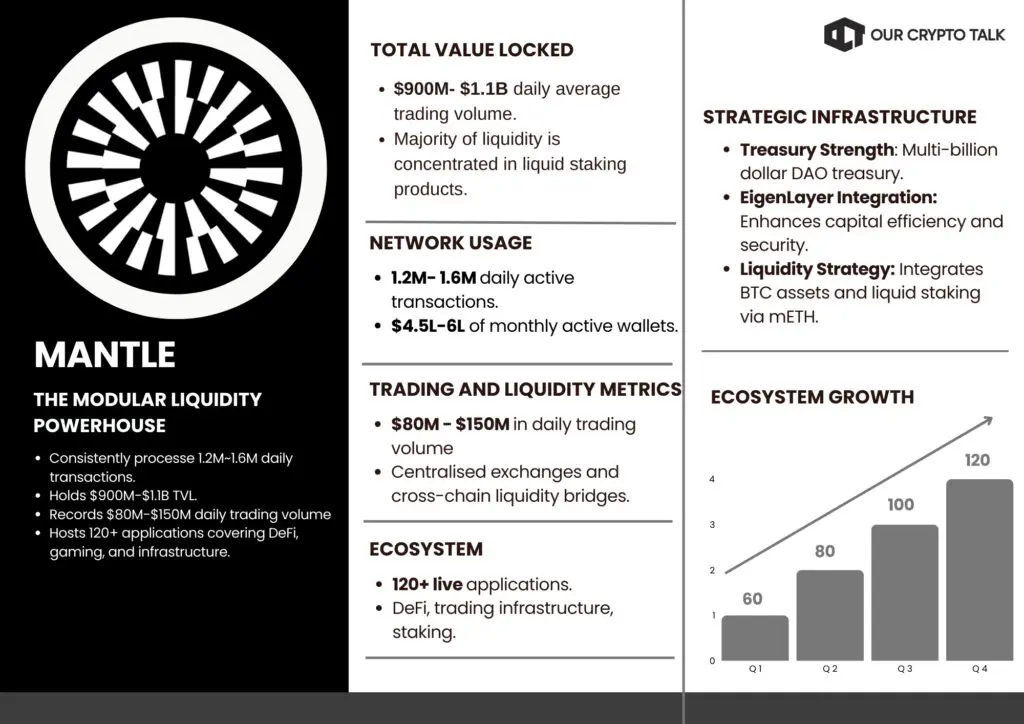
Mantle has emerged as one of the most strategically positioned Layer 2 networks in Ethereum’s scaling ecosystem. As of early 2026, Mantle maintains a market capitalization near $2 billion and a fully diluted valuation approaching $4 billion.
Mantle differentiates itself through a modular architecture. It separates execution, settlement, and data availability layers to optimize scalability and cost efficiency. Currently, Mantle leverages Ethereum blob space for data availability, which reduces costs while maintaining Ethereum-grade security. As a result, Mantle achieves transaction fees near $0.01 while sustaining high throughput.
Most importantly, Mantle focuses heavily on liquidity infrastructure. Its “Liquidity Chain” vision integrates Bitcoin through wrapped assets such as fBTC and supports liquid staking through mETH. These integrations allow Mantle to aggregate capital across ecosystems and improve capital efficiency.
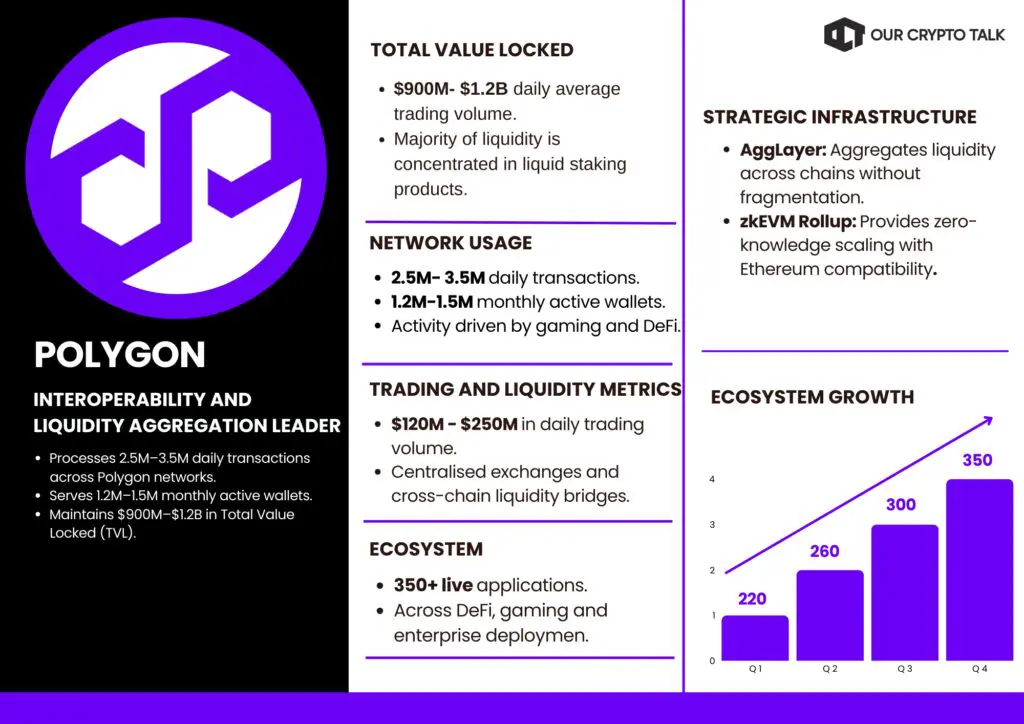
Polygon has evolved from a simple Ethereum scaling solution into a comprehensive blockchain infrastructure network. Its native token, POL, replaced MATIC through a 1:1 migration and now supports staking, governance, and network security across Polygon’s expanding ecosystem.
As of early 2026, POL maintains a market cap between $1.1 billion and $1.2 billion. It also supports strong trading volume and widespread ecosystem adoption. Polygon currently operates multiple scaling solutions, including Polygon PoS, zkEVM, and custom chain deployments.
Most importantly, Polygon has introduced AggLayer, its flagship interoperability system. AggLayer aggregates liquidity and state across multiple chains. This architecture allows users and applications to interact seamlessly across networks without worrying about bridging or fragmentation. As a result, AggLayer directly addresses one of Ethereum’s largest structural limitations.
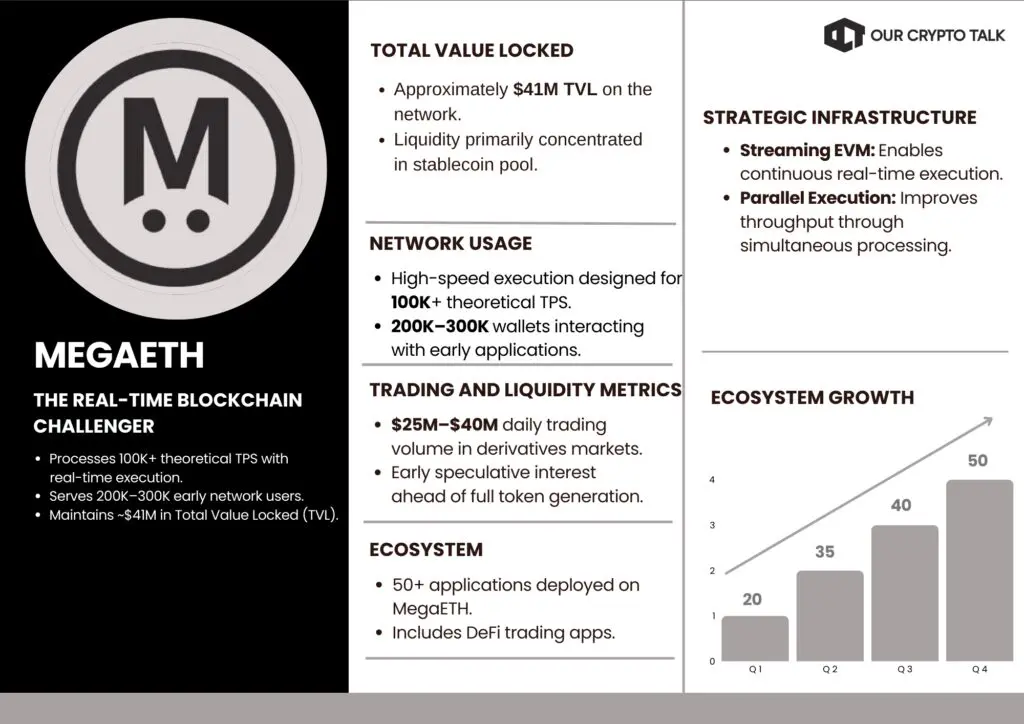
MegaETH has entered the Ethereum Layer 2 ecosystem with one of the most aggressive performance-focused architectures to date. Following its public mainnet launch on February 9, 2026, MEGA trades in pre-market and perpetual markets around $0.129–0.136, implying a fully diluted valuation near $1.29 billion based on its 10 billion total supply. However, official circulating supply remains limited, and a full token generation event depends on meeting ecosystem growth milestones.
MegaETH differentiates itself through its Streaming EVM architecture, which separates execution from settlement and enables continuous transaction processing. Unlike traditional rollups that batch transactions, MegaETH processes them in real time using parallel execution and in-memory state management.
Early adoption metrics show strong initial activity. MegaETH processed nearly 39 million transactions within its first day and onboarded over 50 live applications across DeFi, gaming, and payments. Its total value locked has reached approximately $41 million, primarily in stablecoins.
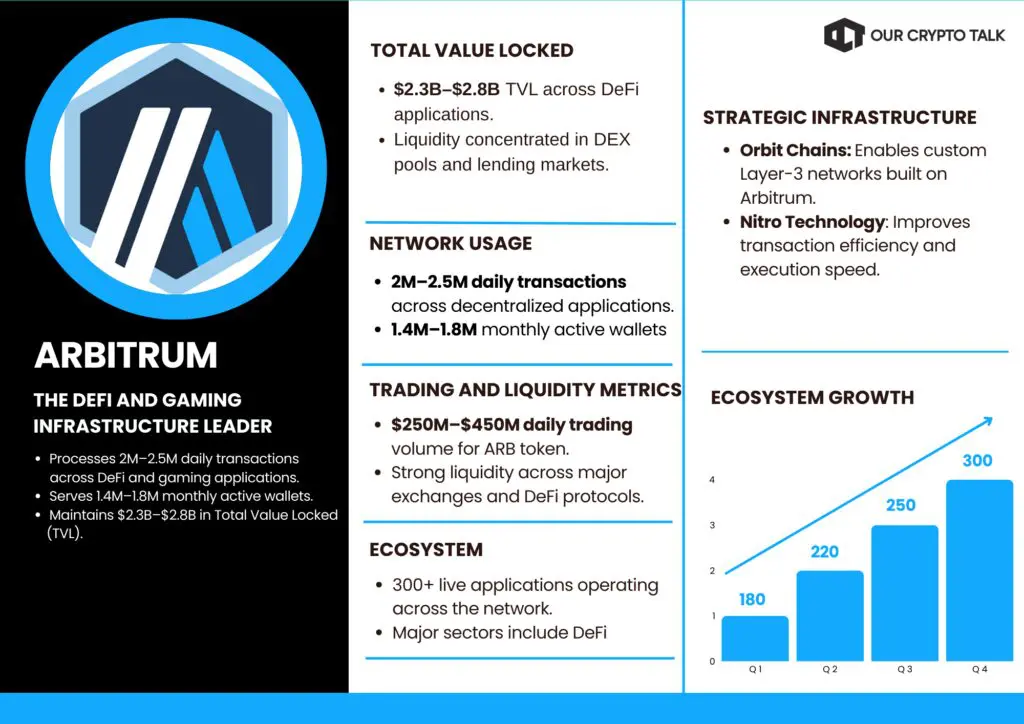
Arbitrum has established itself as one of the most widely adopted Layer 2 networks on Ethereum. As of early 2026, ARB maintains a market cap near $600–700 million and supports a fully diluted valuation exceeding $1 billion.
Arbitrum’s success comes primarily from its strong DeFi ecosystem. Major protocols such as GMX, Uniswap, and various derivatives platforms operate on Arbitrum. These applications attract billions in liquidity and generate consistent network activity.
Arbitrum uses optimistic rollup technology, which batches transactions and submits proofs to Ethereum. This design significantly reduces fees while maintaining Ethereum-level security. As a result, Arbitrum supports sub-cent transaction costs and high throughput.
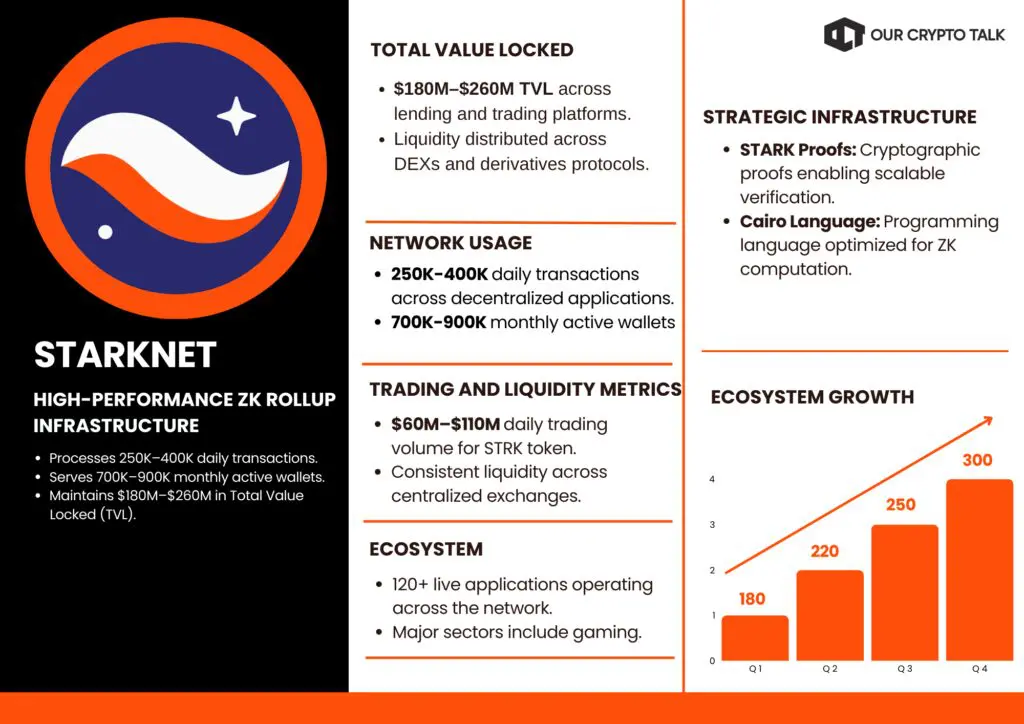
Starknet represents one of the most advanced zero-knowledge scaling solutions in Ethereum’s ecosystem. As of early 2026, STRK maintains a market cap near $265 million and supports strong daily trading activity.
Starknet uses STARK proofs to verify transactions cryptographically. Unlike optimistic rollups, Starknet does not rely on fraud challenges. Instead, it provides mathematical proof of correctness. This approach improves scalability, security, and finality.
Starknet also uses Cairo, a custom programming language designed for zero-knowledge computation. Cairo enables efficient execution of complex applications such as advanced DeFi, gaming, and AI workloads.
By early 2026, Starknet has reached millions of unique addresses and hundreds of millions in total value locked. Its ecosystem includes lending platforms, trading protocols, and gaming applications.
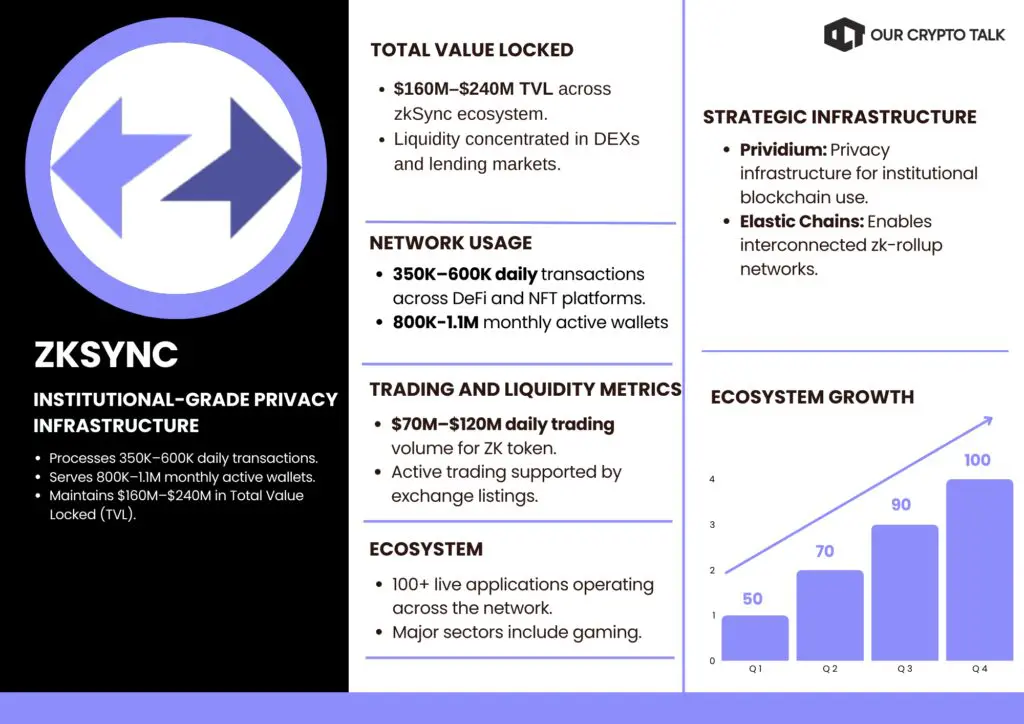
ZKsync has positioned itself as a leading zero-knowledge Layer 2 network focused on privacy, scalability, and institutional adoption. As of early 2026, ZK maintains a market cap near $200 million and supports consistent trading volume.
ZKsync uses zero-knowledge proofs to verify transactions securely. This approach reduces costs and improves scalability while maintaining Ethereum security.
ZKsync’s most important innovation focuses on privacy infrastructure. Its Prividium framework allows institutions to hide sensitive transaction data while remaining compliant with regulations. This capability enables banks, funds, and financial institutions to use blockchain without exposing confidential information.
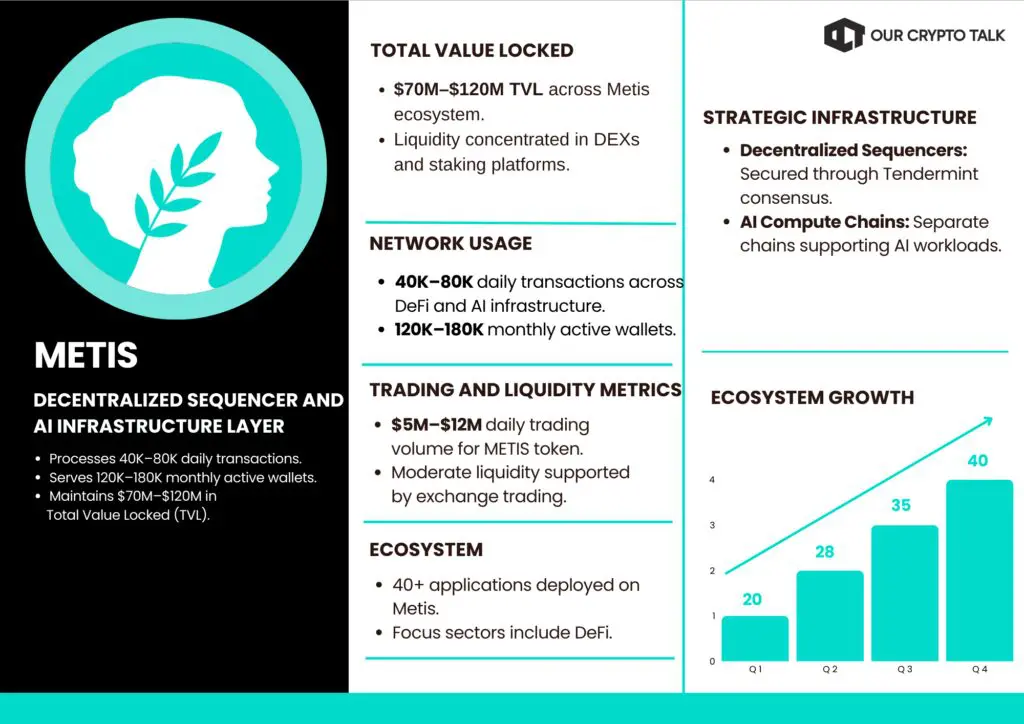
Metis has developed a unique position within Ethereum’s Layer 2 ecosystem by focusing on decentralized sequencers and AI infrastructure. As of early 2026, METIS maintains a market cap near $26 million.
Most Layer 2 networks rely on centralized sequencers. However, Metis uses decentralized sequencers secured through Tendermint consensus and MPC signing. This design improves reliability, censorship resistance, and decentralization.
Metis also focuses heavily on AI integration. It introduced a multi-chain architecture with separate chains for settlement, compute, and AI workloads. These chains support decentralized AI applications and compute infrastructure.
This design allows Metis to support emerging blockchain AI applications such as decentralized agents and on-chain inference.Metis continues to expand its ecosystem across DeFi, gaming, and AI applications. Staking and governance provide incentives for network participants.However, Metis remains smaller than major competitors. Adoption and ecosystem growth remain key challenges.
Strength vs weakness positioning among leading Layer-2 ecosystems in 2026
Layer 2 networks improve scalability, but they still face structural and operational risks. First, many rely on centralized sequencers to order transactions, which creates temporary censorship and downtime risk. Second, bridge infrastructure introduces security vulnerabilities, and past exploits have caused major asset losses across ecosystems.
Additionally, liquidity fragmentation forces users to move assets between networks, which reduces capital efficiency and complicates user experience. Economic sustainability also remains uncertain for some networks once incentives decline.
Furthermore, regulatory scrutiny may increase as Layer 2 networks support tokenized financial assets. Therefore, long-term success depends on decentralization progress, secure bridging, sustainable tokenomics, and strong ecosystem adoption.
Layer 2 networks have transitioned from experimental scaling solutions into foundational blockchain infrastructure. Arbitrum, Base, Optimism, zkSync, Starknet, Polygon, and Blast each play distinct roles in scaling Ethereum.
These networks collectively secure billions of dollars in value, support massive transaction volumes, and enable applications that were previously impractical due to cost or scalability limitations.
As consolidation continues, leading Layer 2 networks will likely capture even greater market share. Developers, institutions, and users will increasingly rely on these platforms for scalable blockchain applications.
Ultimately, Layer 2 solutions enable Ethereum to function as a global settlement layer while supporting scalable execution environments. Their continued growth will shape the future of decentralized finance, digital ownership, and blockchain adoption worldwide.