

Loading Ratings...



Chainlink ’s oracle stack powers DeFi, stablecoin transparency, cross-chain messaging, and institutional tokenization with CRE and ACE.

Author: Tanishq Bodh
Published On: Sun, 04 Jan 2026 14:47:20 GMT
Crypto moves in loud cycles. Memes spike. Narratives rotate. New chains trend, then fade. Yet under all that noise, one layer keeps doing the unglamorous work that makes the ecosystem function: reliable data and secure connectivity. That is where the Chainlink oracle network sits.
Chainlink started as a decentralized oracle solution that lets smart contracts access off-chain information safely. Today, it looks more like a modular infrastructure stack for on-chain finance. It powers price feeds, verifiable randomness, automated triggers, cross-chain messaging, and compliance tooling. In other words, it handles the parts of crypto that break first when stakes get real.
As of late 2025, Chainlink’s reported transaction value enabled has crossed the tens of trillions of dollars, reflecting how much economic activity depends on its services. At the same time, it holds dominant share in the oracle market, especially across Ethereum-based DeFi, where accurate data is not a “nice-to-have.” It is risk management itself.
These numbers do not make Chainlink exciting. They make it essential. And as tokenization and institutional use cases move from pilots to production, the essential layer starts to matter more than any short-term hype cycle.
Early crypto rewarded spectacle. Thin liquidity and reflexive narratives could move entire sectors. Today, the direction is different.
As crypto integrates deeper with stablecoins, real-world assets, and institutional settlement rails, the ecosystem needs three things:
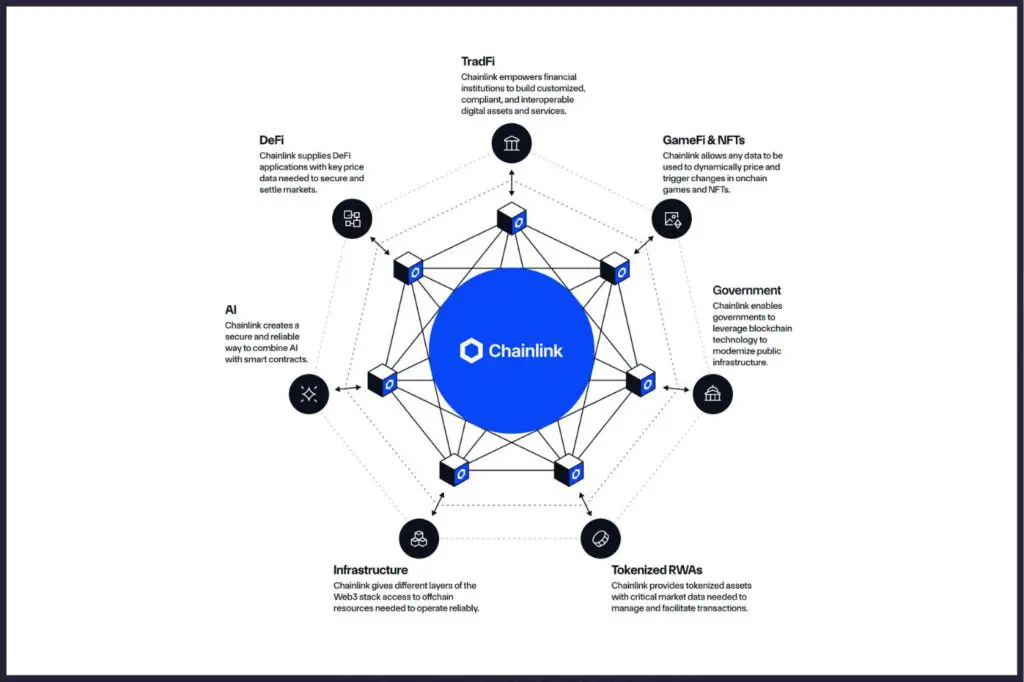
The Chainlink oracle network sits at the center of those needs because it turns “smart contracts” into “smart contracts that can safely interact with the real world.” That shift defines the difference between experimental DeFi and financial infrastructure.
It also explains why Chainlink’s impact often feels invisible. When oracles work, nobody notices. When oracles fail, everything breaks at once.
Chainlink’s strongest claim is not branding. It is adoption density.
Across the on-chain economy, Chainlink has maintained dominant oracle market share through most of the DeFi era. It also secures a large portion of the value inside lending markets, stablecoin systems, and derivatives protocols.
That matters because DeFi is a leverage machine. Lending, perps, liquidations, and collateral management all rely on price inputs. If you want to understand DeFi’s real risk layer, you have to understand the oracle layer.
Builders choose Chainlink for one reason: the cost of failure is too high. A cheaper or faster oracle means nothing if it fails during volatility. Reliability is the product.
This is why Chainlink’s “quiet” approach works. It does not compete for attention the way tokens do. It competes for trust. And in infrastructure, trust compounds.
The common mistake is to think Chainlink equals price feeds. Price feeds are only the entry point.
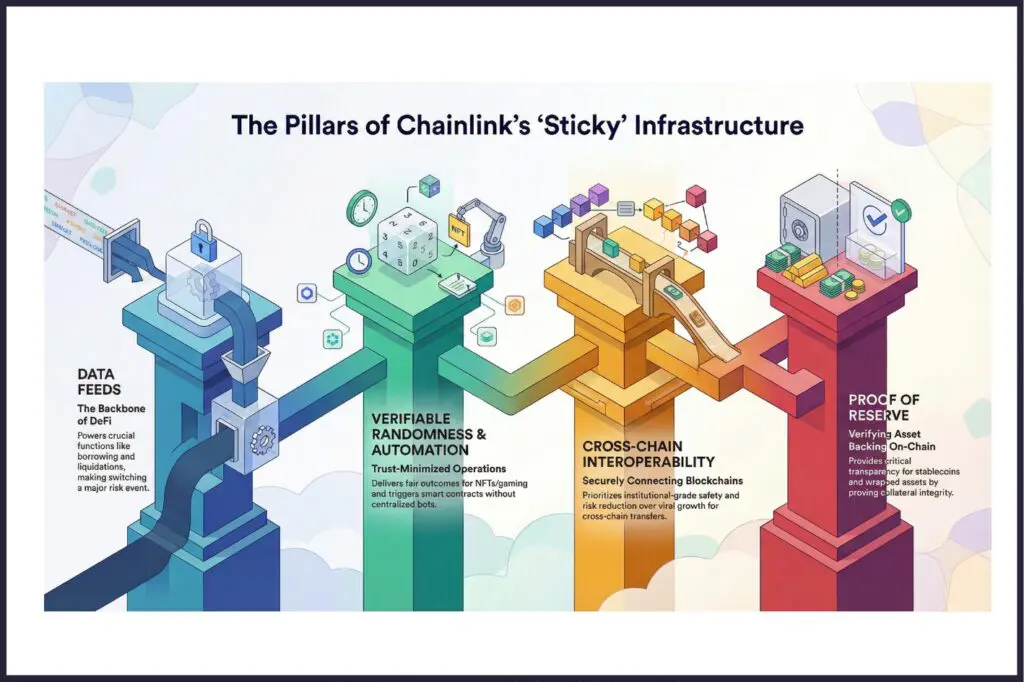
Here are the core modules that explain why the Chainlink oracle network has become sticky infrastructure.
Price feeds are the backbone of collateralized DeFi. They help determine how much someone can borrow, when liquidations trigger, and how risk parameters adjust. Once a major protocol integrates these feeds deeply, switching costs rise.
A migration is not just a code change. It becomes a risk event.
That creates a compounding advantage. Every cycle that Chainlink survives increases confidence that it can survive the next one too.
Randomness and automation sound like side features until you look at scale.
Verifiable randomness supports fair outcomes for gaming, lotteries, NFT minting, and on-chain distributions. Automation triggers smart contract actions without relying on centralized bots.
These modules matter because they reduce the need for trusted intermediaries. That is the whole purpose of programmable systems.
Cross-chain messaging has historically been a security minefield. Bridges are attacked because they concentrate value.
Chainlink’s interoperability stack is built around the idea that cross-chain transfers must be treated as critical infrastructure, not as growth hacks. Instead of optimizing for viral adoption, it optimizes for risk reduction, predictable execution, and institutional-grade safety.
If crypto is moving toward a multi-chain world, then secure interoperability becomes a foundational requirement.
Proof of Reserve is one of Chainlink’s most underrated tools. It exists for one job: transparency around backing.
Stablecoins, wrapped assets, and tokenized products all face one recurring question: are they really backed? Proof of Reserve reduces that uncertainty by allowing reserve signals to be verified and surfaced on-chain.
As tokenization grows, this becomes even more important. The market does not need more synthetic assets. It needs synthetic assets that can prove collateral integrity.
Retail cycles dominate headlines, but institutional adoption shapes the long game. Chainlink’s biggest shift in late 2025 was moving from “oracle provider” to “workflow and orchestration layer.”
The Chainlink Runtime Environment, known as CRE, is positioned as a major step toward institutional-grade on-chain workflows. Instead of focusing only on data delivery, CRE focuses on orchestration.
Institutions do not want isolated smart contracts. They want systems that can:
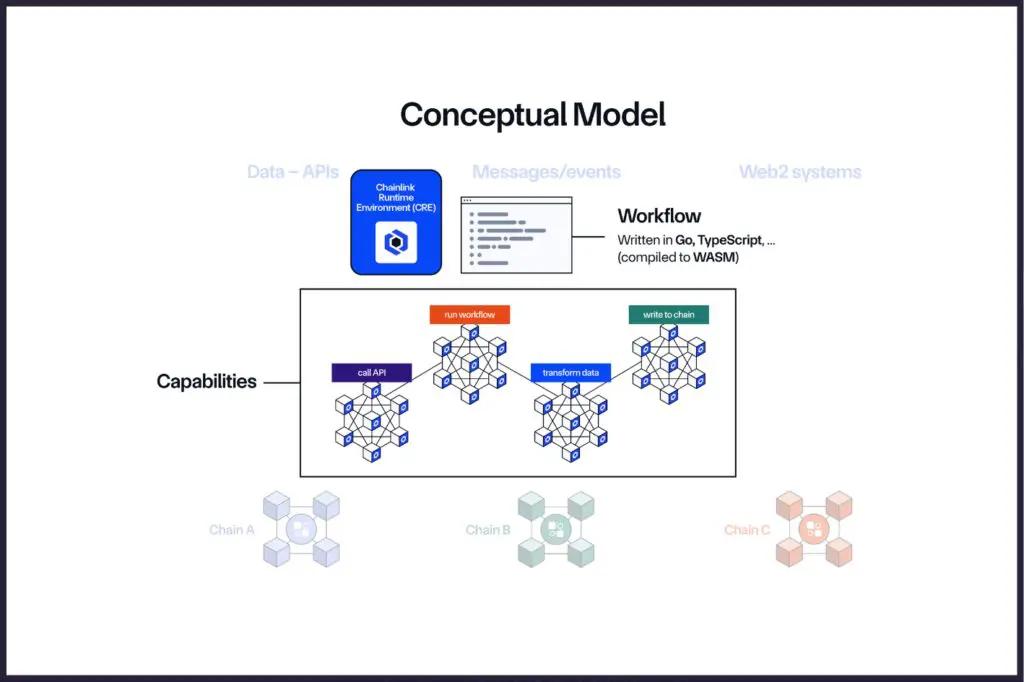
CRE is designed to make those workflows easier to build and safer to operate. It effectively treats on-chain finance as an operating environment rather than a collection of separate protocols.
That is a meaningful evolution. It expands Chainlink’s role from “feeds” to “finance execution.”
The Automated Compliance Engine, known as ACE, exists for the part of tokenization that crypto often avoids discussing: regulation.
Tokenized assets at institutional scale require policy enforcement. That includes KYC, sanctions checks, jurisdiction rules, and compliance reporting. Without that layer, large institutions cannot move meaningful capital on-chain.
ACE aims to provide that layer as infrastructure, not as a patchwork of custom integrations. If it succeeds, it lowers the friction for trillions in tokenized assets to exist in regulated form.
That is why the Chainlink oracle network narrative is shifting. It is no longer only about “getting data onto chain.” It is about making regulated finance operable on-chain.
In crypto, partnerships are often marketing. In infrastructure, partnerships exist because something is needed.
Chainlink’s value proposition matches what large financial systems require:
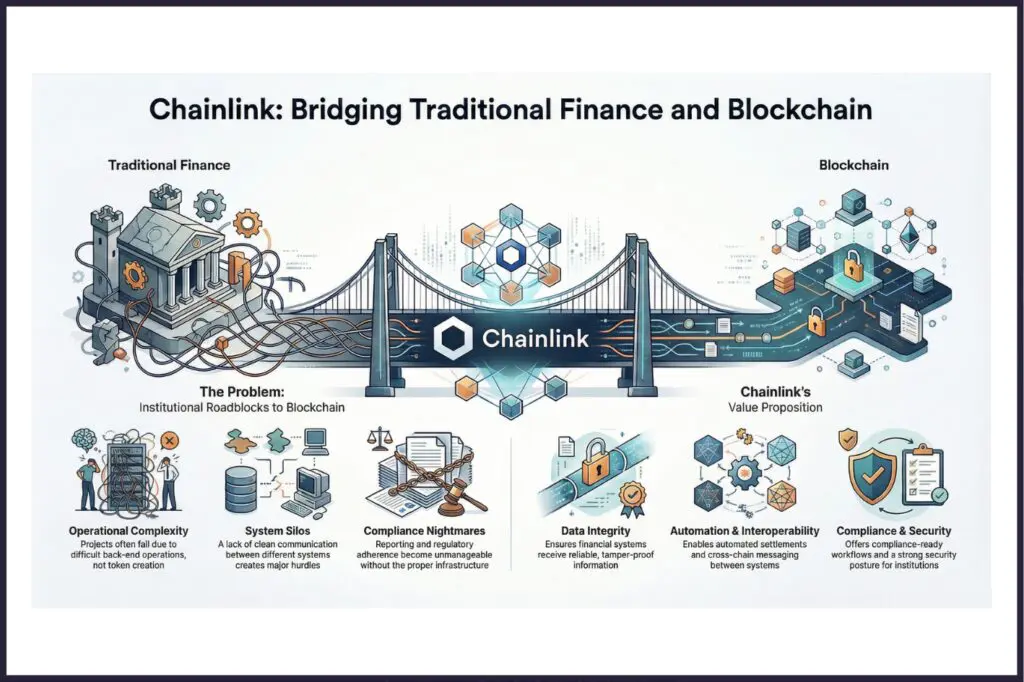
That is why institutions continue exploring Chainlink as a bridge layer. Tokenization projects do not fail because the tokens are difficult. They fail because operations are difficult, they fail because systems cannot talk to each other cleanly and they fail because compliance and reporting become nightmares.
Chainlink is targeting exactly those bottlenecks.
The hardest part of infrastructure investing is value capture. Even if a system becomes a standard, token value does not automatically follow.
LINK’s role is to support payments and economic security in the network. Staking aligns incentives between node operators, data quality, and reliability. Over time, stronger fee generation and stronger security demands should strengthen the utility loop.
Still, the market often misprices infrastructure. It prefers stories. It prefers visible consumer products. Chainlink sits behind the scenes, so it can look “boring.”
That boring profile can be an advantage. It means the thesis is less dependent on attention and more dependent on adoption.
However, the cautious view still matters. Infrastructure value capture takes time. It also depends on how fees and security requirements evolve across products like CCIP and institutional workflows.
Chainlink has strong positioning, but it is not risk-free.
Other oracle systems can compete on speed, latency, or niche use cases, especially in derivatives-heavy environments. Chainlink’s edge is reliability, but specialization remains real.
As Chainlink expands its modules, integration complexity grows. More features create more surface area. Infrastructure must still remain simple for builders.
Even strong infrastructure can lag during meme-dominant markets. Markets are not always efficient. If the broader cycle rewards spectacle, LINK may underperform even while adoption grows.
Tokenization is not an overnight flip. TradFi moves in quarters and years, not weeks. That can slow down value capture even if the long-term direction is clear.
Chainlink rarely wins the loudest narrative of the week. It does not need to. Infrastructure wins differently.
The Chainlink oracle network has become a default layer for DeFi pricing integrity, secure interoperability, reserve transparency, and emerging institutional workflows. It powers the systems that keep crypto usable when volatility spikes and when capital is at risk.
The deeper shift is what comes next. With orchestration and compliance tooling, Chainlink is no longer only feeding smart contracts data. It is trying to coordinate entire financial workflows that can satisfy institutional requirements.
Crypto is moving from stories to systems. In that world, the projects that connect everything tend to become unavoidable.
Chainlink is one of the few that already is.
| Theme | Key Points |
|---|---|
| Evolution | Price feeds → full modular on-chain infrastructure stack |
| Market Dominance | Oracle leader across major DeFi ecosystems |
| Core Stack | Data feeds · VRF · Automation · CCIP · Proof of Reserves |
| Institutional Push | CRE + ACE enable compliance-ready tokenization workflows |
| Key Risks | Competition · complexity · slow institutions · narrative cycles |
| Core Strength | Boring reliability as crypto becomes infrastructure |
Real voices. Real reactions.
All the opinions in this article are that of the author and in no way are financial advice. Our Crypto Talk and the author always suggest you do your own research in crypto and to never take anything as financial advice that you read on the internet. Check our Terms and conditions for more info.