Loading Search...


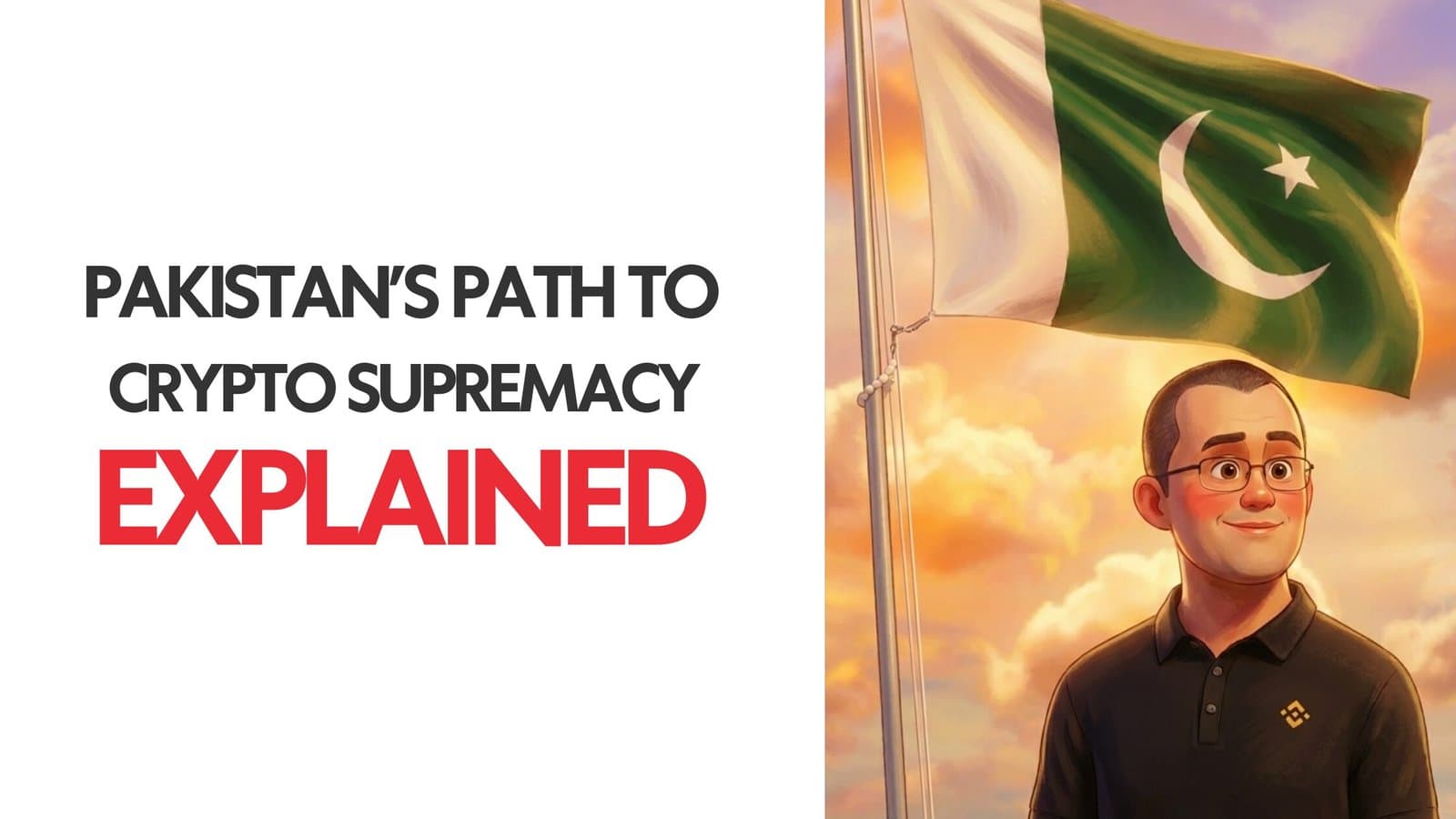
Pakistan crypto adoption explained: how regulation, CZ’s support, rapid policy shifts could position Pakistan as global crypto leader by 2030.

Author: Tanishq Bodh
In December 2025, a statement from one of crypto’s most influential figures reignited a global conversation about where the next wave of blockchain leadership might emerge. Changpeng Zhao, widely known as CZ and best recognized as the founder of Binance, suggested that Pakistan could become one of the world’s leading crypto nations by 2030.
Coming from the architect of the largest crypto exchange in history, this was not a casual remark. CZ tied his prediction to visible changes inside Pakistan: faster regulatory execution, growing grassroots adoption, and a government that has shifted from resistance to acceleration.
For a country that once restricted crypto activity through its banking system, the idea of becoming a global crypto leader seems improbable at first glance. Yet, when viewed through the lenses of demographics, economic incentives, and policy momentum, Pakistan’s trajectory begins to make sense. This explained article unpacks how Pakistan reached this point, why CZ believes the country is uniquely positioned, and what obstacles still stand between ambition and execution.
CZ is not just a market commentator. He is one of the most consequential operators in crypto history. Since founding Binance in 2017, he helped scale the exchange into a platform serving more than 150 million users globally, processing trillions of dollars in trading volume.
Although he stepped down as CEO in 2024 following regulatory settlements in the United States, CZ remains deeply embedded in the crypto ecosystem as an advisor, investor, and educator. His post-Binance focus has shifted toward emerging markets, where regulatory clarity and early adoption can still shape national outcomes.
In 2025, CZ joined the Pakistan Crypto Council as a strategic advisor and spent time meeting regulators, policymakers, and industry leaders. His assessment of Pakistan was based on firsthand engagement rather than abstract optimism. When he said Pakistan was “moving at speed,” he was comparing it to countries that spend years debating frameworks while adoption happens elsewhere.

Source : Pakistan Virtual Assets Regulatory Authority
Pakistan’s crypto journey did not start with enthusiasm.
In 2018, the State Bank of Pakistan prohibited banks from facilitating cryptocurrency transactions, citing financial stability and compliance risks. Despite this, adoption quietly grew. Freelancers, remittance recipients, and young investors turned to peer-to-peer platforms and stablecoins to bypass friction in traditional finance.
By 2024, Pakistan ranked among the top countries globally for crypto adoption per capita, despite operating in a legal gray zone. This disconnect between policy and reality forced a reassessment.

Source : Ministry of Finance, Government of Pakistan
The pivot came in 2025. Facing inflation, foreign exchange shortages, and pressure to modernize financial infrastructure, policymakers began viewing crypto as an opportunity rather than a threat. The government announced plans to allocate 2,000 megawatts of surplus electricity to Bitcoin mining and AI data centers, turning idle energy into exportable value.
Shortly afterward, Pakistan established the Pakistan Virtual Assets Regulatory Authority, modeled after Dubai’s VARA. This signaled a move toward regulated participation rather than suppression. Exchanges began receiving approval to operate under defined rules, and discussions around taxation, compliance, and consumer protection accelerated.
CZ’s optimism centers on several structural advantages Pakistan possesses.
First is demographics. More than 60 percent of Pakistan’s population is under 30. This cohort is digitally native, mobile-first, and increasingly involved in freelancing, gaming, and online commerce. Crypto fits naturally into this economic behavior. Unlike traditional finance, blockchain does not require gatekeepers or legacy credentials.
Second is economic necessity. Pakistan processes over $30 billion annually in remittances, much of it subject to high fees and delays. Crypto rails, particularly stablecoins and DeFi protocols, offer faster and cheaper alternatives. Even marginal efficiency gains at national scale can have outsized impact.
Third is speed. CZ emphasized that Pakistan compressed what normally takes years into months. Regulatory bodies engaged directly with industry leaders, launched pilot frameworks, and pursued tokenization initiatives without prolonged paralysis. In crypto, speed is not a luxury. It is a competitive edge.
One of the most important developments underpinning Pakistan’s crypto ambitions is its interest in tokenization.
Tokenizing government securities, commodities, or real-world assets allows fractional ownership, global participation, and continuous settlement. For Pakistan, this could unlock foreign investment without relying solely on traditional debt markets.
The government has already explored tokenizing billions of dollars in assets in partnership with global exchanges. If executed correctly, this could position Pakistan as a regional hub for compliant on-chain finance, particularly for emerging markets and Islamic finance structures.
Additionally, discussions around a central bank digital currency and regulated on-ramps indicate an attempt to integrate crypto into the existing financial system rather than operate in parallel.
Despite rapid progress, Pakistan’s path to crypto leadership is not guaranteed.
Infrastructure remains a constraint. Electricity reliability and internet access vary by region, limiting consistent participation. Regulatory overreach could also stall growth if compliance burdens become excessive or inconsistent.
Macroeconomic volatility adds another layer of risk. A depreciating currency can drive crypto adoption, but it can also magnify losses during market downturns. Trust, once broken by scams or failures, is difficult to restore.
There are also geopolitical considerations. International scrutiny around money laundering and sanctions compliance means Pakistan must balance openness with credibility to attract institutional capital.
Pakistan’s strategy contrasts sharply with peers in the region.
India, despite its massive developer base, imposed punitive taxes that pushed activity offshore. Nigeria embraced grassroots adoption but struggled with regulatory consistency. The UAE built success through regulatory clarity and capital inflows but operates from a position of wealth rather than necessity.
Pakistan’s advantage lies in alignment. Policy, adoption, and economic incentives are moving in the same direction. That alignment is rare and powerful.
CZ’s prediction that Pakistan could become a crypto leader by 2030 is not a forecast of inevitability. It is a conditional statement.
If Pakistan maintains regulatory clarity, invests in education, protects users, and continues integrating blockchain into real economic activity, leadership becomes plausible. If momentum stalls or policy reverses, the opportunity window narrows quickly.
Crypto rewards early movers, but it punishes inconsistency.
Pakistan’s crypto journey reflects a broader truth about the digital asset era. Leadership no longer belongs exclusively to wealthy nations or legacy financial centers. It belongs to those willing to move decisively.
CZ’s endorsement matters because it recognizes speed, not size, as the defining factor. Pakistan has demonstrated that speed is possible. The challenge now is sustainability.
Whether Pakistan becomes a global crypto leader by 2030 will depend less on predictions and more on execution. The runway is open. The next five years will decide if the country takes off or taxis indefinitely.



AI Agent Payments Explained: Circle Nanopayments and the x402 Protocol
Top 7 Projects in the World Liberty Financial (WLFI) Portfolio
Where Crypto Actually Makes Money in 2026?
What If Satoshi Nakamoto Was Here in 2026?
AI Agent Payments Explained: Circle Nanopayments and the x402 Protocol
Top 7 Projects in the World Liberty Financial (WLFI) Portfolio
Where Crypto Actually Makes Money in 2026?
What If Satoshi Nakamoto Was Here in 2026?