Loading Search...


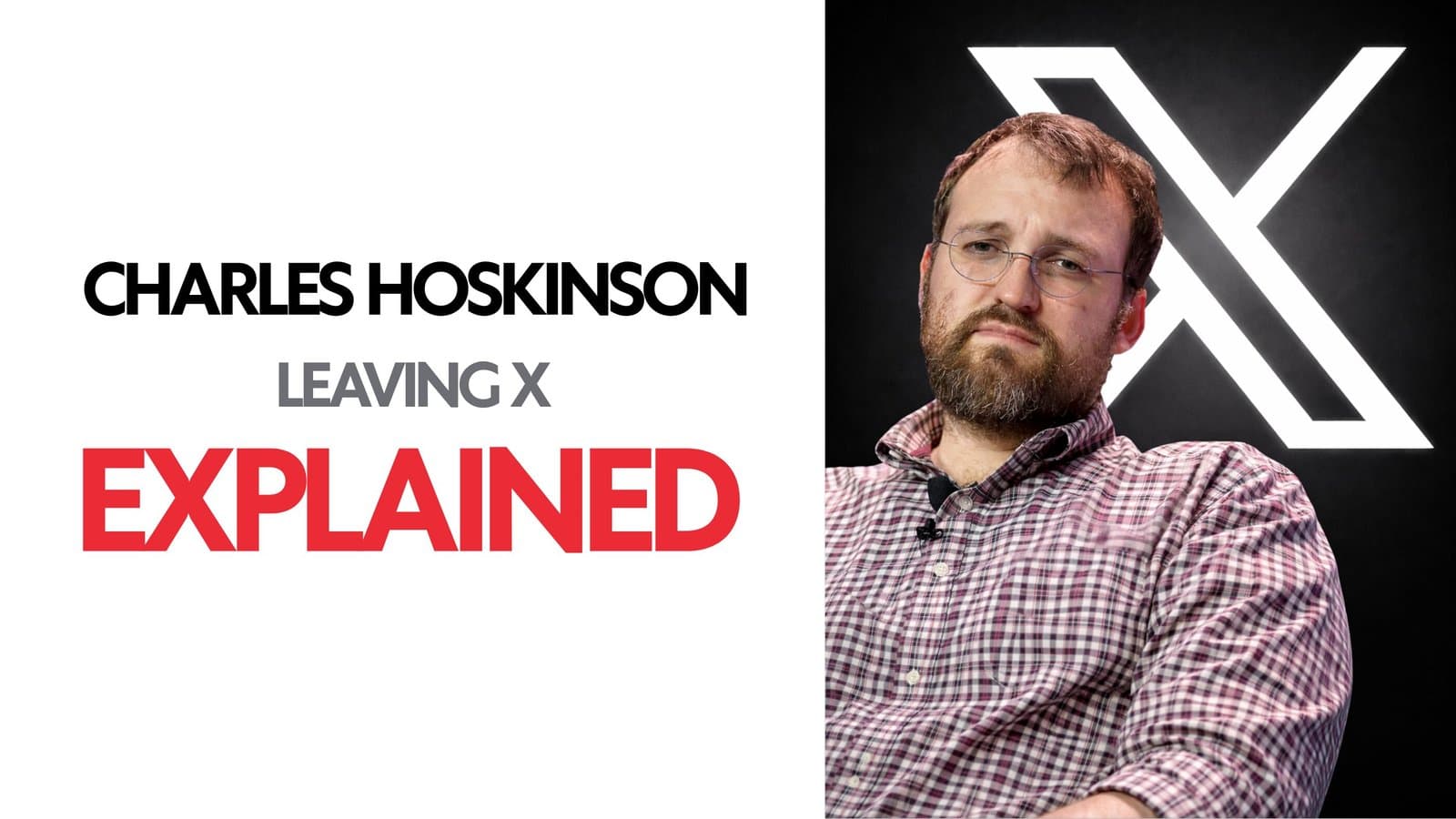
Charles Hoskinson, the founder of Cardano and a co-founder of Ethereum, left X at the start of 2026. We see his love-hate relationship with X.

Author: Sahil Thakur
Charles Hoskinson, the founder of Cardano and a co-founder of Ethereum, left X at the start of 2026. This decision marked a major change in how he interacts with the crypto community. He had spent over a decade on the platform. However, he announced that he would now step away from the noise. He wants to focus on building and long-term projects. As a result, people began debating why he left. They also wondered what it means for Cardano and what he plans to do next.
In this overview, we look at his reasons. We also review the timeline of his exit, his farewell livestream, the Midnight privacy project, his views on the next era of crypto, the reaction from the community, and what may come next.
Hoskinson explained his choice directly. He said he felt deeply dissatisfied with the culture and incentives on X. In late 2025, he criticized the direction of the platform under Elon Musk. He argued that the engagement-driven algorithms promote outrage. Meanwhile, constructive conversations lose attention. In his farewell note, he wrote that X rewards outrage while real progress rewards building. Therefore, he concluded that serious work matters more than endless online arguments.
He also expressed frustration with the quality of discussion. Meaningful talk about technology and innovation keeps getting drowned out. Instead, quick emotional reactions dominate. According to him, this environment leaves little room for thoughtful debate about decentralization or long-term development. By the end of 2025, he described X as increasingly toxic. He believed it rewarded conflict instead of collaboration.
Furthermore, his concerns reflected a broader industry sentiment. Vitalik Buterin also criticized X. He warned that the platform could fuel coordinated hostility if it keeps moving in the same direction. Hoskinson shared that worry. He disliked watching debates turn personal instead of focusing on ideas. He believed projects should be judged by their results, not by who builds them.
In his view, X promotes the wrong incentives. It encourages outrage and personal attacks. Meanwhile, his work on Cardano rewards building real value. Over time, he grew tired of public battles. Therefore, he decided the platform was no longer worth his time. He wants to reclaim his energy from what he calls unproductive noise. Now he plans to redirect it toward work that aligns with his long-term vision.
Hoskinson did not leave suddenly. Instead, he planned the transition. On December 27, 2025, he told his followers that he had only five days left on X. After that, a “digital twin” would manage his account. He marked December 31 as his final personal day on the platform. In his farewell post, he promised to explain the digital twin during his first YouTube stream of the new year.
This idea raised curiosity. He explained that the digital twin would act as an AI-powered version of himself. It could post content. It could also reply to some messages. The system would train on his past tweets, threads, podcasts, and blog posts. Therefore, the account would keep a basic presence. However, Hoskinson would no longer engage directly. In practical terms, he outsourced his Twitter voice to an algorithm.
By January 1, 2026, the change became active. He signed off, and the account entered what he called silent mode. From that point, curators and AI systems would manage it. He compared this setup to autopilot. It may last for weeks or months while the new infrastructure develops. Followers might still see occasional updates. However, those messages come from machines or pre-approved content, not spontaneous thoughts.
This exit closed nearly 12 years on Twitter. Other major crypto figures also left X earlier. For instance, Vitalik Buterin moved to alternative crypto-native platforms in 2024. However, Hoskinson’s strategy stands out. He chose to leave behind an AI version of himself. In some ways, this approach reflects both his technical background and his sense of humor. If the platform already feels dominated by bots, then a bot can handle it.
Earlier, he had taken short breaks from social media. Each time he eventually returned. This time feels different. He described the departure as permanent. His final message thanked those who supported him. Then he added, “To the rest, I will not miss you.” The comment showed clear emotion. He felt ready to leave the trolls, the drama, and the constant conflict behind.
Charles Hoskinson began the new year with a livestream on YouTube. He used it to explain his decision and outline his plans. This January 1, 2026 broadcast served as a farewell message to Crypto Twitter. During it, he described why he left X and reassured viewers about his commitment to Cardano. He made it clear that he is not leaving crypto. He is also not abandoning Cardano. However, he said the approach must change. In short, he is changing how he communicates, not the mission he leads.
Hoskinson called 2025 one of the hardest years of his life. He talked about constant travel. He spent more than 260 days on the road. Meanwhile, online conflicts wore him down. Therefore, stepping away from X became part of a bigger reset. During the stream, he said, “I’ve outgrown X.” He described the move as a farewell to that platform. He believes he no longer needs Twitter as his main communication channel. Moreover, he thinks both he and Cardano have matured beyond relying on it.
A major reason involved growing hostility. He said conversations on X shifted toward personal attacks. People focused more on founders and personalities. They talked less about actual technology. As a result, meaningful discussion became difficult. He disliked watching projects judged by feelings toward individuals instead of real progress. Leaving X gave him space from that environment.
He also addressed integrity issues in crypto. At one point, he criticized politically themed meme coins. He pointed to a “Trump Coin” and said it should never have existed. He added that many leaders agree privately. Yet they often stay quiet because they fear backlash. This example showed both his blunt style and his frustration. Speaking honestly on social media can attract mobs of outrage. By stepping away, he feels freer. He can choose better venues to speak openly without instant drama.
Most importantly, he reassured the Cardano community. He repeated that he is not stepping away from Cardano or crypto. His leadership role continues. Only his social media strategy is evolving. He plans to use long-form communication instead. That means weekly AMAs on the Midnight Discord server. It also means frequent YouTube livestreams and more thoughtful essays. In fact, he had already begun writing again. On December 25, he published a reflective blog post titled “What the Horizon Kept.” It showed renewed passion for storytelling and hinted at broader change in the crypto world.
By the end of the livestream, his message felt clear. He is leaving the outrage cycle of X. However, he is not leaving Cardano. He wants healthier, more focused conversations. And yes, he has no regrets. Critics who depended on attacking him will now lose their target. As he joked, they will not be missed.
One of Hoskinson’s biggest future priorities is Midnight. It is a privacy-focused blockchain project inside the Cardano ecosystem. In his announcement, he directed followers to Midnight’s Discord. He plans weekly Q&A sessions there. This emphasis shows how central Midnight is to his vision. So what exactly is Midnight, and why does privacy matter so much to him?
Midnight is a Cardano sidechain built for data protection and private transactions. It uses advanced cryptography such as zero-knowledge proofs. Yet, it still allows compliance when needed. Hoskinson frames it as a response to growing threats to digital privacy. In late 2025, he strongly opposed proposals that tied online accounts to government digital IDs. He warned such rules could form a surveillance grid. Therefore, he wants technology that protects personal freedom.
Midnight focuses on selective disclosure. Users transact privately by default. However, they can choose to reveal information when lawfully required. This model balances privacy with accountability. Unlike systems that force identity onto every action, Midnight keeps control with the user. People only reveal data on their own terms. He believes this approach pushes back against heavy-handed ID mandates. He summed it up with a vivid line: do not let the vampires in.
The project has gone through years of development. It was first announced in 2022. Since then, it ran test networks and distributed tokens. In 2025, Midnight held the Glacier airdrop for its token, called NIGHT. It also launched a scavenger hunt. Meanwhile, teams prepared for mainnet. By late 2025, anticipation grew that Midnight might launch in 2026. Interest surged. NIGHT climbed into the top 100 cryptocurrencies by market cap. Many saw it as a major privacy solution. Hoskinson even compared Midnight to a Manhattan Project for crypto privacy. He believes it can transform how blockchains handle personal data.
For Hoskinson, Midnight sits at the center of Cardano’s future. He links it to what he calls the fourth generation of blockchain. Now that he has left Twitter, he plans to double down on it. He is working on privacy tools, specifications, and architecture. His plan spans five years. He wants massive adoption. During the livestream, he asked himself how to create a system with a billion users and a trillion dollars in transactions by 2030. The question signals his ambition.
He also connects Midnight to Cardano’s broader mission. Cardano focuses on financial inclusion, especially in Africa, and serious on-chain governance. Privacy must support those goals. As adoption grows, people will need control over their data. Therefore, Midnight becomes part of making blockchain both useful and ethical. He believes data has become a battlefield. Privacy tech helps protect individuals as systems scale.
Now that he is off X, he can fully concentrate on this work. He will continue updating the community through YouTube and Discord. He hopes to push Midnight to the forefront of blockchain privacy throughout 2026 and beyond.
Stepping away from X is part of a broader change in Charles Hoskinson’s outlook. Recently, he has argued that the era he calls the third generation of cryptocurrency is over. He believes a new phase is now beginning. In a December 25, 2025 video, he stated bluntly that the third generation of crypto is dead. At first, this sounds bleak. However, his real message was different. He believes the industry must move beyond hype, speculation, meme coins, and short-lived manias. Instead, it must refocus on technology that creates real value.
Hoskinson often describes blockchain history in generations. Bitcoin represents the first generation. It focused on decentralized digital money. Ethereum represents the second generation. It introduced smart contracts and decentralized applications. Cardano and similar platforms formed the third generation. They focused on scalability, interoperability, and sustainability. Yet by late 2025, he felt the promise of this generation had been overshadowed. Crypto culture had drifted toward fast profits and sensational projects. In his view, too much of the space fell into scams, hype cycles, and empty speculation. Therefore, meaningful innovation struggled to gain attention.
Declaring the third generation dead was his call for a reset. In that December message, he urged a return to long-term thinking and real utility. He also introduced Midnight as a core example of what comes next. He described this new period as a fourth generation of blockchain. In his vision, this new era emphasizes useful applications, regulatory compatibility, sustainability, and privacy. Governance also plays a key role. By placing Midnight at the center, he suggested that secure and private transactions will define the future of crypto.
What might a fourth generation actually look like? Based on his comments, it would include networks that scale to billions of users. They would connect with other blockchains, would protect privacy. They would power systems like identity, supply chains, social tools and would still remain decentralized. However, they would also work within real-world regulatory frameworks. Cardano’s Hydra scaling work, on-chain governance under Voltaire, and sidechains like Midnight all support this direction. Meanwhile, Hoskinson has proposed using Midnight beyond Cardano. He believes it could act as a privacy layer for networks like Bitcoin and XRP. He argued that adding zero-knowledge technology to those systems could enable private DeFi and new privacy features. In his eyes, the goal is not about one chain winning. Instead, it is about lifting the entire ecosystem.
His declaration also reflects on Cardano’s own journey. By 2025, Cardano had delivered smart contracts, many decentralized applications, and progress toward full governance. These developments fulfilled key parts of its roadmap. Now, Hoskinson believes a new chapter is starting. From here forward, success will be measured differently. It will depend on solving real-world problems at scale, not on Twitter buzz or meme coin spikes. Therefore, his message serves as a reminder that speculation leads nowhere without substance.
His move away from Twitter fits this philosophy neatly. Reducing time on Crypto Twitter removes him from a constant cycle of hype and conflict. Instead, he is centering his effort on Midnight, governance initiatives, and growth in emerging markets. These are areas he believes will shape the fourth generation. In short, he wants less noise and more signal. Leaving X is not only about frustration. It also symbolizes a clean break from an era that no longer aligns with his priorities.

To understand the impact of his exit, it helps to look back at his time on social platforms. Since 2013, Hoskinson became one of the most visible voices in crypto on Twitter. His following grew beyond a million people. Hoskinson used the platform as a direct communication channel. He shared updates and debated critics. He voiced opinions on everything from Cardano development to global politics.
His presence was bold. He rarely avoided confrontation and regularly responded to detractors publicly. He engaged in difficult discussions. Fans respected his openness. However, critics argued that the confrontational tone created unnecessary drama. Some Cardano supporters even worried that his online battles overshadowed technical progress. At times, his tweets sparked headlines that focused more on arguments than on engineering work.
Over the years, he had several notable clashes. He debated members of rival communities. His disputes with XRP supporters became especially public. He had friction with parts of the Ethereum community. Influencers and commentators sometimes became entangled in these conflicts. Internal disagreements within the Cardano ecosystem also surfaced on X. Tensions between IOG and the Cardano Foundation appeared in public threads during 2023 and 2024. Prominent community voices left the platform entirely. These events contributed to a perception that Cardano carried constant internal tension. Much of that perception centered around Hoskinson’s personality online.
His communication style could feel raw and unfiltered. He would joke, criticize, and philosophize in equal measure. One late December tweet joked that friends should not let friends get involved in crypto. His blog even describes him humorously as someone who writes thoughts that make people angry. This style made him authentic. It also made him polarizing. The visibility helped Cardano stay in the conversation. However, it also made Hoskinson an easy target. Opponents used his comments as fuel. Eventually, he grew tired of that environment.
By stepping away, he may be intentionally separating himself from Cardano in the public narrative. Cardano has matured into a global ecosystem. It includes hundreds of projects and thousands of contributors. It has governance structures and community leadership that function independently. Therefore, his absence from Twitter does not mean the project loses direction. Instead, it allows other voices to rise. Some observers compared his move to Satoshi Nakamoto leaving Bitcoin. The comparison highlights a transition toward decentralization.
Still, he is not disappearing. He is simply choosing different platforms. He plans to continue speaking through AMAs, conferences, and long-form videos. These spaces allow deeper discussion. They also avoid the constant outrage cycle. His history with Twitter tells a complicated story. It helped him build momentum. Later, it became a source of stress. Now the community recognizes both sides. Some miss his energy, while others welcome the calmer environment. One supporter summed it up humorously by saying that X is not an airport, so you do not need to announce your departure.
Hoskinson’s departure from X drew a wide range of responses. Many in the Cardano community supported the decision. Others reacted with humor or doubt. Under his announcement, several followers praised him. One person wrote that leaving X was probably something many people had considered, given the platform’s direction. Supporters believed that the declining quality of conversation justified stepping away. They respected him for actually taking action. A few older crypto figures even said they had considered stepping back themselves. From this perspective, Hoskinson looked like a leader who prioritized mental health and meaningful interaction over clout. Some Cardano members also felt relief. They believed the project could now shift attention away from constant personality drama and toward actual development news.
However, skepticism arrived quickly. Many users joked that X is not an airport, so there is no need to announce departures. They suggested that anyone can simply delete the app quietly. Therefore, they viewed his announcement as theatrical. Some doubted he would stay away for long. Others worried about Cardano’s visibility. They asked whether leaving such a large audience might weaken communication around the project. Despite his reassurance that he was not leaving Cardano, a portion of users remained uneasy. On trading forums, people argued that the founder disappearing from the largest social network could hurt marketing in the short term or leave rumors unchallenged.
Meanwhile, the market reacted briefly. Cardano’s ADA rose about nine percent in the 24 hours after his New Year message. It outperformed Bitcoin and Ethereum during that window. Traders likely viewed his renewed focus on building as a positive sign. Or perhaps ADA simply bounced technically after a decline. However, the bigger picture still showed weakness. ADA was still well below its highs and about eighteen percent down from the previous month. Analysts emphasized that social media behavior rarely drives long-term value. One report noted that temporary absences from Hoskinson had not caused sustained price problems before. Broader market forces and technological milestones matter far more than tweets.

Inside the ecosystem, official Cardano groups reacted calmly. There was no panic or disruption. Development continued as usual through early 2026. Many leaders even saw the move as a sign of maturity. One Cardano-focused article argued that no blockchain should depend on a single person forever. According to that view, Cardano was now showing decentralization in culture, not only in technology. Supporters echoed this idea. They believed that progress should speak through developers, researchers, and community representatives rather than through one founder’s feed.
The wider crypto world also paid attention. Some observers recalled earlier moments when founders distanced themselves from their projects. Those events often created uncertainty. However, this situation felt different. Hoskinson was not leaving Cardano. He was only stepping off a platform. Therefore, most people did not interpret it as abandonment. Instead, some analysts argued that it reflected industry growth. As crypto matures, leaders may favor quality communication and consistent research over constant social posting. In that sense, Hoskinson’s move could represent a healthier approach to leadership.
Overall, reactions ranged from applause to sarcasm to quiet curiosity. Some people expect less hype. Others worry about visibility. Yet the consensus remains that Cardano’s fate rests on adoption and technology, not on one account. If anything, less noise could allow progress to stand out more clearly.
Now that he has left Twitter behind, Hoskinson is redirecting his energy toward building. So what comes next?
First, he remains CEO of Input Output Global. His work on Cardano continues without interruption. He intends to remain closely involved in research, design, and strategic direction. Over the next phase of the roadmap, Cardano moves deeper into Basho for scaling and Voltaire for governance. Hoskinson will likely focus on Hydra scaling improvements and on the rollout of full on-chain governance. These pieces include the constitution, treasury management, and voting through delegated representatives. They are challenging milestones. Nevertheless, they could define Cardano’s maturity. Without social media distractions, he can dedicate more time to reviews, planning, and direct collaboration with engineers.
Second, Midnight sits at the center of his plans. He has mapped out a five-year strategy aimed at huge adoption. His vision imagines hundreds of millions, maybe even a billion users, conducting private transactions by 2030. Achieving that will require technical progress and ecosystem growth. It will require partnerships, developer support, clear regulation paths, and real-world applications. Therefore, we can expect Hoskinson to champion Midnight across conferences, research forums, and policy discussions. Privacy, identity, and digital rights have become core parts of his message. Midnight gives him a concrete platform to advance those beliefs.
Third, his communication style is shifting toward depth. He will host weekly AMA sessions on Midnight’s Discord. This creates a space for people who genuinely want to discuss ideas. It reduces trolling. He will also continue frequent YouTube livestreams. Videos let him explain context, show updates, and talk through complex ideas slowly. In many cases, this format may reach more people than Twitter ever did. It also creates a record that viewers can revisit.
In addition, Hoskinson plans more long-form writing. He has hinted at essays, blog entries, and possibly books. He wants to reflect on the industry, its mistakes, and its direction. Writing gives him more control. It also allows deeper storytelling than short posts. Over time, this body of work may shape how people understand Cardano’s philosophy.
On a personal level, he plans to travel less. He intends to spend more time at his Wyoming ranch. Rest and health have become priorities. He wants a schedule that supports creativity rather than burnout. A calmer lifestyle may help him stay focused on research and leadership.
Looking across all this, his pivot signals a more mature stage of the industry. Instead of chasing daily attention, he is choosing longevity. Cardano no longer needs constant promotional fire. It needs execution. Governance, partnerships, and technical delivery will likely define the next years. With initiatives like the Cardano Pentad collaboration among major organizations in the ecosystem, coordination may improve even further.
In essence, Hoskinson plans to build more and argue less. He will remain central, but in quieter ways. His influence may show up in code, governance proposals, and educational efforts rather than rapid-fire posts. If the strategy works, Cardano and Midnight could enter a period of real expansion. And later, people might look back and say this was the moment when he decided to log off and build.