Loading Search...


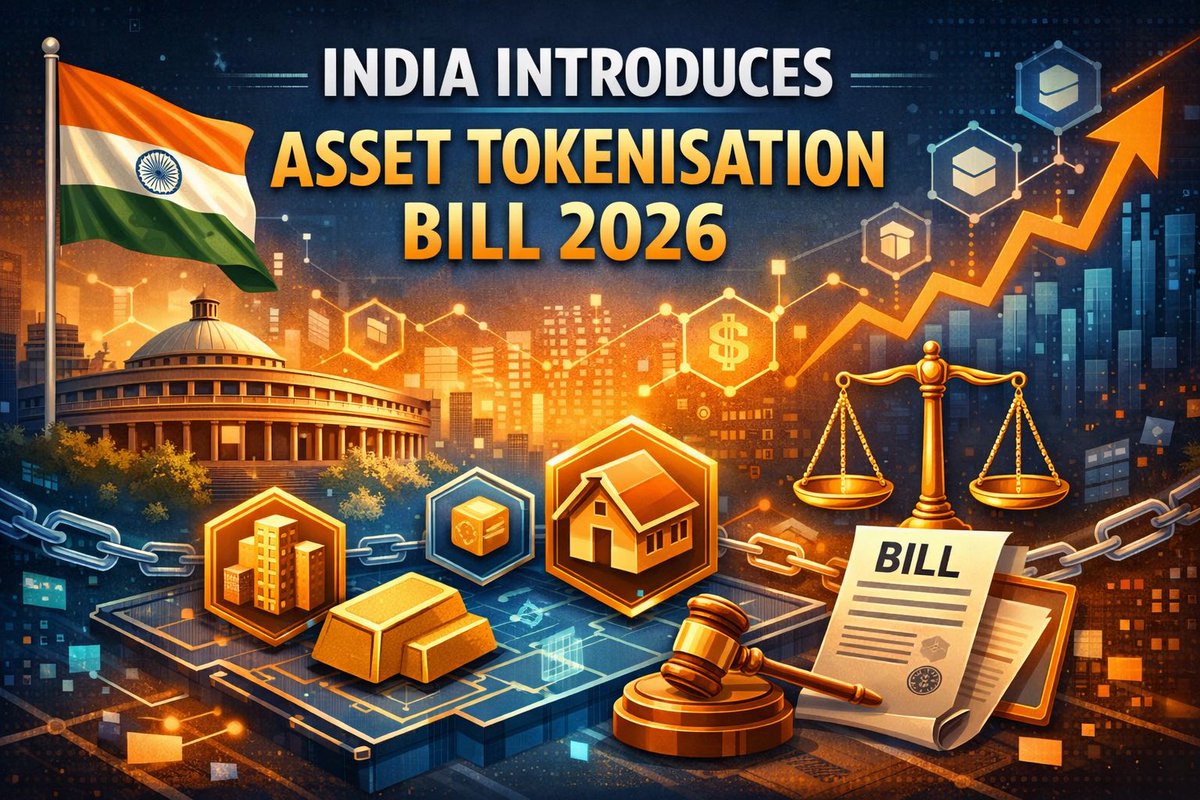
India introduces the Asset Tokenisation Bill 2026 to regulate blockchain-based ownership, trading, and custody of real-world assets.

Author: Akshay
Steady attention without excessive speculation.
March 17, 2026 — Raghav Chadha introduced the Asset Tokenisation (Regulation) Bill, 2026 in India’s Rajya Sabha, aiming to establish a legal framework for blockchain based ownership of real world assets. The proposal seeks to regulate the issuance, trading, custody, and settlement of tokenised assets while providing clarity to a rapidly growing digital finance sector.
High Signal Summary For A Quick Glance

Daulat X
@Daulat_X

🚨🇮🇳 The Asset Tokenization Bill, 2026, introduced by MP Raghav Chadha, aims to legally recognize and regulate the conversion of real-world assets (real estate, gold, infrastructure) into digital tokens on blockchain, enabling fractional ownership for retail investors. https://t.co/fgHE4LPOUG
05:25 AM·Mar 17, 2026

Esa.
@taessanj
@cryptoamanclub Professional cryptocurrency trading community, offer highly accurate trading signals designed to maximize profits minimize losses. 💹 Whether you're a beginner or an expert, Don't miss out! click the link in my profile now and join the winning team 🚀
🚨 TOKENIZATION BILL 2026! 🇮🇳 MP Raghav Chadha has introduced The Asset Tokenisation Bill, 2026 in the Rajya Sabha. To provide legal recognition by converting assets like Real Estate and Gold into digital tokens. Small investors will now be able to gain fractional ownership in https://t.co/tSA9Yt6iRy
10:59 PM·Mar 14, 2026
The Asset Tokenisation Bill introduced by Raghav Chadha aims to create a legal framework for converting real-world assets into blockchain-based tokens. Specifically, the proposal was presented in the Rajya Sabha to address gaps in regulation. Moreover, it focuses on enabling fractional ownership and improving liquidity. At the same time, the bill seeks to establish clear rules for issuance, trading, and custody under regulatory oversight.
The move follows growing global interest in tokenised assets and India’s evolving crypto landscape. Chadha had previously advocated for tokenisation and blockchain based property systems, making the bill largely expected in policy circles. Its introduction reflects rising demand for clearer regulations to support innovation while addressing investor protection and capital outflows.
Timeline: India’s Asset Tokenisation (Regulation) Bill, 2026 – from proposal to potential legislation
Raghav Chadha advocates for a national “Tokenisation Bill,” highlighting fractional ownership of real-world assets and comparing its potential impact to UPI.
Further parliamentary discussions emphasize crypto legalization, stablecoin frameworks, and blockchain-based land registries.
The Asset Tokenisation (Regulation) Bill, 2026 is introduced in the Rajya Sabha as a Private Member’s Bill, proposing a legal framework for tokenized assets.
The bill enters the ballot process for Private Members’ Bills, determining whether it will be scheduled for discussion during the Budget Session.
If not debated or advanced before the session ends, the bill risks lapsing, as is common with Private Member legislation.
The bill may be reintroduced in the Monsoon Session or adopted and advanced by the government as an official legislative proposal.
If progressed, the bill would move through Rajya Sabha debate and vote, Lok Sabha approval, committee review, and eventual presidential assent.
The Asset Tokenisation Bill introduced by Raghav Chadha marks the first time such a framework has been formally proposed in the Rajya Sabha. No prior bill government or private has specifically addressed legal recognition and regulation of tokenised real world assets in India, making this a first of its kind legislative step.
Earlier discussions were limited to policy speeches and broader crypto proposals. For example, Chadha had called for a tokenisation framework in late 2025, but no formal legislation followed at the time. Compared to past crypto related proposals focused on restrictions, this bill takes a more enabling approach, aiming to support innovation and structured growth in digital asset markets.
There is no direct precedent for market reaction, as this is the first tokenisation focused bill introduced in India. However, earlier signals from Raghav Chadha provide context. His December 2025 speech calling for a tokenisation framework triggered positive sentiment across crypto communities, though it had no measurable impact on prices or trading volumes.
A broader comparison comes from the 2021 crypto bill proposal, which created fear of restrictions and led to sharp sell offs on Indian exchanges. In contrast, the current proposal takes a pro innovation approach, and early sentiment remains positive, with discussions centered on financial inclusion and growth rather than regulatory risk.
India’s approach vs prior advocacy and global regulatory trends
The immediate focus is whether the bill gains traction during the ongoing session led by Raghav Chadha. In the next 1–2 weeks, the key trigger is the Private Member’s Bill ballot, which determines if it gets priority for discussion. If selected, it could be taken up during upcoming Private Members’ Business days before April 2, 2026, when the session ends. Without a ballot slot or debate, the bill risks stalling or lapsing.
Beyond scheduling, watch for government signals and regulatory alignment. Any response from the Finance Ministry, Securities and Exchange Board of India, or Reserve Bank of India would be critical. Support or parallel policy action could accelerate momentum, while silence or opposition would likely stall progress. In the near term, narrative direction depends less on markets and more on whether this proposal transitions from a symbolic move to an actionable legislative pathway.
Our Crypto Talk is committed to unbiased, transparent, and true reporting to the best of our knowledge. This news article aims to provide accurate information in a timely manner. However, we advise the readers to verify facts independently and consult a professional before making any decisions based on the content since our sources could be wrong too. Check our Terms and conditions for more info.



Indian MP Proposes Asset Tokenization Bill 2026
PancakeSwap launches PancakeTown, First Ever Interactive AI agent World
South Korea Fines Bithumb $24.6M Over AML Violations
YZI Labs Leads $52M Round In Physical AI Company RoboForce
Indian MP Proposes Asset Tokenization Bill 2026
PancakeSwap launches PancakeTown, First Ever Interactive AI agent World
South Korea Fines Bithumb $24.6M Over AML Violations
YZI Labs Leads $52M Round In Physical AI Company RoboForce