Loading Search...


Aave governance crisis explained: a battle between Aave Labs & the DAO over revenue, brand control, and who truly owns the lending protocol.

Author: Tanishq Bodh
In decentralized finance, few names carry as much weight as Aave. What began as ETHLend in 2017 evolved into one of the most dominant lending protocols in crypto, securing more than $33 billion in total value locked and generating roughly $140 million in annual revenue. Aave is not just another DeFi app. It is core infrastructure. That is why the current Aave governance crisis matters far beyond one protocol.
As of December 2025, Aave is caught in a public and escalating conflict between Aave Labs, the private company that builds and operates the protocol’s frontend and development roadmap, and the Aave DAO, which is governed by $AAVE token holders. At stake is a fundamental question that DeFi has struggled to answer for years.
Who actually owns a decentralized protocol?
The dispute has already triggered governance proposals to seize brand assets, accusations of stealth privatization, threats from developers to exit, and a sharp market reaction that pushed $AAVE down more than 15 percent in days. What started as a frontend integration has turned into one of the most important governance tests DeFi has faced.
This article breaks down what happened, why it escalated so quickly, and what it means for Aave and the broader crypto ecosystem.
At the heart of the controversy is a split that exists across much of DeFi.
The Aave DAO controls the smart contracts. Token holders vote on risk parameters, reserve factors, emissions, and upgrades. Economically, the DAO represents the users and investors who funded growth through dilution and incentives.
Aave Labs, rebranded as Avara, controls almost everything else. That includes the Aave frontend, the website domain, trademarks, GitHub repositories, social media accounts, and the engineers building future upgrades like Aave V4 and Horizon.
For years, this arrangement worked because growth mattered more than revenue extraction. Frontend integrations occasionally routed surplus fees to the DAO treasury as voluntary contributions. Nobody fought over them.
That changed when real money entered the picture.
Aave now captures an estimated 87 percent of DeFi lending fees. As the protocol matured, frontend activity became a meaningful revenue stream rather than a rounding error. Once fees started flowing consistently, the question of who they belonged to could no longer be ignored.
The immediate catalyst was a partnership announcement.
On December 4, 2025, Aave Labs announced the integration of CoW Swap into the Aave interface. The upgrade promised better swap pricing and protection from MEV. On the surface, it looked like a user-first improvement.
One week later, on-chain analysis changed the narrative.
Aave delegate @DeFi_EzR3aL published evidence showing that swap fees generated through the CoW Swap integration were being routed to a private wallet controlled by Aave Labs, not the DAO treasury. The analysis suggested that this decision could divert roughly $10 million per year away from token holders.
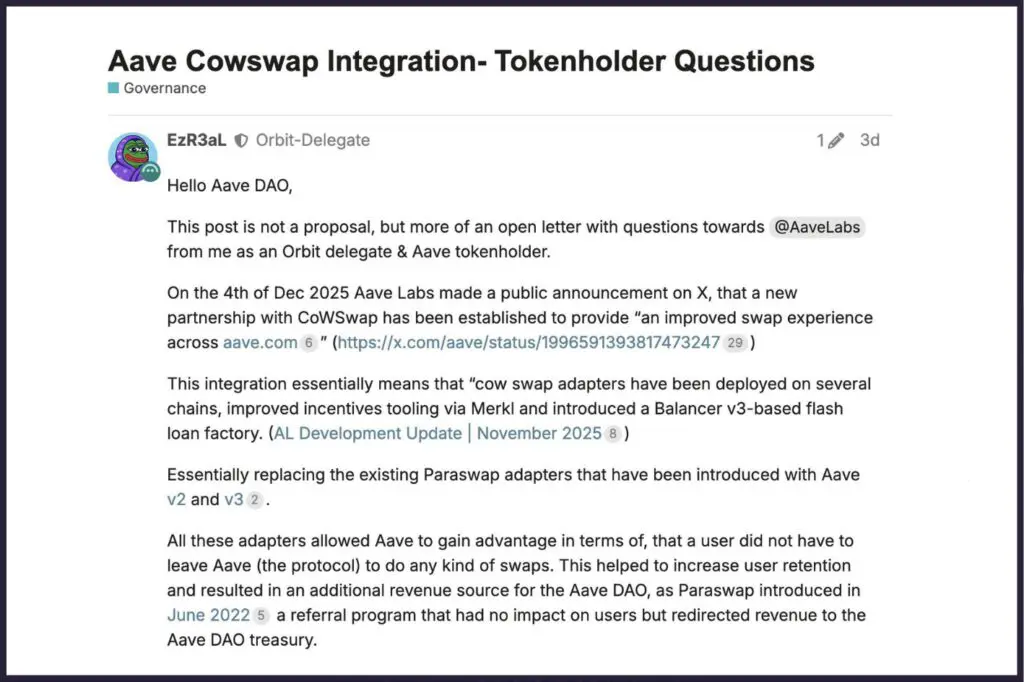
The DAO had not voted on this change.
That detail transformed a technical integration into a governance crisis.
Marc Zeller, founder of Aave Chan Initiative and the largest Aave delegate, called the move “stealth privatization.” His argument was straightforward.
Token holders funded Aave’s growth through dilution, incentives, and governance risk. Allowing a private company to extract value from the Aave brand without approval undermines the entire DAO model.
The pushback spread quickly. Delegates questioned whether Labs was gradually converting a DAO-owned protocol into a private business while leaving governance token holders with limited upside.
Aave Labs pushed back just as firmly.
The Labs position was that frontend revenue was never guaranteed to the DAO. Past contributions were voluntary. Labs owns the frontend, brand, and infrastructure, pays for engineers and audits, and bears operational risk. From their perspective, the DAO owns the contracts, not the company.
That disagreement exposed a fault line that had always existed but never fully surfaced.
By mid-December, the conflict escalated from debate to brinkmanship.
Two aggressive proposals emerged.
The first, dubbed the “Poison Pill,” proposed seizing all Aave intellectual property, code, brand assets, and past revenue earned through the Aave name. It would effectively force Aave Labs to become a DAO-owned subsidiary.
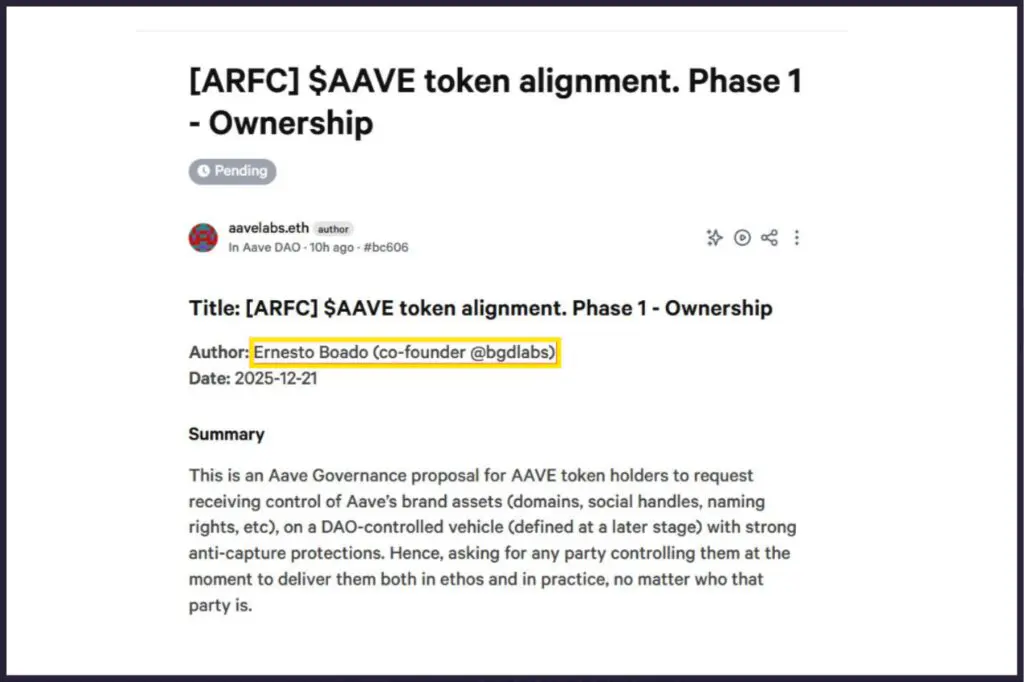
The second, known as the “Brand Seizure” proposal, aimed to immediately transfer trademarks, domains, social media accounts, and GitHub repositories to the DAO. The argument was that the DAO funded the brand’s value and therefore deserved ownership.
These proposals marked a turning point. They moved the conversation from revenue transparency to outright asset confiscation.
Aave Labs responded with an explicit warning.
If the proposals passed, Labs would exit the DAO within months, and development of Aave V4 would effectively stop.
Whether viewed as a threat or a statement of reality, the message was clear. The DAO depended heavily on Labs for execution.
Despite internal disagreement, a Snapshot vote to transfer brand assets went live between December 22 and December 23. The timing raised immediate concerns.
The proposal’s own author, former Aave CTO Ernesto Boado, publicly disowned the vote. He called it rushed, poorly communicated, and a breach of trust, especially during the holiday season when voter participation would be low.
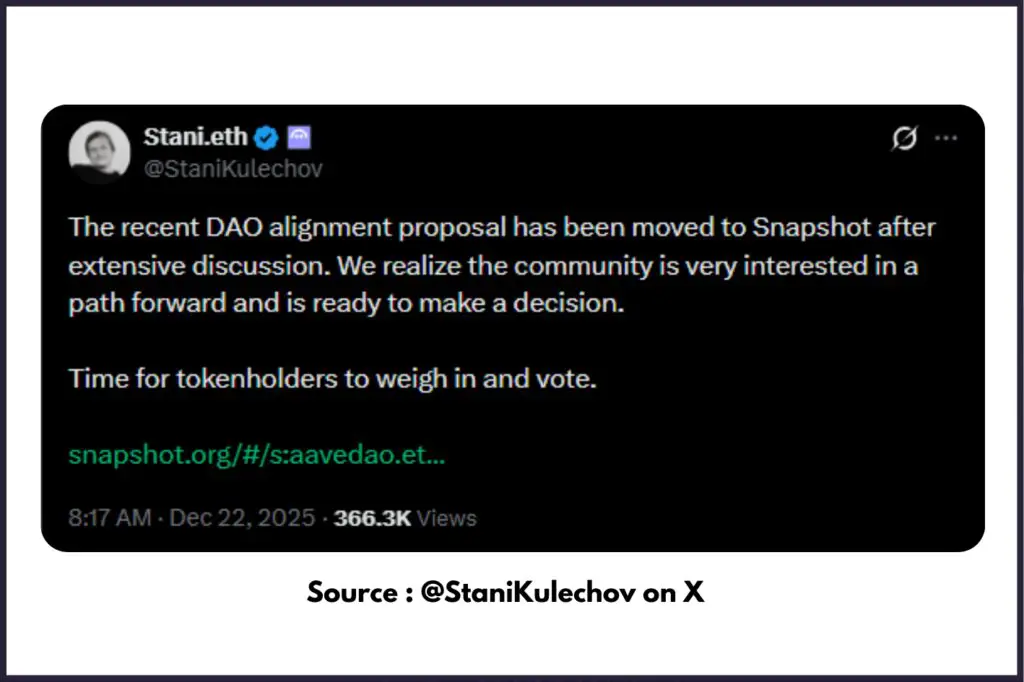
Marc Zeller accused Labs of interference and criticized the timing as an attempt to suppress engagement. Stani Kulechov voted against the proposal, citing legal complexity and development risk.
Markets reacted faster than governance.
A whale sold approximately 230,000 $AAVE, worth around $38 million, at a loss. The token dropped between 15 and 20 percent in days. Traders did not wait for resolution. They priced in uncertainty.
The Aave governance crisis is not an isolated incident.
It reflects a structural problem in DeFi.
Smart contracts decentralize easily. Brands, frontends, legal liability, and development teams do not.
Most DAOs rely on private entities to build and maintain products while claiming decentralization at the protocol layer. When revenue becomes significant, this hybrid model breaks down unless incentives are clearly defined.
Uniswap faced similar debates. Hyperliquid took a different path by routing nearly all revenue into token buybacks. Each model reflects a different answer to the same question.
Is a governance token an ownership stake or just a coordination tool?
Aave is now stress-testing that assumption in public.
As of December 24, 2025, the Snapshot vote remains unresolved. Whatever the outcome, the path forward likely involves compromise rather than conquest.
Possible outcomes include formal revenue-sharing agreements, clearer frontend disclosures, or legal structures that align DAO governance with operating entities. Without alignment, future conflicts are inevitable.
Loading chart...
If the DAO secures direct revenue rights, $AAVE could reprice higher based on improved fundamentals. If Labs retains control, trust in DAO governance may weaken, not just for Aave but across DeFi.
Either way, this moment will be studied.
The Aave governance crisis is not about a swap integration or a Snapshot vote. It is about whether decentralized finance can reconcile ideals with reality.
DAOs want ownership. Builders want control. Investors want clarity.
Aave sits at the intersection of all three.
How this dispute resolves will shape expectations for governance tokens, frontend ownership, and founder accountability across the entire DeFi ecosystem. The industry is watching closely, not because Aave is failing, but because it is big enough to force the question everyone has avoided.
Who really owns DeFi?
The answer may redefine the next cycle.