Loading Search...



Top crypto exchanges by volume in 2026 ranked by liquidity, trading activity, and global market dominance across major platforms.

Author: Kritika Gupta
The cryptocurrency market experienced one of its most important expansion phases in 2025, and crypto exchanges played a central role in facilitating this growth. Global trading volume exceeded $100 trillion across spot and derivatives markets, reflecting both accelerating institutional inflows and expanding retail participation. As a result, crypto exchanges processed unprecedented levels of capital, solidifying their position as the core infrastructure layer of the digital asset economy.
First, clearer regulatory frameworks such as the U.S. GENIUS Act increased institutional confidence and reduced legal uncertainty. Second, stablecoins expanded rapidly as core settlement infrastructure, allowing faster and more efficient capital movement between traditional finance and crypto markets. Third, decentralized finance protocols attracted massive liquidity as bull market conditions returned and new trading strategies emerged.
At the same time, centralized crypto exchanges continued to dominate global trading volume because they offered deep liquidity, advanced derivatives infrastructure, and seamless fiat integration. However, decentralized exchanges grew significantly as perpetual futures, automated market makers, and on-chain trading infrastructure matured.
Crypto exchanges serve as the core infrastructure layer of the digital asset economy. In 2025, these platforms processed capital flows comparable to major global financial markets. Their scale directly influenced liquidity, volatility, and institutional participation.
High-volume exchanges provide deeper order books, which reduce slippage and improve execution efficiency. This matters especially during volatile market conditions, when liquidity determines whether traders can enter or exit positions without significant price impact.
In addition, exchange volume reveals broader structural trends. For example, centralized exchanges such as Binance and Coinbase reflect institutional adoption and regulatory integration. Meanwhile, decentralized exchanges such as Uniswap and dYdX reflect growing demand for trustless, self-custodial trading infrastructure.
Centralized vs Decentralized Exchanges
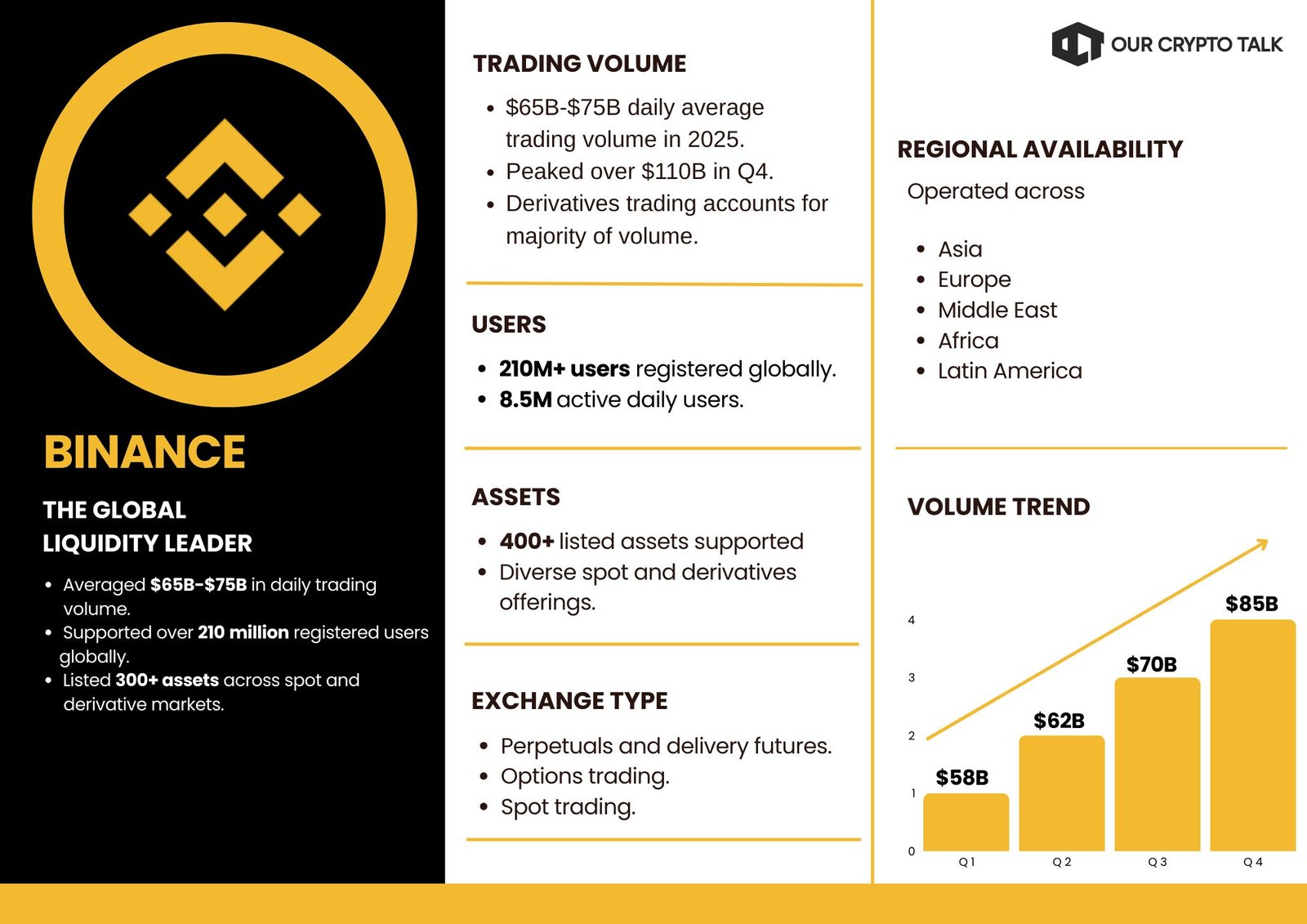
Binance maintained its position as the largest crypto exchange in the world throughout 2025. It continued to dominate both spot and derivatives trading despite ongoing regulatory challenges in certain jurisdictions. Moreover, its unmatched liquidity depth, broad asset selection, and advanced derivatives infrastructure allowed it to remain the primary venue for global crypto price discovery and institutional trading.
Binance averaged between $65 billion and $75 billion in daily trading volume throughout 2025. Additionally, peak activity exceeded $110 billion during the fourth quarter as institutional participation accelerated and market momentum strengthened. It served more than 210 million registered users globally. Furthermore, approximately 8.5 million users remained active daily. Its massive user base includes retail traders, institutional firms, algorithmic trading desks, and market makers.
Binance generates massive trading volume primarily because it provides unmatched global liquidity and dominates derivatives markets. Additionally, it supports over 400 assets and offers advanced products such as perpetual futures, options, and margin trading, which significantly increase trading activity. Furthermore, its user base exceeding 210 million registered users ensures continuous capital inflows. As a result, deep order books enable efficient execution for both institutional and retail traders, and its global presence across major crypto regions continuously reinforces its position as the primary venue for price discovery.
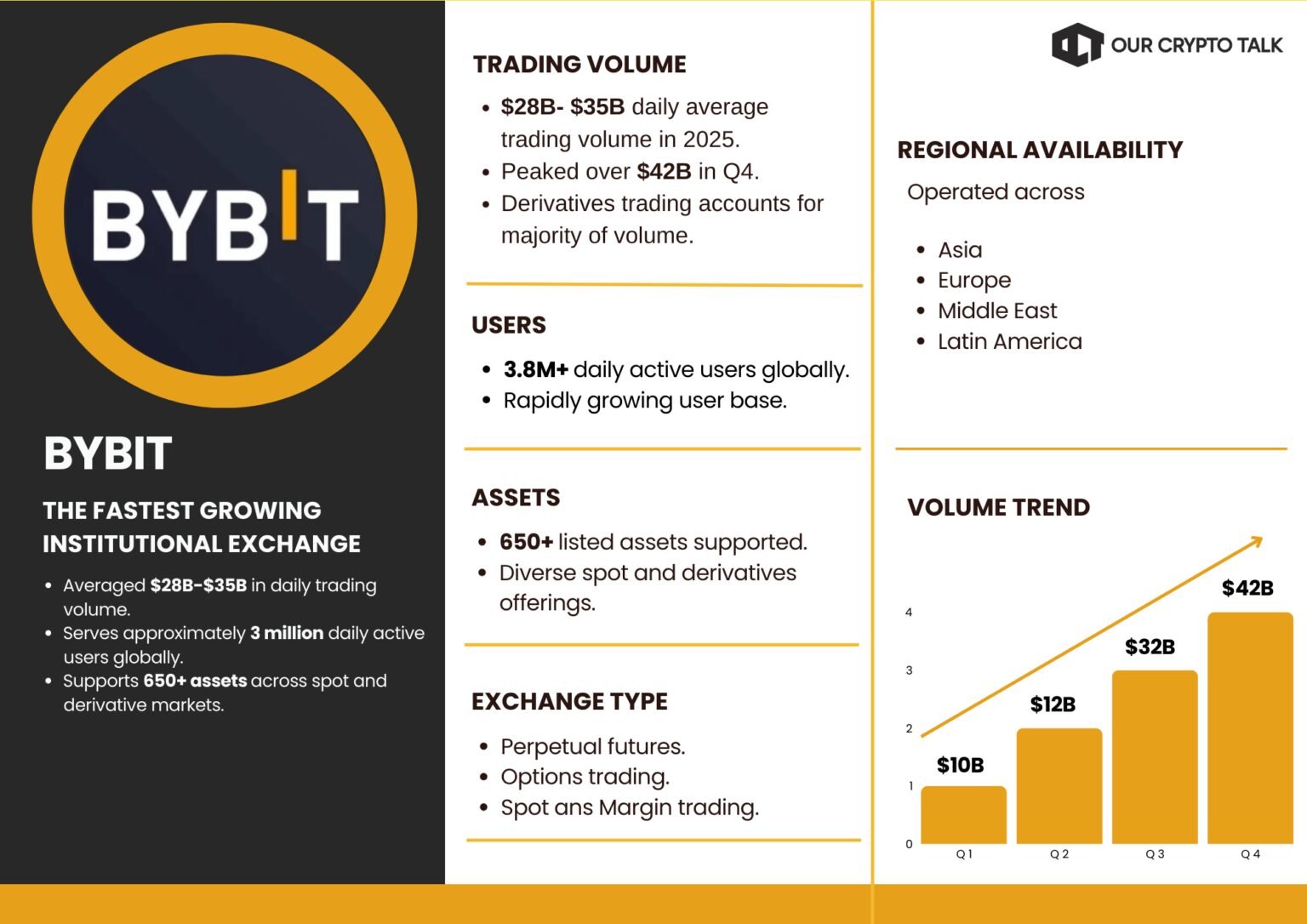
Bybit emerged as one of the fastest-growing crypto exchanges in 2025. It strengthened its position as a global leader in derivatives trading and institutional liquidity. In addition, its rapid growth resulted from high-performance infrastructure, deep derivatives liquidity, and aggressive global expansion.
Bybit averaged between $28 billion and $35 billion in daily trading volume during 2025. Furthermore, peak activity exceeded $42 billion during the fourth quarter as institutional inflows accelerated and derivatives markets expanded significantly.Bybit serves approximately 3.8 million daily active users globally. Consequently, its rapidly growing user base reflects increasing trust in its trading infrastructure and execution quality.
Bybit maintains high trading volume because it focuses heavily on derivatives trading, which drives the majority of crypto market activity. Moreover, its high-speed infrastructure enables fast execution, which attracts hedge funds, institutional investors, and algorithmic traders. In addition, its rapid global expansion and broad asset selection strengthen user adoption. Consequently, derivatives products generate higher turnover than spot trading, and this sustained activity significantly increases the platform’s overall trading volume.
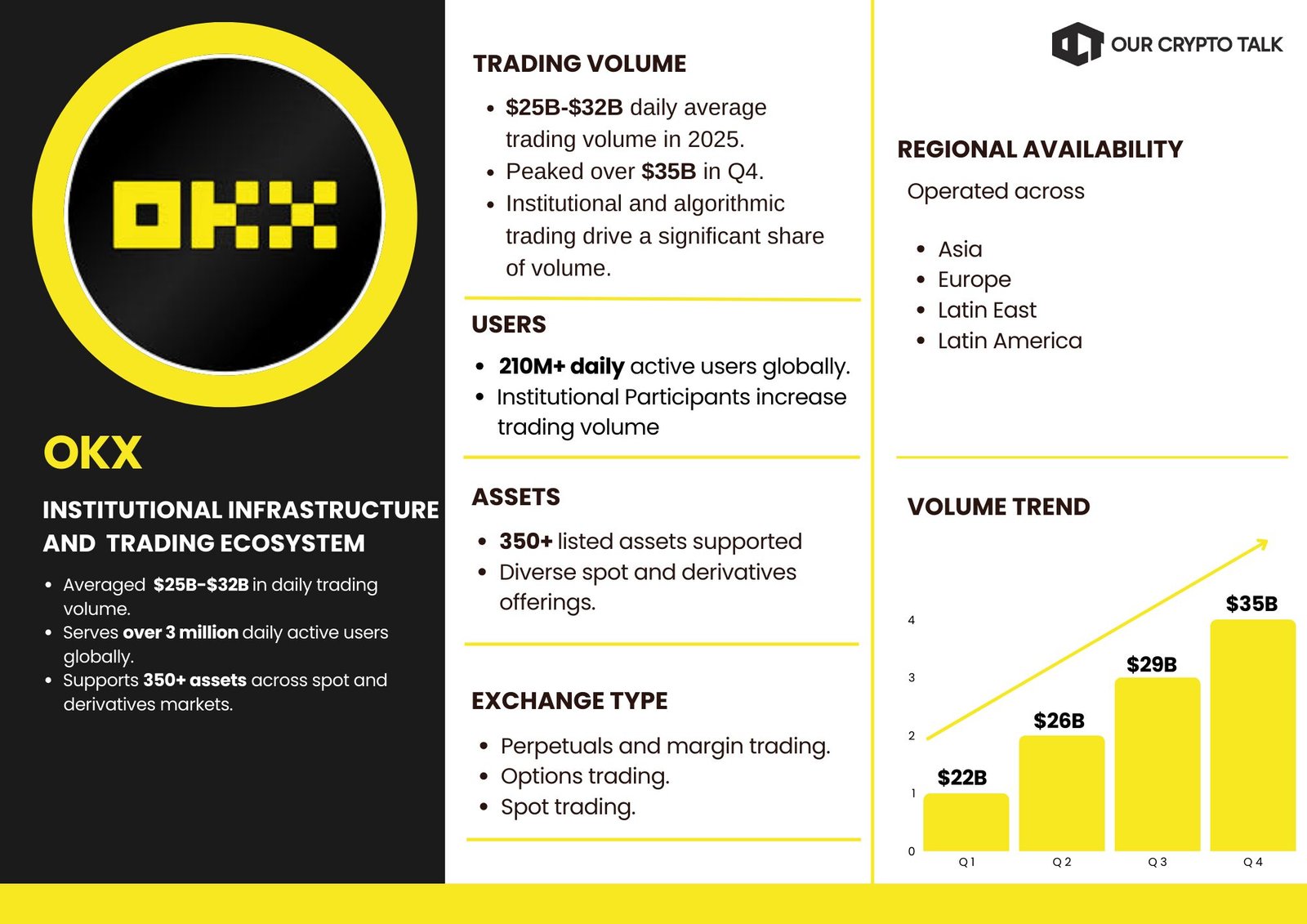
OKX maintained its position as one of the most technologically sophisticated crypto exchanges in 2025. It combines advanced derivatives infrastructure with strong institutional trading capabilities. Furthermore, its integrated centralized and decentralized trading approach attracted professional traders and long-term investors seeking comprehensive market access.
OKX averaged between $25 billion and $32 billion in daily trading volume throughout 2025. Additionally, peak activity reached approximately $35 billion during the fourth quarter. It serves more than 3 million daily active users globally. Moreover, institutional participants and algorithmic trading firms drive an increasing share of its total trading volume.
OKX sustains strong trading volume because it combines advanced infrastructure with a comprehensive derivatives ecosystem. Furthermore, it attracts institutional traders by offering efficient execution, structured investment products, and integrated trading tools. In addition, its hybrid ecosystem connects centralized trading with decentralized tools, which expands trading opportunities. As a result, multiple sources of trading activity contribute to consistent liquidity and stable volume growth across global markets.
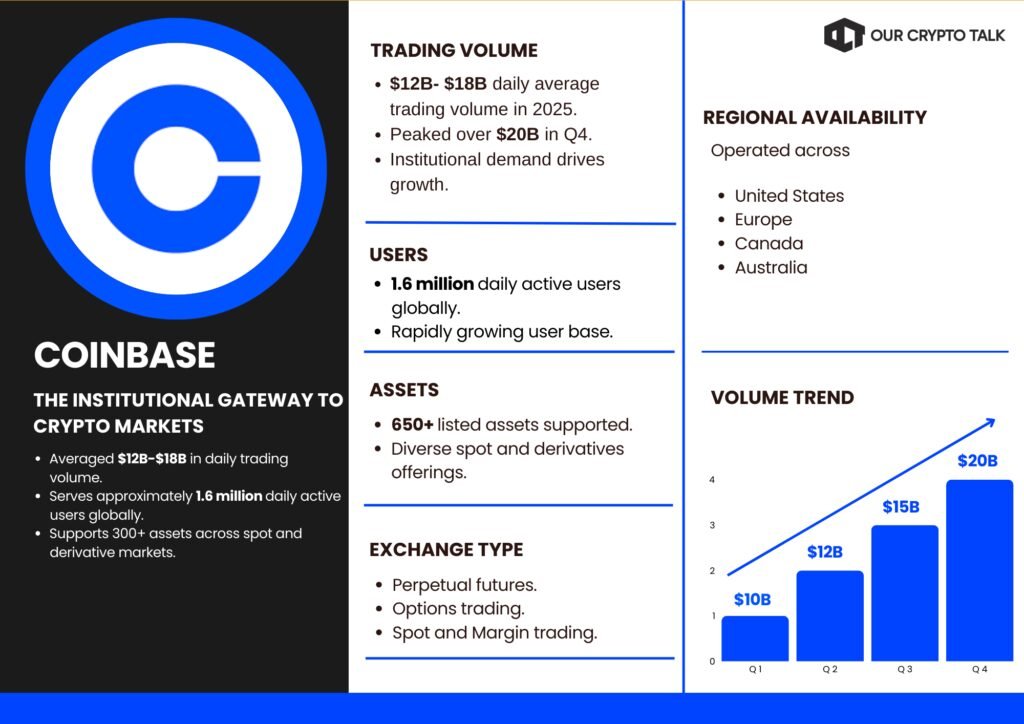
Coinbase remained the dominant regulated crypto exchanges throughout 2025. It served as the primary entry point for institutional investors in the United States and other regulated markets. Moreover, its regulatory compliance, institutional custody services, and integration with traditional financial systems strengthened its position as one of the most trusted crypto platforms.
Coinbase averaged between $12 billion and $18 billion in daily trading volume during 2025. Additionally, peak volume approached $20 billion during the fourth quarter as institutional demand increased. It serves approximately 1.6 million daily active users. Importantly, institutional investors, asset managers, and ETF participants represent a significant portion of its user base.
Coinbase generates substantial trading volume because it serves as a trusted gateway between traditional finance and crypto markets. Moreover, its regulatory compliance and institutional custody infrastructure attract asset managers, corporations, and ETF participants. Additionally, institutional traders execute large capital transactions, which significantly increase total volume. Therefore, even with fewer derivatives offerings, strong institutional participation consistently drives meaningful trading activity on the platform.
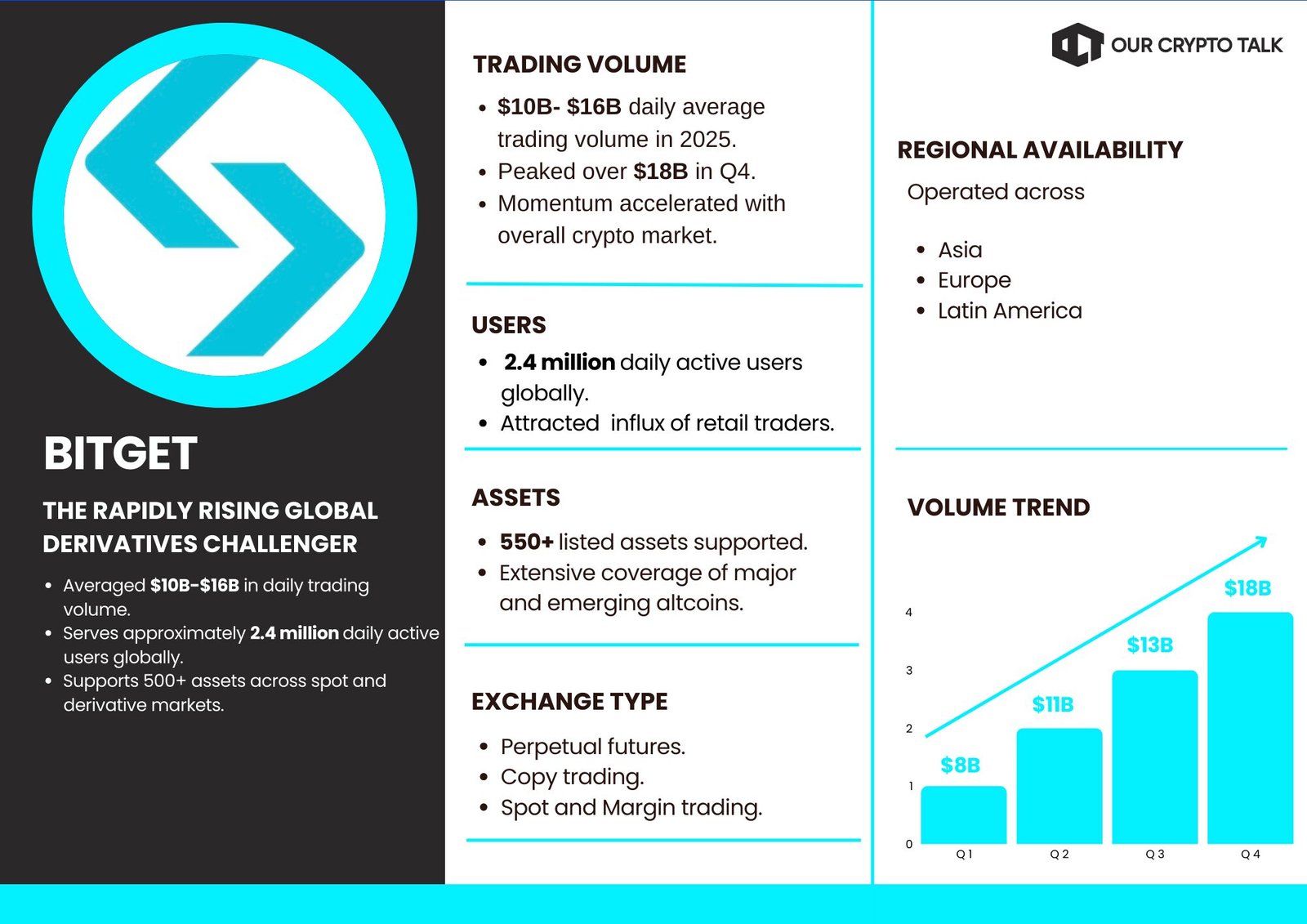
Bitget experienced one of the fastest growth trajectories among centralized crypto exchanges in 2025. It emerged as a major force in global derivatives markets. Furthermore, its rise resulted from aggressive global expansion, strong retail onboarding, and a highly differentiated product suite centered around copy trading and perpetual futures.
Bitget averaged between $10 billion and $16 billion in daily trading volume throughout 2025. Additionally, peak activity approached $18 billion during the fourth quarter as overall crypto market momentum accelerated. It serves approximately 2.4 million daily active users globally. Moreover, its total registered user base expanded significantly throughout the year. Much of this growth came from retail traders entering crypto markets for the first time.
Bitget increases its trading volume primarily through strong retail participation and its copy trading ecosystem. Specifically, users replicate professional trading strategies, which increases transaction frequency and engagement. Furthermore, its derivatives offerings and broad asset selection attract a rapidly expanding global user base. As a result, increased retail derivatives trading and global expansion continuously strengthen its overall trading volume.
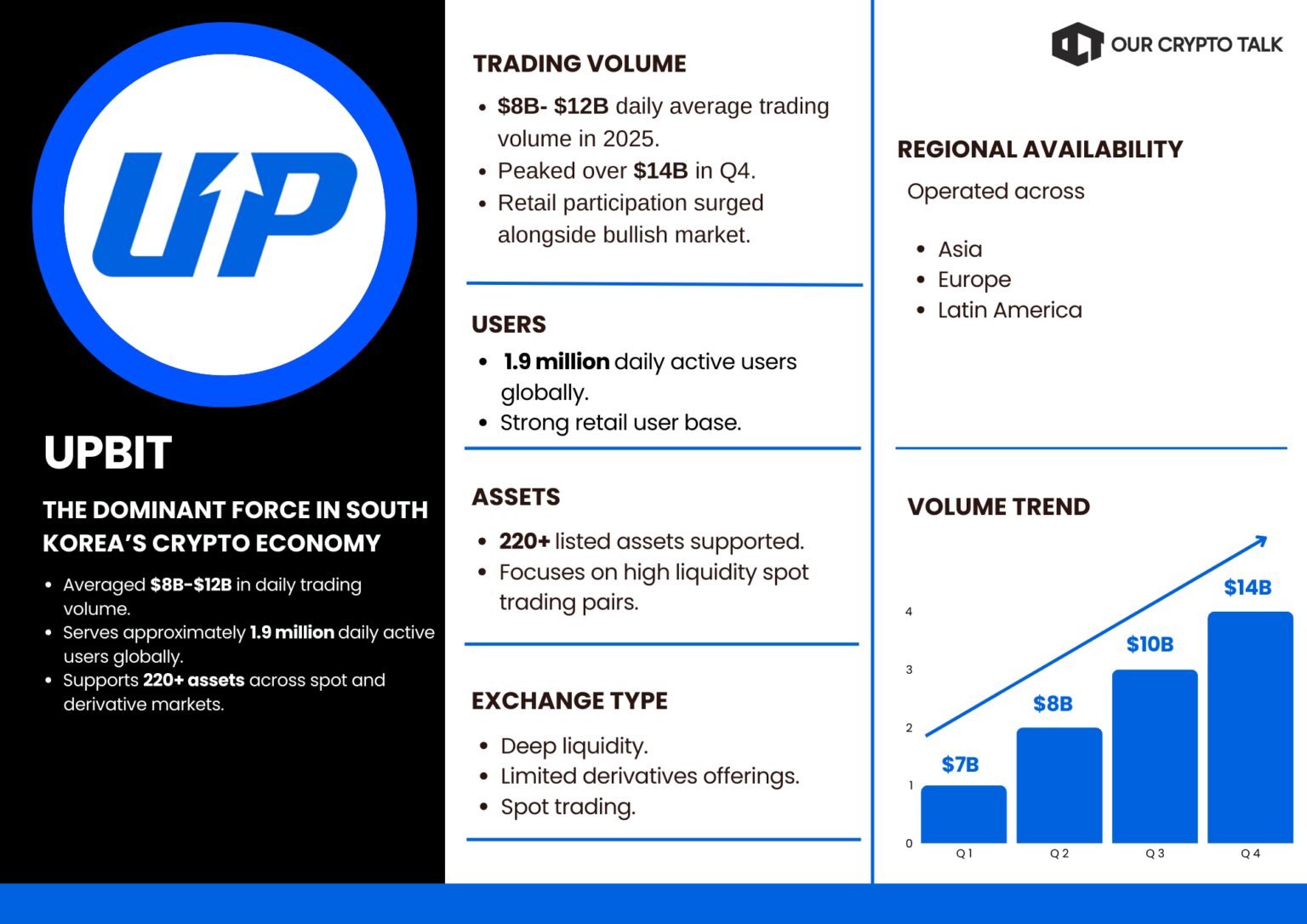
Upbit maintained its position as South Korea’s largest cryptocurrency exchange throughout 2025. It benefited from one of the most active and mature retail crypto markets in the world. Additionally, South Korea remained a major center of crypto trading activity.
Upbit averaged between $8 billion and $12 billion in daily trading volume during 2025. Furthermore, peak volume reached approximately $14 billion during the fourth quarter as retail participation surged alongside bullish market conditions. It serves approximately 1.9 million daily active users. Consequently, it remains one of the most heavily utilized exchanges relative to its geographic scope. Its strong retail user base consistently drives high spot trading activity.
Upbit generates strong trading volume because it dominates South Korea’s highly active retail crypto market. Moreover, high retail participation drives frequent spot trading activity, particularly in altcoins. In addition, strict local regulations limit foreign competition, which strengthens its domestic market control. Consequently, consistent retail demand and strong regional dominance sustain high liquidity and overall trading volume.
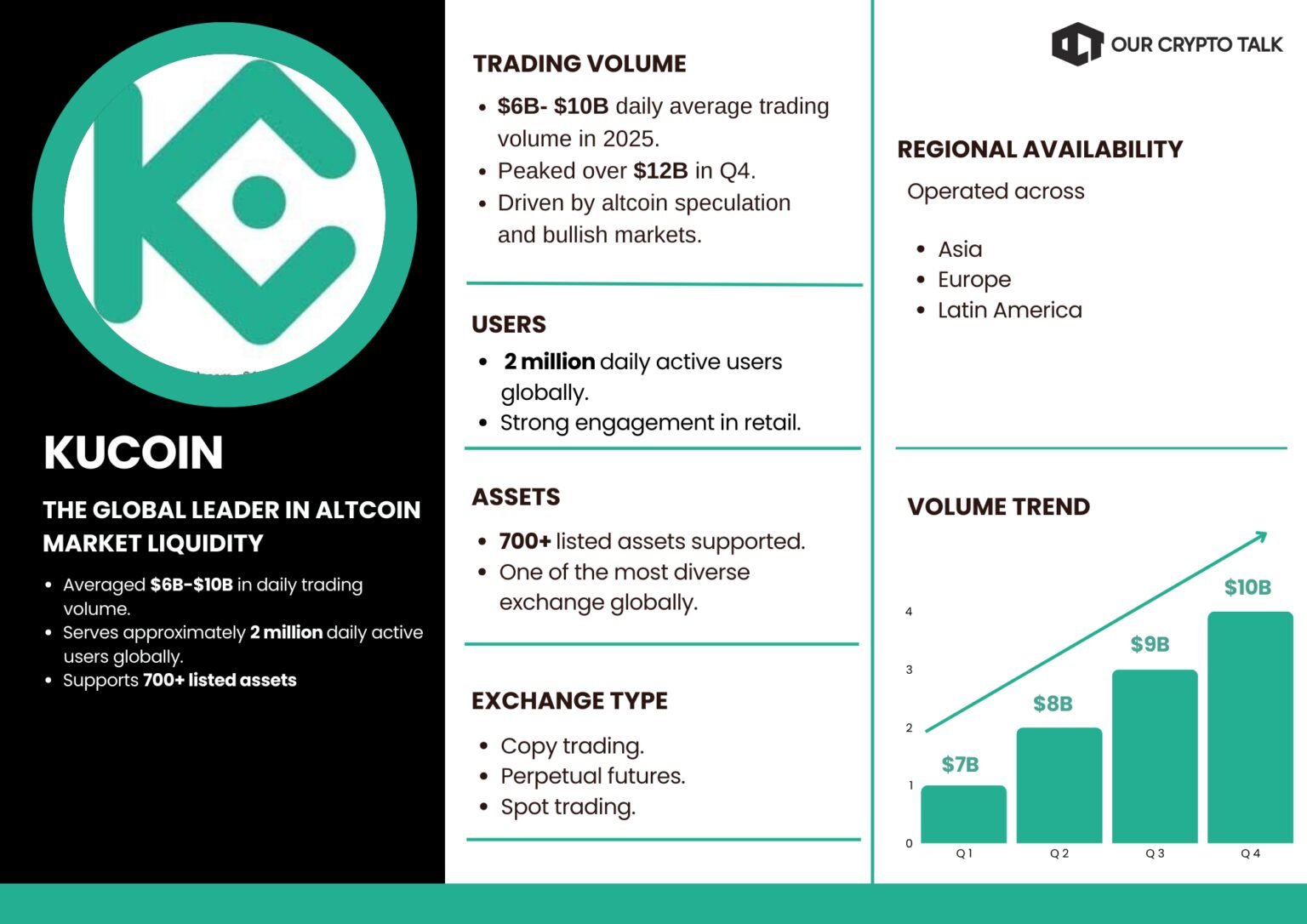
KuCoin remained one of the most important exchanges for altcoin trading throughout 2025. It offers one of the broadest selections of digital assets in the crypto ecosystem. Additionally, its early listing strategy and willingness to support emerging projects made it a preferred destination for traders seeking exposure to new and smaller-cap cryptocurrencies.
KuCoin averaged between $6 billion and $10 billion in daily trading volume throughout 2025. Furthermore, peak volume approached $12 billion during the fourth quarter as speculative trading intensified during bullish market conditions. It serves approximately 2 million daily active users globally. Consequently, it maintains strong engagement across retail trading communities and altcoin-focused investors.
KuCoin drives trading volume by offering one of the broadest selections of altcoins in the crypto ecosystem. Additionally, it lists emerging assets early, which attracts speculative traders seeking new opportunities. Furthermore, global accessibility increases user participation across multiple regions. As a result, frequent altcoin trading and strong retail engagement significantly contribute to its overall trading activity.
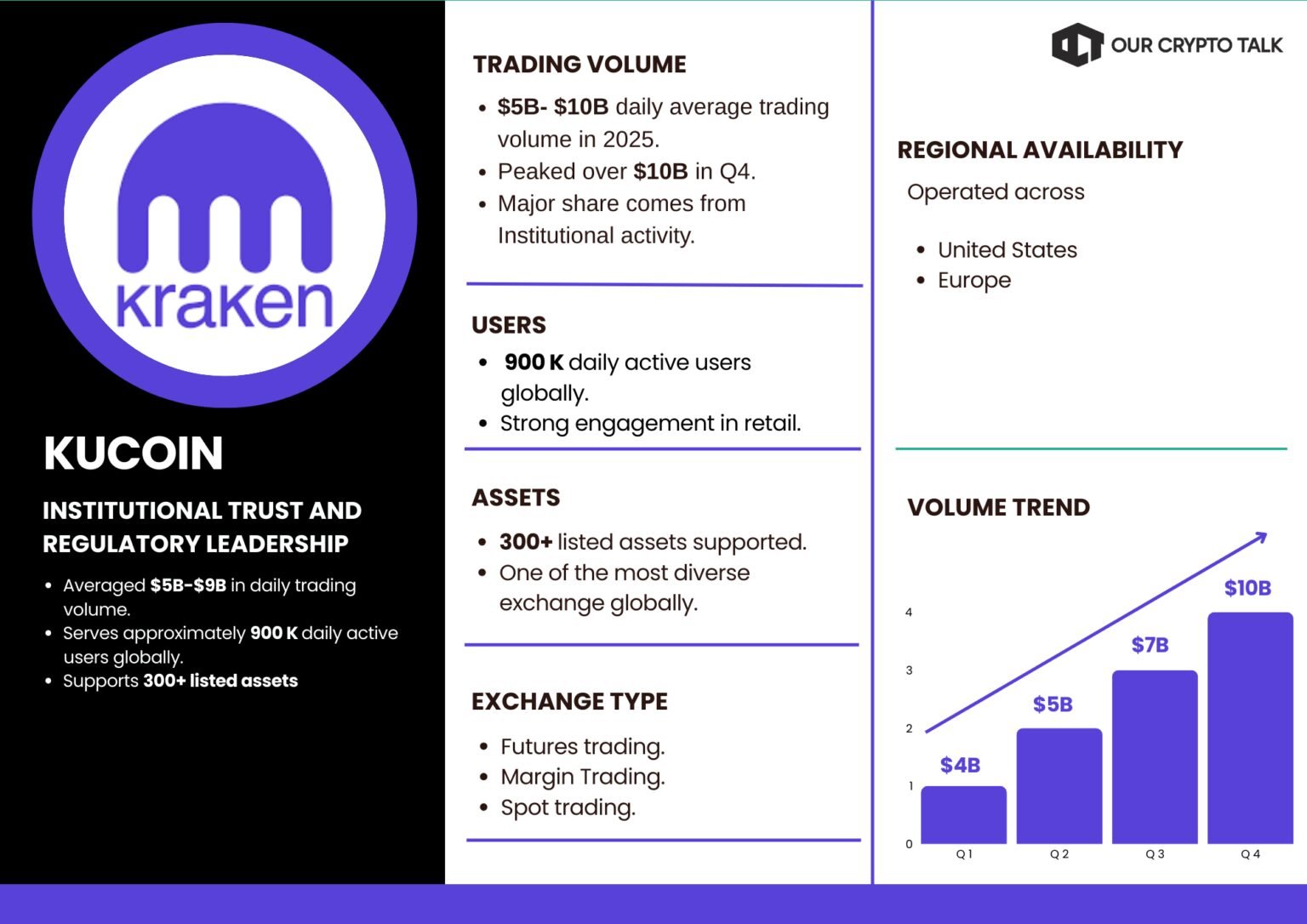
Kraken remained one of the most trusted crypto exchanges globally throughout 2025. It maintained particularly strong credibility among institutional investors and users in regulated markets. Additionally, its strong compliance framework and institutional-grade infrastructure positioned it as a preferred trading venue for long-term investors and professional traders.
Kraken averaged between $5 billion and $9 billion in daily trading volume during 2025. Furthermore, peak volume reached approximately $10 billion during the fourth quarter.It serves approximately 900,000 daily active users globally.
Kraken maintains steady trading volume because it prioritizes regulatory compliance, security, and institutional-grade infrastructure. Moreover, professional traders and institutional investors actively use the platform due to its strong trust and regulatory standing. In addition, its secure custody services attract long-term investors. Therefore, consistent institutional participation and strong credibility sustain its trading activity.
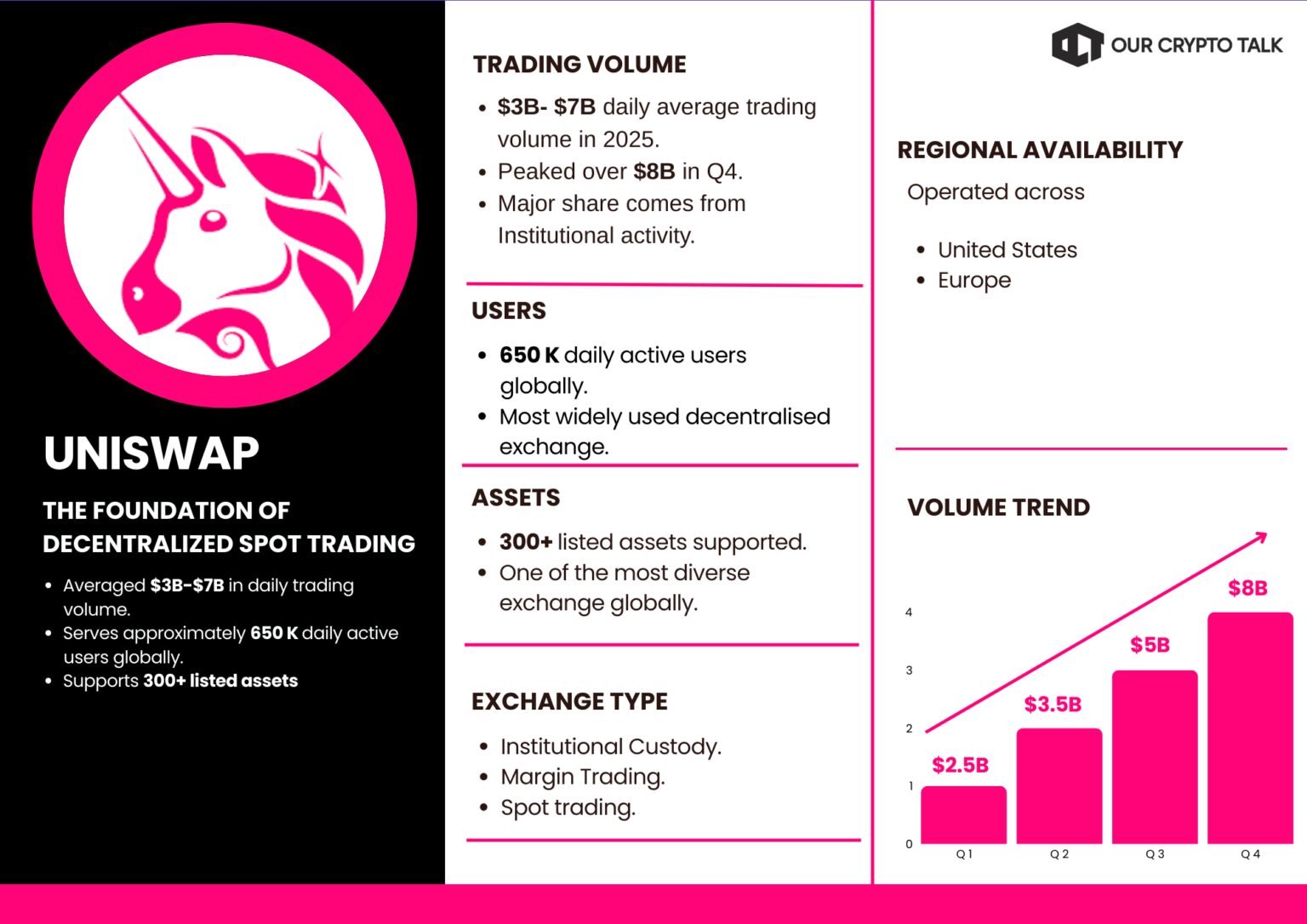
Uniswap remained the largest decentralized exchange globally throughout 2025. It serves as the primary liquidity hub for on-chain spot trading. Furthermore, its permissionless architecture allows users to trade directly from self-custodied wallets without relying on centralized intermediaries.
Uniswap averaged between $3 billion and $7 billion in daily trading volume during 2025. Additionally, peak volume reached approximately $8 billion during the fourth quarter. It serves approximately 650,000 daily active users globally. Consequently, it remains the most widely used decentralized exchange.
Uniswap generates trading volume by enabling decentralized, permissionless trading directly from self-custodied wallets. Furthermore, its automated market maker infrastructure ensures continuous liquidity without centralized intermediaries. In addition, global accessibility allows users to trade freely without geographic restrictions. Consequently, increasing adoption of decentralized finance continuously drives trading activity on the platform.
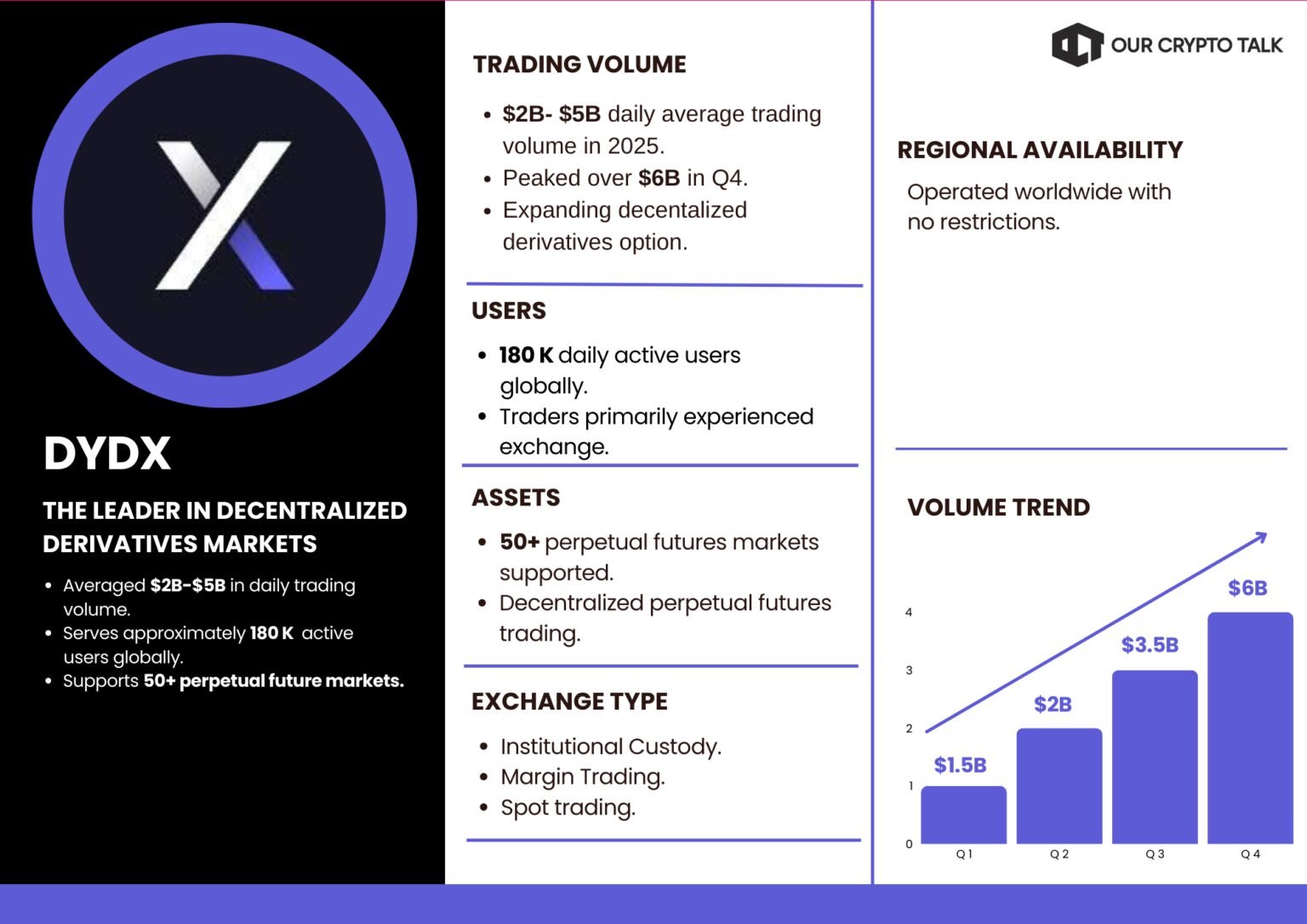
dYdX emerged as the leading decentralized derivatives exchange in 2025. It offers perpetual futures trading through fully decentralized infrastructure. Furthermore, its advanced trading engine and decentralized architecture made it a preferred platform for traders seeking leveraged exposure without centralized custody.
dYdX averaged between $2 billion and $5 billion in daily trading volume during 2025. Additionally, peak activity reached approximately $6 billion during the fourth quarter. It serves approximately 180,000 daily active users globally. Consequently, experienced derivatives traders represent the majority of its user base.
dYdX sustains trading volume by providing decentralized perpetual futures trading with advanced derivatives functionality. Moreover, its decentralized architecture allows traders to access leveraged positions without centralized custody. In addition, experienced traders actively use its platform for advanced derivatives strategies. As a result, growing adoption of decentralized derivatives trading continues to increase its overall trading volume.
Top 10 Crypto Exchanges — Full Comparative Overview (2025)
Despite their scale, these exchanges carry inherent risks. Centralized exchanges face security breaches, regulatory enforcement actions such as freezes or operational bans, and centralization vulnerabilities including single point failures. Meanwhile, decentralized exchanges expose users to smart contract exploits, impermanent loss, and increased slippage when liquidity remains limited.
In addition, some platforms still report inflated trading volume due to wash trading activity. Furthermore, leverage amplifies both profits and losses, and during 2025, liquidations erased billions of dollars in trader capital.
The top 10 crypto exchanges of 2025 demonstrate a maturing ecosystem where centralized platforms provide scale, liquidity, and institutional reliability, while decentralized exchanges drive trustless innovation and user sovereignty. Platforms such as Binance reinforced global dominance, while decentralized competitors introduced new models for secure and transparent trading.
As the market enters 2026, exchanges will deepen integration with traditional financial systems, deploy AI driven trading infrastructure, and adapt to evolving regulatory frameworks. These platforms now serve as foundational infrastructure supporting the global crypto economy rather than functioning solely as trading venues.